What GF-41 is, and what enforcement can lead to
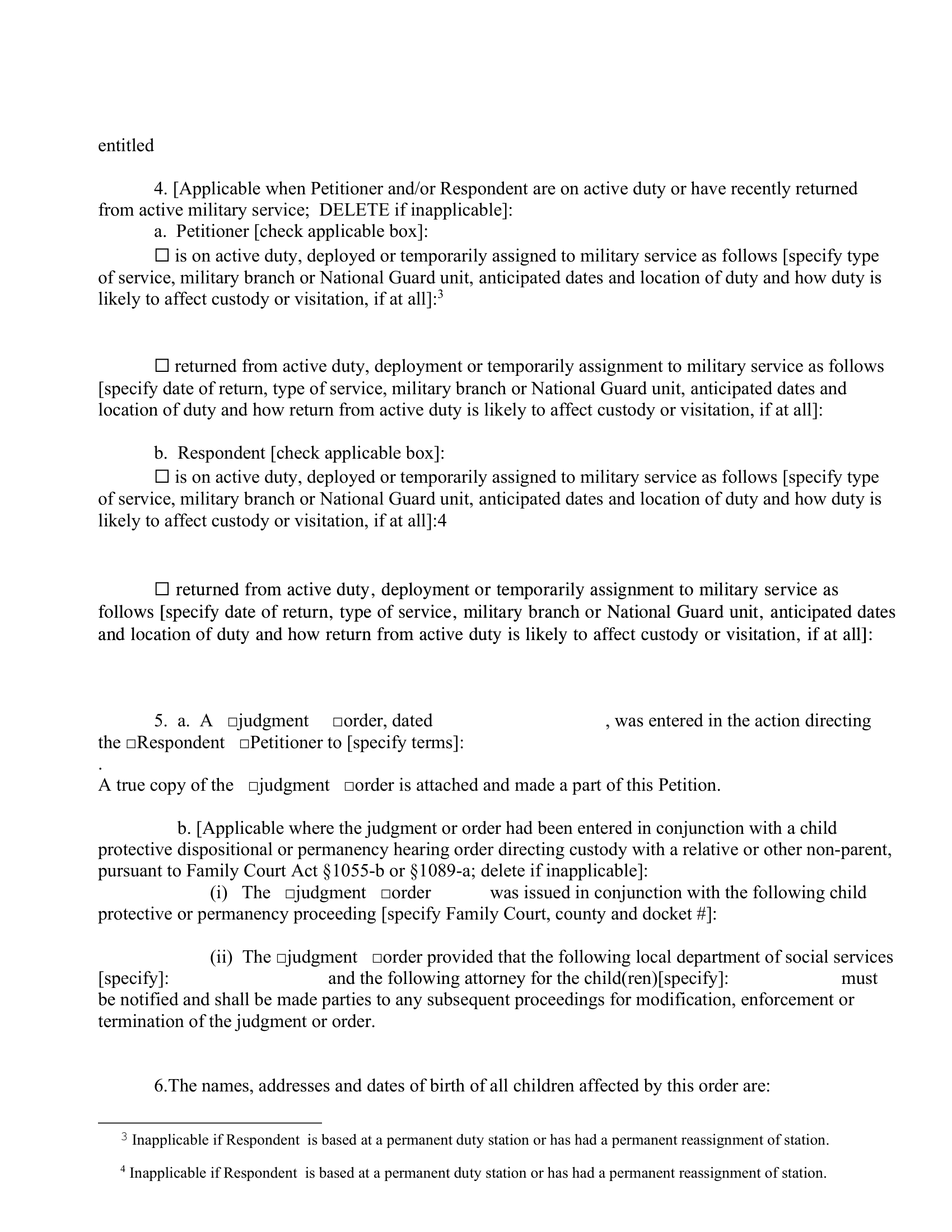
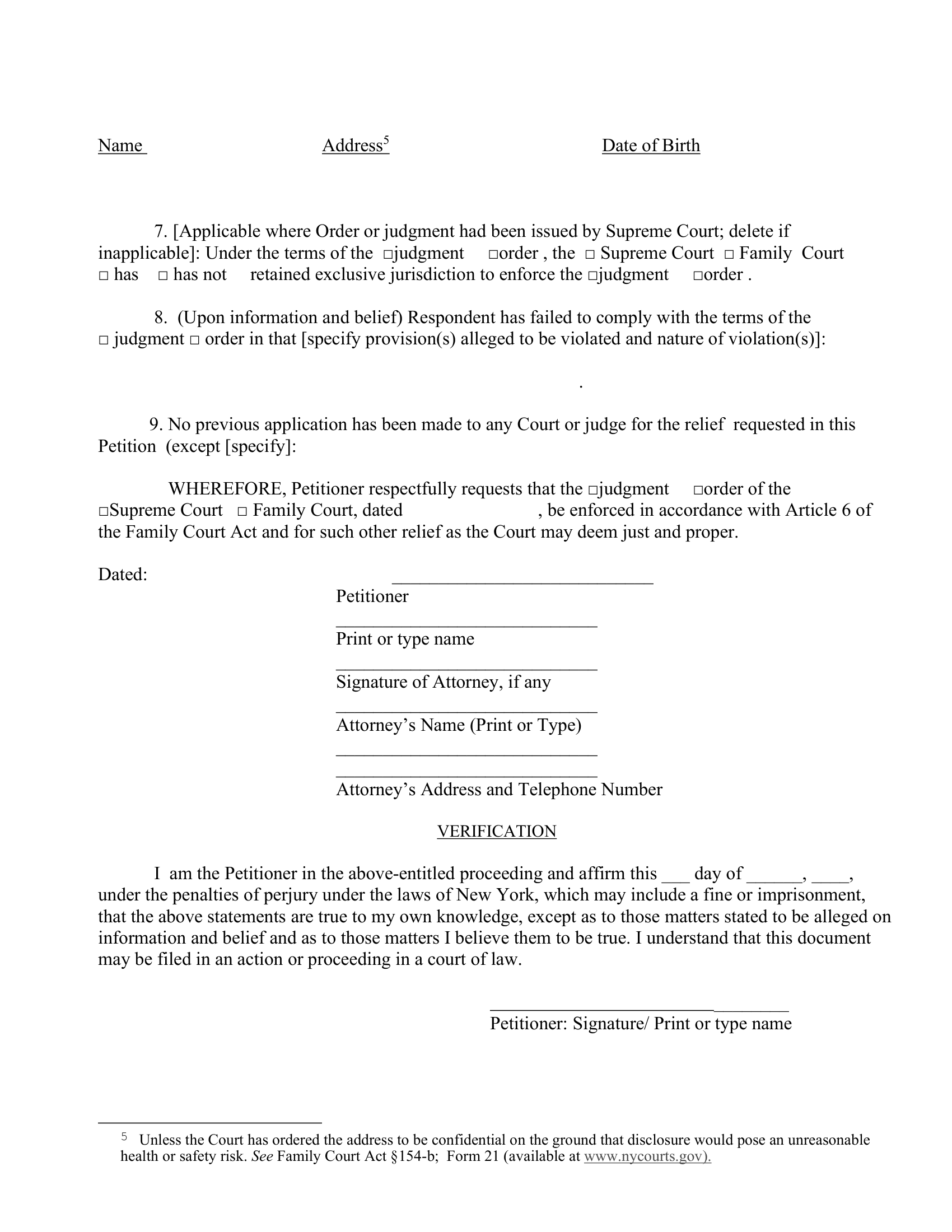
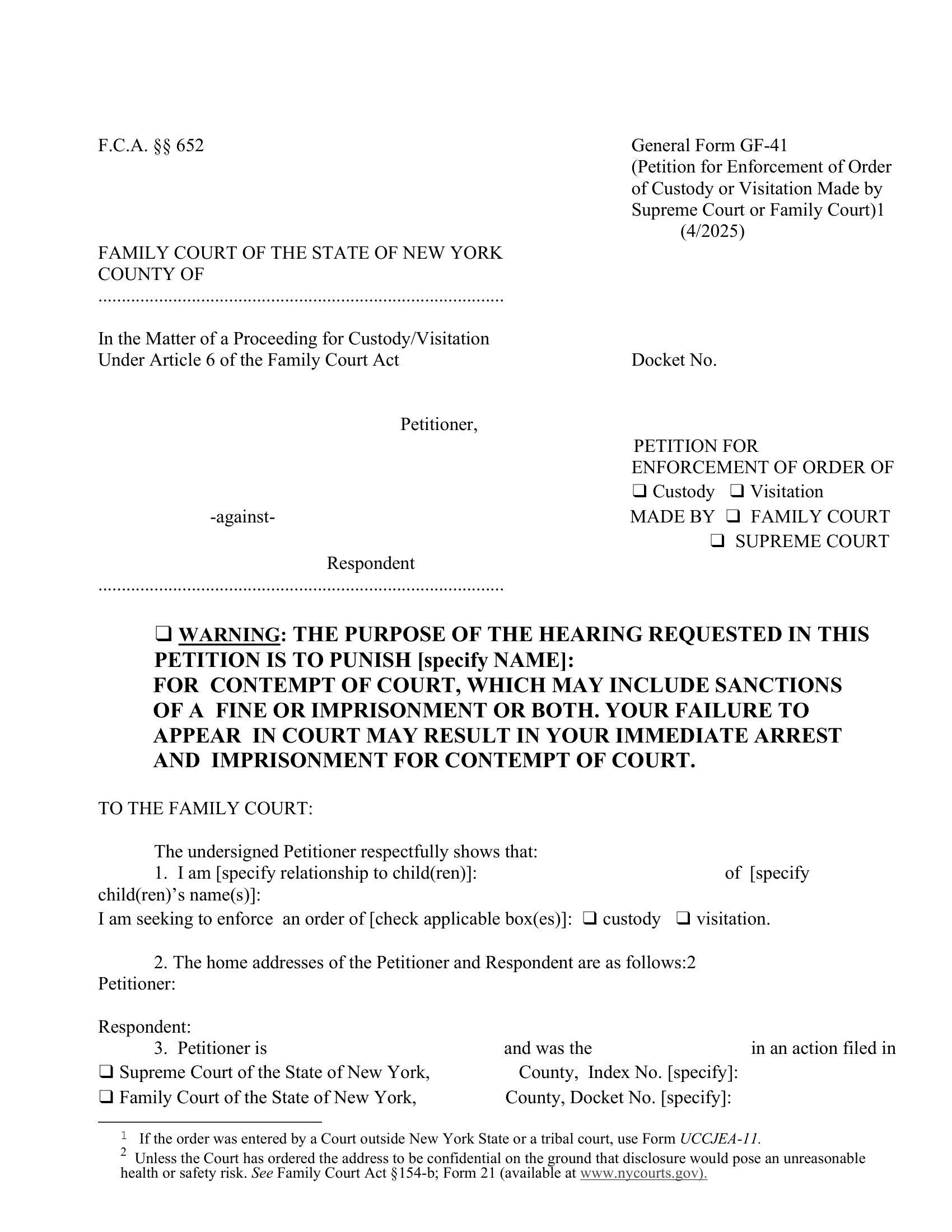
GF-41 is one of the official Family Court forms; 22 NYCRR 205.7(a) says those forms shall, in substantially the same form as set forth, be uniformly used throughout the State. The court system’s custody forms listing names it “GF-41 Petition for Enforcement of Order of Custody or Visitation made by Supreme Court or Family Court,” with GF-41a, Order on Petition for Enforcement of Order of Custody Visitation, as the matching order. The header of the 4/2025 form prints “F.C.A. §§ 652”, and the caption reads PETITION FOR ENFORCEMENT OF ORDER OF Custody or Visitation MADE BY FAMILY COURT or SUPREME COURT.
Family Court Act § 652(b) is the authority the header cites. It says that, unless the Supreme Court provides in its order or judgment awarding custody or visitation in a divorce, separation or annulment that it may be enforced or modified only in the Supreme Court, the Family Court may determine an application to enforce that order or judgment. Section 467(b) says the same. For the Family Court’s own orders, Family Court Act § 156 says the Judiciary Law’s provisions on civil and criminal contempt apply in any proceeding in which the Family Court has jurisdiction, and that violating a Family Court order directing a party to do or refrain from doing an act is punishable under them, unless another law provides a specific punishment or remedy.
Judiciary Law § 753(A) gives a court of record power to punish, by fine and imprisonment, or either, a neglect or violation of duty by which a right or remedy of a party may be defeated, impaired, impeded or prejudiced, including a party’s disobedience to a lawful mandate of the court. Judiciary Law § 756 says an application to punish for a contempt punishable civilly shall contain on its face a notice that the purpose of the hearing is to punish the accused for a contempt of court, and that the punishment may consist of fine or imprisonment, or both, together with the legend “WARNING: YOUR FAILURE TO APPEAR IN COURT MAY RESULT IN YOUR IMMEDIATE ARREST AND IMPRISONMENT FOR CONTEMPT OF COURT.” GF-41’s WARNING box prints that notice.
When contempt is sought, the respondent has a right to counsel. Family Court Act § 262(a)(vi) gives that right, including assigned counsel for a person who cannot afford one, to any person in a proceeding in which an order is sought to hold that person in contempt or in willful violation of a previous order of the court.
The process, in CourtHelp’s words: if the child’s other parent will not follow the custody or visitation order, you may file an enforcement petition in Family Court; there will be a hearing, and the court will decide whether there was a violation and what to do next.
What to file with GF-41
- UCCJEA-11: Petition to Enforce Custody/Visitation Order - UCCJEA. Instead of GF-41, if the order was entered by a court outside New York State or a tribal court, as footnote 1 says.
- GF-40: Petition for Modification of Order of Custody or Visitation. A different petition, if you want the order’s terms changed rather than enforced. Read the GF-40 walkthrough.
- Form 8-2: Petition - Family Offense. A separate proceeding, not an attachment, if what you need is an order of protection. GF-41 has no paragraph for one.
- GF-41a: Order on Petition for Enforcement of Order of Custody Visitation. Not filed by you. It is the order form listed with GF-41 on the court system’s custody forms page.
CourtHelp says it is free to file a case in Family Court and that every Family Court has a Help Center. The free Custody/Visitation Enforcement DIY Form program can be used if the order was signed by a judge of a New York State court, you are the children’s parent, the children are under 18 and not in foster care, and only you and the other parent are on the order; it asks you to have the other parent’s name and address, a copy of the order, and the children’s names, addresses and birth dates. If you believe a child is being neglected or abused, the program page gives the child welfare number, 1-800-342-3720, and says to call 911 if a child is in immediate danger.