GF-40 Petition for Modification of Order of Custody or Visitation (New York): how to fill it out, paragraph by paragraph

A walkthrough of General Form GF-40, the New York Family Court petition to change a custody or visitation order made by the Family Court or the Supreme Court: the caption, paragraphs 1 through 12, the signature lines, and the verification.

Researched by Dan Martin, Legal Researcher · Published by Onbello Legal

Quick answer

General Form GF-40 is the New York Family Court petition to change an existing custody or visitation order, whether the Family Court or the Supreme Court made it. It is five pages with twelve numbered paragraphs. Paragraph 9 asks what change of circumstances has happened since the order was entered, and paragraph 10 asks how the order should be modified because of it. Family Court Act § 652(b) lets the Family Court modify a Supreme Court custody or visitation order upon a showing that there has been a subsequent change of circumstances and modification is required, unless the Supreme Court’s order says it may be modified only in the Supreme Court, and CourtHelp says an order may be changed if the court decides that things have changed and that changing the order would be best for the child. You attach a true copy of the order, sign a verification under the penalties of perjury, and file in Family Court.

Summary: what GF-40 does, and what you need first

  • GF-40 changes an order a New York court made. Footnote 1 on the form says that if the order was entered by a court outside New York State or a tribal court, use Form UCCJEA-9 instead.
  • Get a copy of the order or judgment. Paragraph 5 asks for its date and terms and says a true copy is attached and made a part of the petition, and paragraph 3 asks for the court, county, and index or docket number of the original case.
  • If the Supreme Court made the order in a divorce, read it for any provision that only the Supreme Court may modify it. Family Court Act § 652(b) lets the Family Court modify such an order unless the Supreme Court provided that, and paragraph 7 asks you to state that it did not retain exclusive jurisdiction.
  • Write paragraph 9 first: what has changed since the order was entered, with dates. The court system’s Custody/Visitation Modification DIY page describes the petition as the way to change the order if there is a “change in circumstances.”
  • Write paragraph 10 as the order you want: the custody arrangement, the schedule, and anything else that should be different.
  • If you are a relative or other non-parent and a child protective case or permanency report involves the children, complete paragraph 8 (the Indian Child Welfare Act) and paragraph 11.
  • Domestic Relations Law § 76-h applies in a child custody proceeding, which Domestic Relations Law § 75-a(4) defines as one in which custody or visitation is an issue. It requires each party to give under oath, if reasonably ascertainable, five years of the children’s addresses and caregivers in the first pleading or an attached affidavit. GF-40 asks only for current addresses, so give that information in an attached affidavit. The court’s statewide form for it is UCCJEA-3, Affirmation - UCCJEA; the clerk can tell you whether your court wants that form.
  • Sign the verification, file in Family Court, and arrange service of the summons and petition by someone other than you. For orders from a New York court between two parents, the court system offers a free Custody/Visitation Modification DIY Form program that helps you fill out the modification petition.

The full form

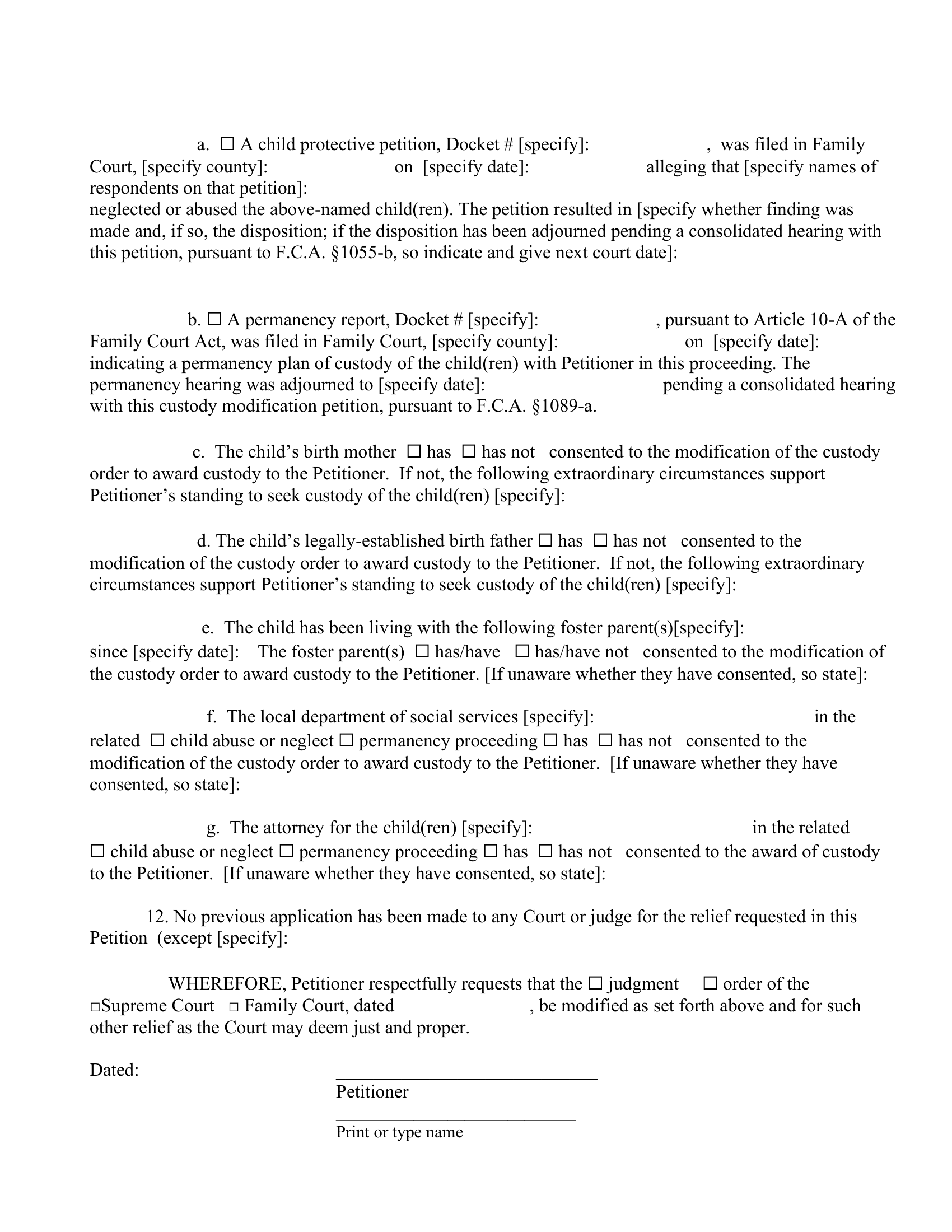
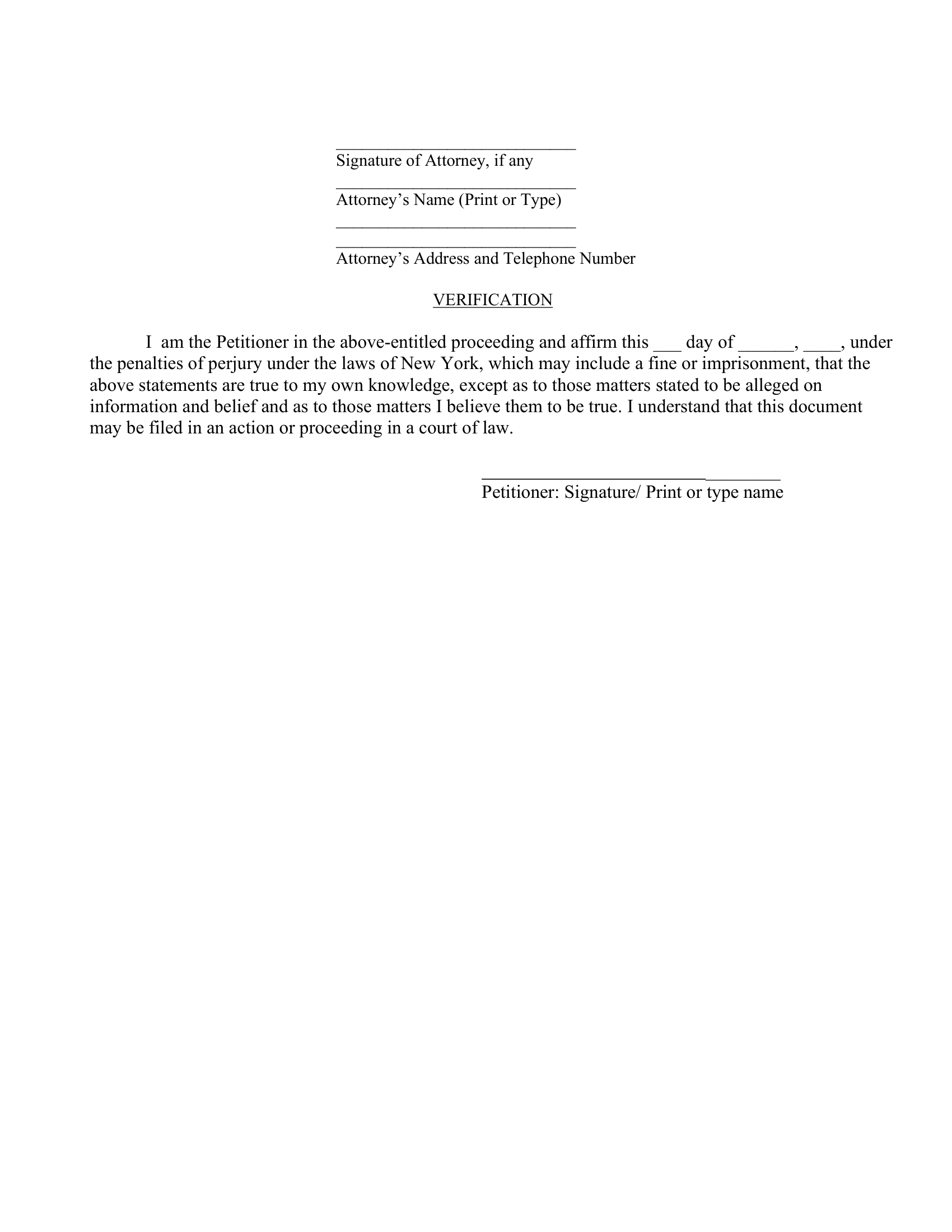
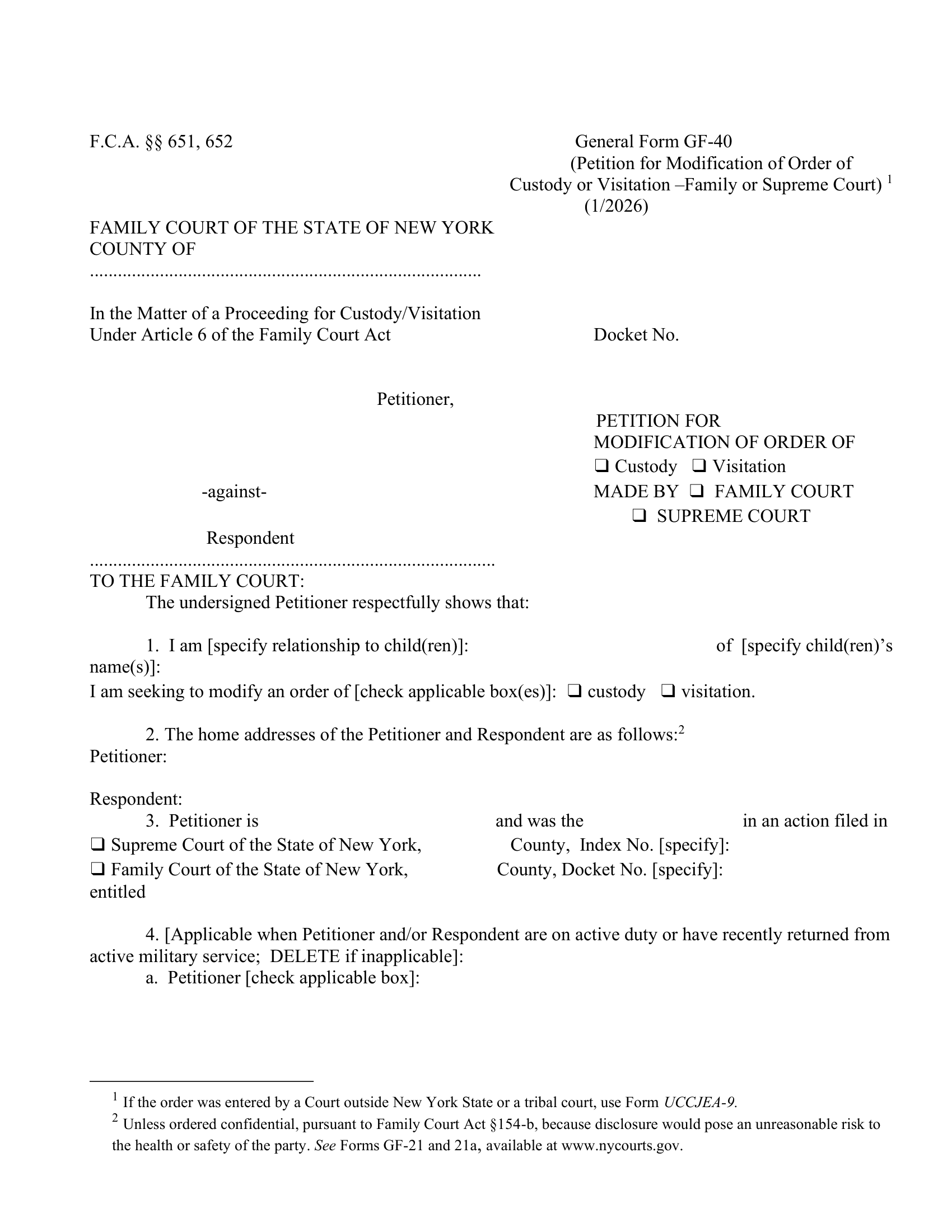
All 5 pages of GF-40 (1/2026) as the court prints them. Open a page to read it full size; the walkthrough below shows the matching part of the form under each item.

What GF-40 is, and the standard for changing an order

GF-40 is one of the official Family Court forms; 22 NYCRR 205.7(a) says those forms shall, in substantially the same form as set forth, be uniformly used throughout the State. The court system’s custody forms listing names it “GF-40 Petition For Modification Of Order Of Custody Visitation,” and lists GF-40a, Order On Petition For Modification Of Order Of Custody visitation, as the matching order. The header of the 1/2026 form reads “F.C.A. §§ 651, 652”, and the caption reads PETITION FOR MODIFICATION OF ORDER OF Custody or Visitation MADE BY FAMILY COURT or SUPREME COURT.

Those two statutes are the Family Court’s authority. Family Court Act § 651(b) gives the Family Court jurisdiction over custody and visitation proceedings initiated there, to be decided in accordance with Domestic Relations Law § 240(1). Family Court Act § 652(b) says that, unless the Supreme Court provides in its order or judgment awarding custody or visitation in a divorce, separation or annulment that it may be enforced or modified only in the Supreme Court, the Family Court may determine an application to modify that order or judgment upon a showing that there has been a subsequent change of circumstances and modification is required. Section 652(a) states the same standard for applications the Supreme Court refers to the Family Court. For an order the Family Court made itself, Family Court Act § 651(b) has the Family Court decide custody and visitation in accordance with Domestic Relations Law § 240(1), which lets the court, on the application of either parent or of a person who has custody under the order, modify a custody direction. Neither section spells out a change of circumstances test for those orders; the court system’s CourtHelp and DIY pages describe it.

So a modification petition has two parts, and GF-40 asks for them in order. Paragraph 9 is the change of circumstances since the order. Paragraph 10 is what the order should become. CourtHelp puts it this way: custody and visitation orders may be changed if the court decides that things have changed and that changing the original order would be best for the child. The best interests standard is the one in Domestic Relations Law § 240(1)(a), which also says there is no prima facie right to the custody of the child in either parent.

Military service has its own rule. Domestic Relations Law § 75-l(3) and § 240(1)(a-2) say that, unless the parties have stipulated or agreed otherwise, if an order was issued because a parent was activated, deployed or temporarily assigned to military service, the parent’s return is considered a substantial change in circumstances, and on either parent’s request the court decides on the basis of the child’s best interests whether the earlier order should be modified.

Once a hearing on the petition begins, 22 NYCRR 205.14 says a proceeding under Family Court Act § 467, 651 or 652 to determine temporary or permanent custody or visitation shall proceed to conclusion within 90 days. Before any permanent or initial temporary custody or visitation order, Domestic Relations Law § 240(1)(a-1) has the court review related child protective decisions, warrants, the statewide registry of orders of protection and the sex offender registry.

This page is public legal information, not legal advice, and Onbello is not a law firm. The item numbers and labels below are those printed on the New York State Unified Court System form (GF-40, 1/2026). Procedures differ by county. If you can afford an attorney, we encourage you to hire one.

GF-40 paragraph by paragraph

GF-40 numbers its paragraphs 1 through 12 in the body, with lettered items under paragraphs 4, 5, 8 and 11. Several paragraphs are printed with a bracketed note to delete them if inapplicable, and paragraph 8 tells a petition between two parents to skip to paragraph 9. Paragraph numbers and wording below are the ones printed on the 1/2026 form.

When an item runs out of room

GF-40 leaves blank space after each paragraph rather than printing lines. If paragraph 9 or 10 needs more room, continue on an attached sheet labeled with the paragraph number, and attach the true copy of the judgment or order that paragraph 5 says is made a part of the petition.

Caption

In the Matter of a Proceeding for Custody/Visitation Under Article 6 of the Family Court Act

GF-40, page 1, caption, as printed on the form
GF-40, page 1, caption — tap to open the full page
What it asks
The county; the petitioner and respondent; Docket No.; and the title PETITION FOR MODIFICATION OF ORDER OF Custody or Visitation MADE BY FAMILY COURT or SUPREME COURT.
What to put
Write the county where you are filing and the names of both parties, for example Maria Lopez, petitioner, against Daniel Reyes, respondent. Check custody, visitation or both, and check which court made the order. Leave the docket number for the clerk unless the court tells you to use the old one.
Common mistake
Checking FAMILY COURT for an order that came out of a divorce. A divorce judgment is a Supreme Court order, and that choice drives paragraphs 3 and 7.

Paragraph 1

I am [relationship to child(ren)] of [child(ren)’s name(s)]; I am seeking to modify an order of custody or visitation

GF-40, page 1, paragraph 1, as printed on the form
GF-40, page 1, paragraph 1 — tap to open the full page
What it asks
The opening line, “The undersigned Petitioner respectfully shows that,” then your relationship to the children, their names, and whether you are seeking to modify an order of custody, visitation or both.
What to put
For example: I am the mother of Ana Reyes and Leo Reyes. Check both boxes if the order covers both custody and visitation and you want both changed.
Common mistake
Checking custody when you only want the schedule changed. If the change is to visitation alone, check visitation; paragraph 10 is where you say exactly what should change.

Paragraph 2

The home addresses of the Petitioner and Respondent are as follows

GF-40, page 1, paragraph 2, as printed on the form
GF-40, page 1, paragraph 2 — tap to open the full page
What it asks
Your home address and the respondent’s.
What to put
Footnote 2 says to give the addresses unless ordered confidential under Family Court Act § 154-b because disclosure would pose an unreasonable risk to the health or safety of the party, and points to Forms GF-21 and 21a on nycourts.gov. Section 154-b(2)(c) has the court designate the clerk or another person as agent for service for the party whose address is confidential.
Common mistake
Using an old address for the respondent. The summons and petition will be served there.

Paragraph 3

Petitioner is [ ] and was the [ ] in an action filed in Supreme Court or Family Court

GF-40, page 1, paragraph 3, as printed on the form
GF-40, page 1, paragraph 3 — tap to open the full page
What it asks
Your role (for example, the mother) and the role you had in the original case (for example, the plaintiff or the respondent), whether that case was in the Supreme Court (county and index number) or the Family Court (county and docket number), and the case title after “entitled.”
What to put
Copy the court, county, number and title from the first page of the order. A Supreme Court divorce case has an index number; a Family Court case has a docket number.
Common mistake
Writing your role in this petition instead of the original case. The line asks what you were in the action where the order was made.

Paragraph 4

Applicable when Petitioner and/or Respondent are on active duty or have recently returned from active military service

GF-40, page 1, paragraph 4, as printed on the form
GF-40, page 1, paragraph 4 — tap to open the full page
GF-40, page 2, paragraph 4 (continued), as printed on the form
GF-40, page 2, paragraph 4 (continued) — tap to open the full page
What it asks
a. Whether you are on active duty, deployed or temporarily assigned to military service, or returned from it, with the type of service, branch or unit, dates and location, and how it is likely to affect custody or visitation. b. The same for the respondent. The note says to delete the paragraph if inapplicable.
What to put
Footnotes 3 and 4 say the paragraph does not apply if the person is based at a permanent duty station or has had a permanent reassignment of station, which Domestic Relations Law § 75-l(4) also says. If an earlier order was made because of a deployment, a return from service is, under § 75-l(3), considered a substantial change in circumstances unless the parties agreed otherwise.
Common mistake
Deleting the paragraph when a return from service is the reason for the petition. If it is, say so here and again in paragraph 9.

Paragraph 5

A judgment or order, dated [ ], was entered in the action directing the Respondent or Petitioner to [terms]

GF-40, page 2, paragraph 5, as printed on the form
GF-40, page 2, paragraph 5 — tap to open the full page
What it asks
a. Whether it was a judgment or an order, its date, whom it directed, and its terms, with the statement that a true copy is attached and made a part of the petition. b. Only where the order was entered with a child protective dispositional or permanency hearing order directing custody with a relative or other non-parent under Family Court Act § 1055-b or § 1089-a: (i) the related proceeding, and (ii) the department of social services and attorney for the child the order says must be notified and made parties.
What to put
Summarize the custody and visitation terms as the order states them, for example: joint legal custody, primary physical custody to the respondent, parenting time to the petitioner every other weekend from Friday 6 p.m. to Sunday 6 p.m. Attach a copy of the whole order.
Common mistake
Describing the arrangement you have now instead of what the order says. Paragraph 5 is the order; what has changed belongs in paragraph 9.

Paragraph 6

The names, addresses and dates of birth of all children affected by this order

GF-40, page 2, paragraph 6, as printed on the form
GF-40, page 2, paragraph 6 — tap to open the full page
What it asks
A table with each child’s Name, Address and Date of Birth.
What to put
List every child the order covers, even one whose arrangement you are not asking to change. Footnote 5 says to give the address unless it was ordered confidential under Family Court Act § 154-b.
Common mistake
Leaving out a child because the change concerns only one. The paragraph asks for all children affected by the order.

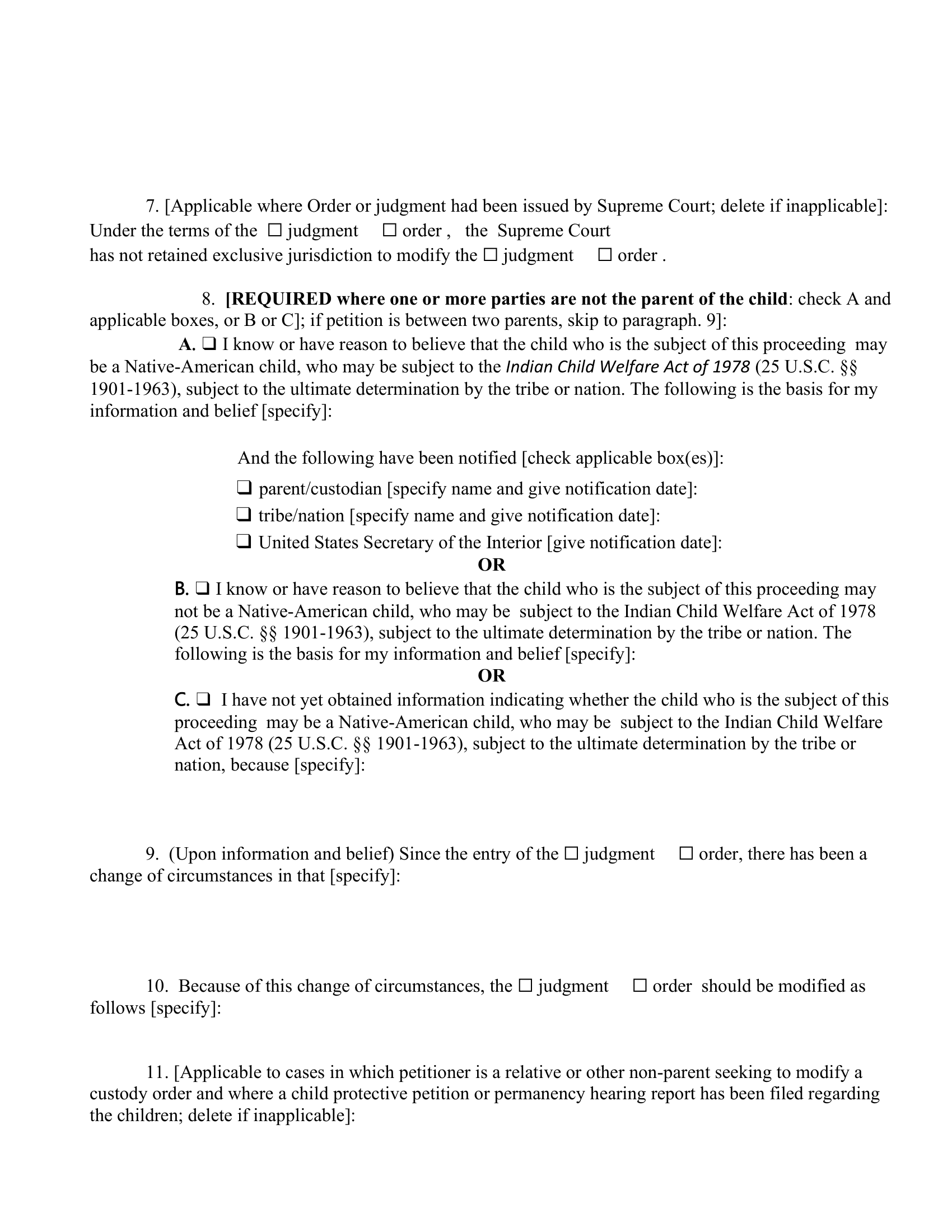
Paragraph 7

Under the terms of the judgment or order, the Supreme Court has not retained exclusive jurisdiction to modify it

GF-40, page 3, paragraph 7, as printed on the form
GF-40, page 3, paragraph 7 — tap to open the full page
What it asks
Applicable where the order or judgment was issued by the Supreme Court: the statement that under its terms the Supreme Court has not retained exclusive jurisdiction to modify it. Delete it if the order is a Family Court order.
What to put
Read the Supreme Court judgment for language that custody or visitation may be modified only in the Supreme Court. Family Court Act § 652(b) lets the Family Court modify the order only if the Supreme Court did not provide that. The paragraph prints only “has not”; if the judgment does reserve modification to the Supreme Court, the statement would not be true, so ask the Family Court clerk before filing.
Common mistake
Leaving paragraph 7 in for a Family Court order. The bracketed note says it applies where the order was issued by the Supreme Court and to delete it if inapplicable.

Paragraph 8

REQUIRED where one or more parties are not the parent of the child: the Indian Child Welfare Act

GF-40, page 3, paragraph 8, as printed on the form
GF-40, page 3, paragraph 8 — tap to open the full page
What it asks
Check A (you know or have reason to believe the child may be a Native American child subject to the Indian Child Welfare Act of 1978, with the basis and who has been notified), or B (reason to believe the child may not be), or C (you have not yet obtained the information, and why). The note says a petition between two parents skips to paragraph 9.
What to put
22 NYCRR 205.51 says that in any proceeding in which custody is to be determined, the petition shall set forth whether the child is a Native American child subject to the Indian Child Welfare Act. Give the basis for whichever box you check.
Common mistake
Skipping it as a grandparent or other relative. The paragraph is printed as REQUIRED whenever a party is not a parent.

Paragraph 9

(Upon information and belief) Since the entry of the judgment or order, there has been a change of circumstances in that

GF-40, page 3, paragraph 9, as printed on the form
GF-40, page 3, paragraph 9 — tap to open the full page
What it asks
What has changed since the judgment or order was entered.
What to put
Specific events after the date in paragraph 5, each with a date and how it affects the children. For example: since the March 2025 order, the respondent began working nights and the children have stayed with the petitioner on 41 of the respondent’s scheduled overnights, per the attached calendar. For a Supreme Court order, Family Court Act § 652(b) asks for a subsequent change of circumstances, and for any order CourtHelp says the court looks at whether things have changed, so start from what happened after the order.
Common mistake
Restating what the court already heard when it made the order. The paragraph is printed as changes since the entry of the judgment or order.

Paragraph 10

Because of this change of circumstances, the judgment or order should be modified as follows

GF-40, page 3, paragraph 10, as printed on the form
GF-40, page 3, paragraph 10 — tap to open the full page
What it asks
How the order should be changed.
What to put
Write the new terms as you want them to read: who has legal and physical custody, the weekly schedule, holidays, exchanges, and anything else. CourtHelp says the court may change an order if things have changed and changing the original order would be best for the child, so tie the request to the children’s needs.
Common mistake
Asking for a change that has nothing to do with the change in paragraph 9. The paragraph opens “Because of this change of circumstances,” so the request should follow from it.

Paragraph 11

Applicable where petitioner is a relative or other non-parent and a child protective petition or permanency hearing report has been filed

GF-40, page 3, paragraph 11, as printed on the form
GF-40, page 3, paragraph 11 — tap to open the full page
GF-40, page 4, paragraph 11 (continued), as printed on the form
GF-40, page 4, paragraph 11 (continued) — tap to open the full page
What it asks
a. A child protective petition: docket number, county, date, the respondents named, and the result. b. A permanency report under Article 10-A indicating a plan of custody with you. c. and d. Whether the birth mother and the legally established birth father have or have not consented, and if not, the extraordinary circumstances supporting your standing. e. The foster parents and whether they consent. f. Whether the local department of social services consents. g. Whether the attorney for the child consents. Items a to g are on page 4.
What to put
Delete the paragraph if you are a parent or no such case exists. If it applies, copy the docket numbers from the other case. CourtHelp says that when a judge decides custody between a parent and a non-parent, the judge first considers whether there are extraordinary circumstances, such as neglect, abuse, abandonment or a parent in prison, before the child’s best interests.
Common mistake
Answering c or d with a conclusion. Without the parent’s consent, the items ask for the extraordinary circumstances that support your standing.

Paragraph 12

No previous application has been made to any Court or judge for the relief requested in this Petition

GF-40, page 4, paragraph 12, as printed on the form
GF-40, page 4, paragraph 12 — tap to open the full page
What it asks
The statement, with an “except” line for any earlier application for the same relief.
What to put
List any earlier petition to modify this order, with the court, docket number and what happened, even if it was dismissed or withdrawn.
Common mistake
Leaving the except line blank because the earlier petition was dismissed. The statement covers any previous application.

WHEREFORE

WHEREFORE, Petitioner respectfully requests that the judgment or order be modified as set forth above

GF-40, page 4, WHEREFORE clause, as printed on the form
GF-40, page 4, WHEREFORE clause — tap to open the full page
What it asks
Whether it is a judgment or order, whether the Supreme Court or the Family Court made it, its date, and the request that it be modified as set forth above and for such other relief as the court may deem just and proper.
What to put
Use the same date as paragraph 5 and check the same court as the caption.
Common mistake
Writing a different date from paragraph 5. The court needs to know exactly which order you are asking it to change.

Signature

Dated; Petitioner; Print or type name; attorney lines

GF-40, page 4, signature lines, as printed on the form
GF-40, page 4, signature lines — tap to open the full page
GF-40, page 5, signature lines (continued), as printed on the form
GF-40, page 5, signature lines (continued) — tap to open the full page
What it asks
The date, your signature and printed name, and an attorney’s signature, name, address and telephone number if you have one. The attorney lines continue at the top of page 5.
What to put
Sign and print your name. Family Court Act § 262(a)(v) gives a parent seeking custody, or contesting the substantial infringement of custody, the right to counsel, including assigned counsel if the parent cannot afford one.
Common mistake
Signing here and skipping the verification on page 5. The verification is a separate signature.

Verification

VERIFICATION

GF-40, page 5, verification, as printed on the form
GF-40, page 5, verification — tap to open the full page
What it asks
That you are the petitioner and affirm, on the date written, under the penalties of perjury under the laws of New York, which may include a fine or imprisonment, that the statements are true to your own knowledge, except those alleged on information and belief, which you believe to be true.
What to put
Fill in the day, month and year, then sign and print your name. It is an affirmation, and the form prints no notary block.
Common mistake
Treating paragraph 9’s “upon information and belief” as room to guess. The verification says those statements are ones you believe to be true.

Common pitfalls

Not showing a change since the order

Family Court Act § 652 lets the Family Court modify a Supreme Court custody order upon a showing that there has been a subsequent change of circumstances and modification is required, and GF-40’s paragraph 9 asks what has changed since the entry of the judgment or order. A petition that only disagrees with the original decision does not answer that question.

Filing in Family Court when the Supreme Court kept the case

Under Family Court Act § 652(b), the Family Court may modify a Supreme Court divorce custody order unless the Supreme Court provided in the order or judgment that it may be enforced or modified only in the Supreme Court. Paragraph 7 asks you to state that it did not.

Leaving out the order

Paragraph 5 says a true copy of the judgment or order is attached and made a part of the petition. CourtHelp also suggests bringing old court orders and other important documents to the hearing, and submitting them for the file beforehand if you can.

Serving the papers yourself

CourtHelp says a party in the case can never serve legal papers, such as a notice of petition and petition, unless a judge gives permission; a process server or another adult 18 or older must do it, and that person completes an Affidavit of Service. In some counties the court serves the papers. Family Court Act § 154-a says a copy of the petition must be served on the respondent with the process or, if that is not practicable, at the respondent’s first court appearance.

Missing the court date

CourtHelp says that if you cannot attend you should contact the court, that the judge can still decide if a party does not appear and the court does not know why, and that if the petitioner does not appear the judge may close the case.

What to file with GF-40

  • UCCJEA-3: Affirmation - UCCJEA. The court system’s form for the statement Domestic Relations Law § 76-h requires in a child custody proceeding; its header prints “D.R.L. § 76-h” and the revision 1/2024. Attach it, or another affidavit with the same information; the clerk can tell you which your court wants.
  • UCCJEA-9: Petition to Modify Custody/Visitation Order - UCCJEA. Instead of GF-40, if the order was entered by a court outside New York State or a tribal court, as footnote 1 says.
  • GF-41: Petition for Enforcement of Order of Custody or Visitation Made by Supreme Court or Family Court. A different petition, for an order that is not being followed. Read the GF-41 walkthrough.
  • GF-17: Petition (Custody, Visitation). Not for this case. GF-17’s own footnote 1 says to use General Forms 40 or 41 once a New York court has entered a custody or visitation order. Read the GF-17 walkthrough.
  • GF-40a: Order On Petition For Modification Of Order Of Custody visitation. Not filed by you. It is the order form listed with GF-40 on the court system’s custody forms page.

CourtHelp says it is free to file a case in Family Court and that every Family Court has a Help Center. The free Custody/Visitation Modification DIY Form program can be used if the order was signed by a judge of a New York State court, you are the children’s parent, the children are not in foster care, and only you and the other parent are on the order; it asks you to have the other parent’s name and address, a copy of the order, and the children’s names, addresses and birth dates.
Keep reading

Common questions

What do I have to show to change a custody order in New York?

A change of circumstances since the order, and that changing it would be best for the child. Family Court Act § 652 lets the Family Court modify a Supreme Court custody or visitation order upon a showing that there has been a subsequent change of circumstances and modification is required, and CourtHelp says an order may be changed if the court decides that things have changed and that changing the original order would be best for the child. GF-40 asks for the change in paragraph 9 and the new terms in paragraph 10.

Can Family Court change a custody order from my divorce?

It can, unless the divorce judgment reserves that to the Supreme Court. Family Court Act § 652(b) says that unless the Supreme Court provides in the order or judgment that it may be enforced or modified only in the Supreme Court, the Family Court may determine an application to modify it upon a showing of a subsequent change of circumstances. GF-40 paragraph 7 asks you to state that the Supreme Court did not retain exclusive jurisdiction to modify the judgment or order.

Does it cost anything to file GF-40?

CourtHelp says it is free to file a case in Family Court. The court system also offers a free Custody/Visitation Modification DIY Form program that helps a parent fill out the petition when the order is from a New York State court and only the two parents are on it.

Does the other parent have to file a written response?

The court system’s custody and visitation forms list has no response form for a modification petition; the respondent comes to court on the date in the summons. Family Court Act § 165 says that where the Act does not prescribe a procedure, the Civil Practice Law and Rules apply to the extent appropriate, and Family Court Act § 262(a)(iii) gives the respondent in a custody proceeding the right to counsel.

Is a return from deployment a change of circumstances?

If the order being changed was issued because the parent was activated, deployed or temporarily assigned to military service, Domestic Relations Law § 75-l(3) says the parent’s return is considered a substantial change in circumstances, unless the parties stipulated or agreed otherwise, and on either parent’s request the court decides by the child’s best interests whether to modify. Section 75-l(4) says this does not apply to permanent duty stations or permanent changes of station.

Ready to prepare your modification petition?

Our guided tool helps you prepare an affidavit in your own words and fills out your court paperwork.

Join the waitlist — $129 at launch

A family law attorney will always have the biggest impact on your case. If you can afford one, we encourage you to hire one.

Onbello prepares court-ready California family law filings for parents without a lawyer.