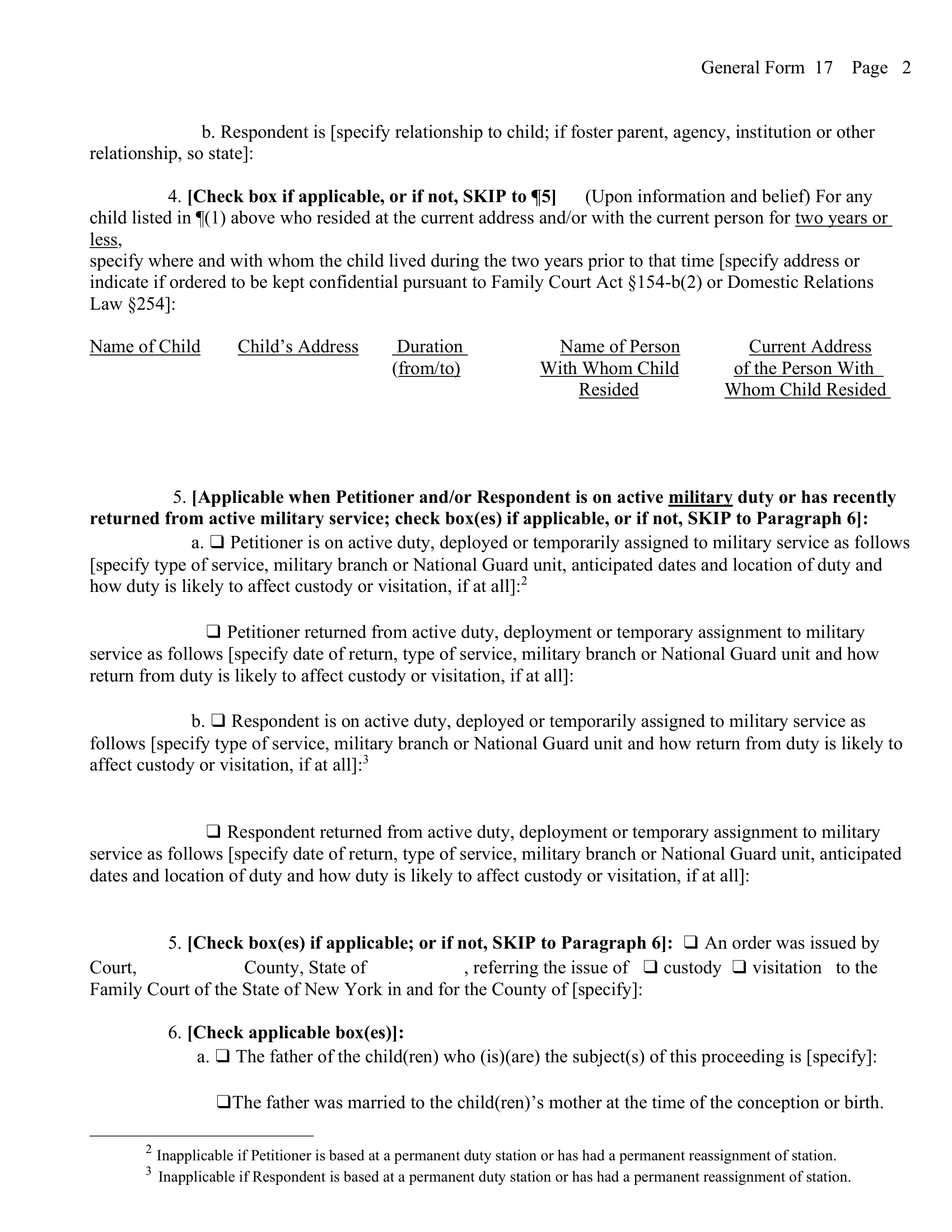
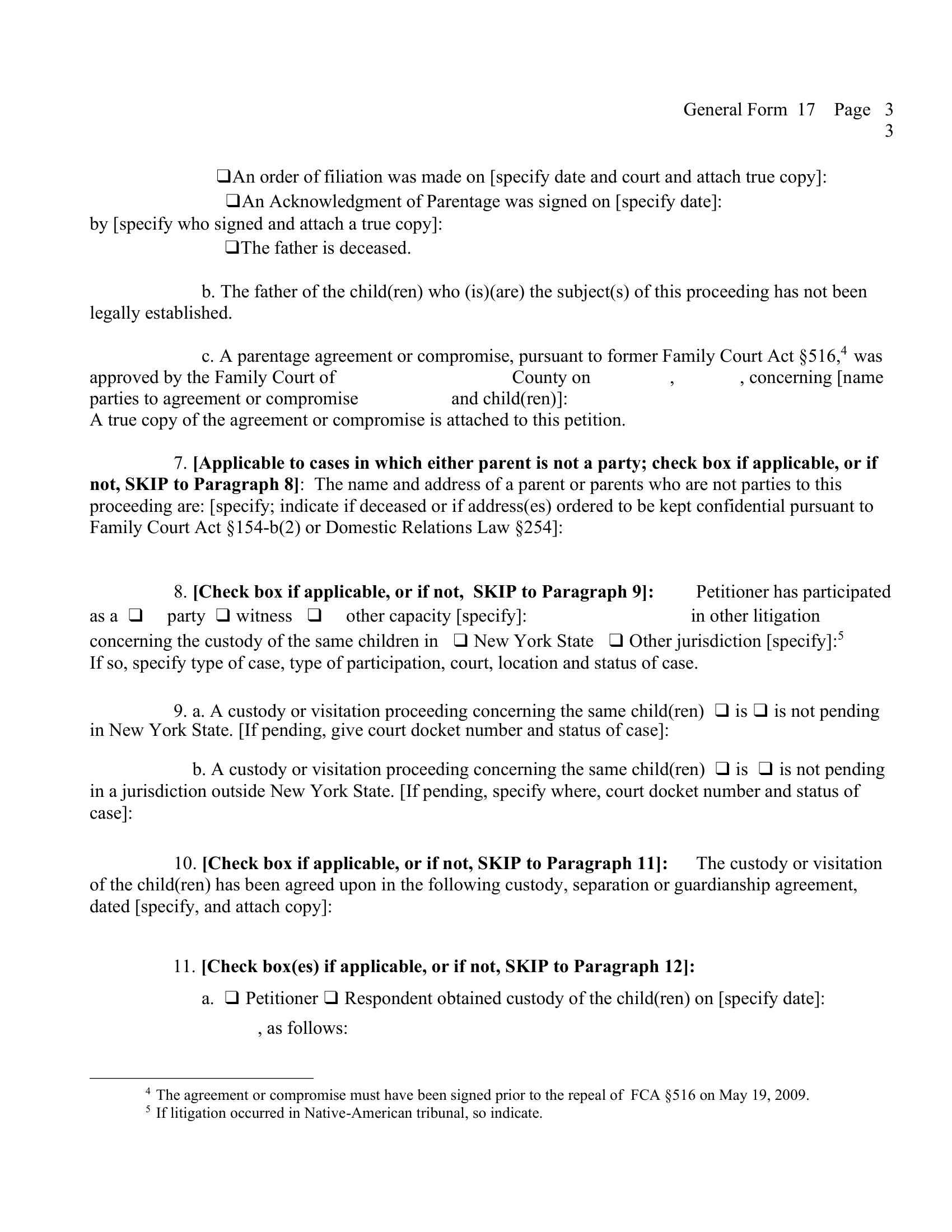
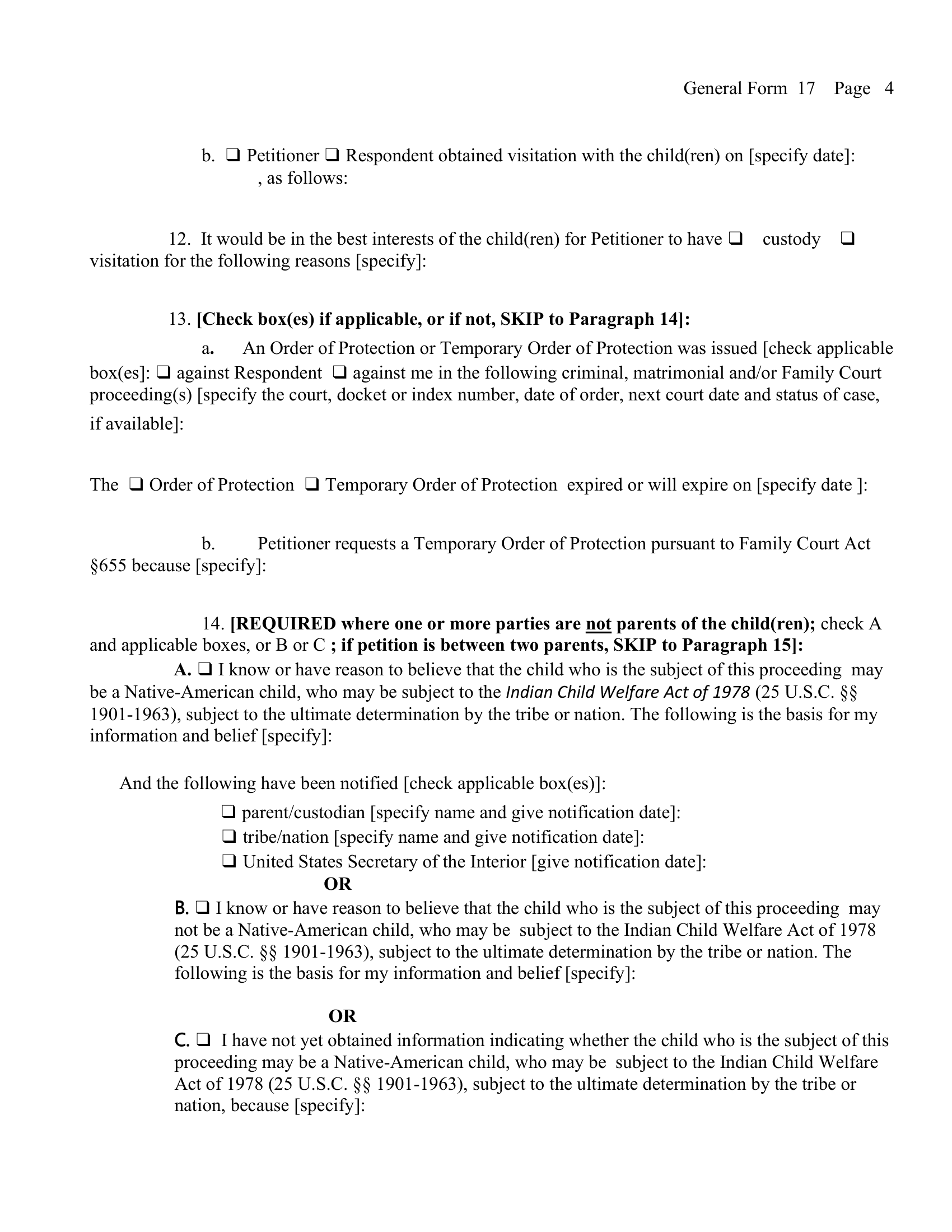
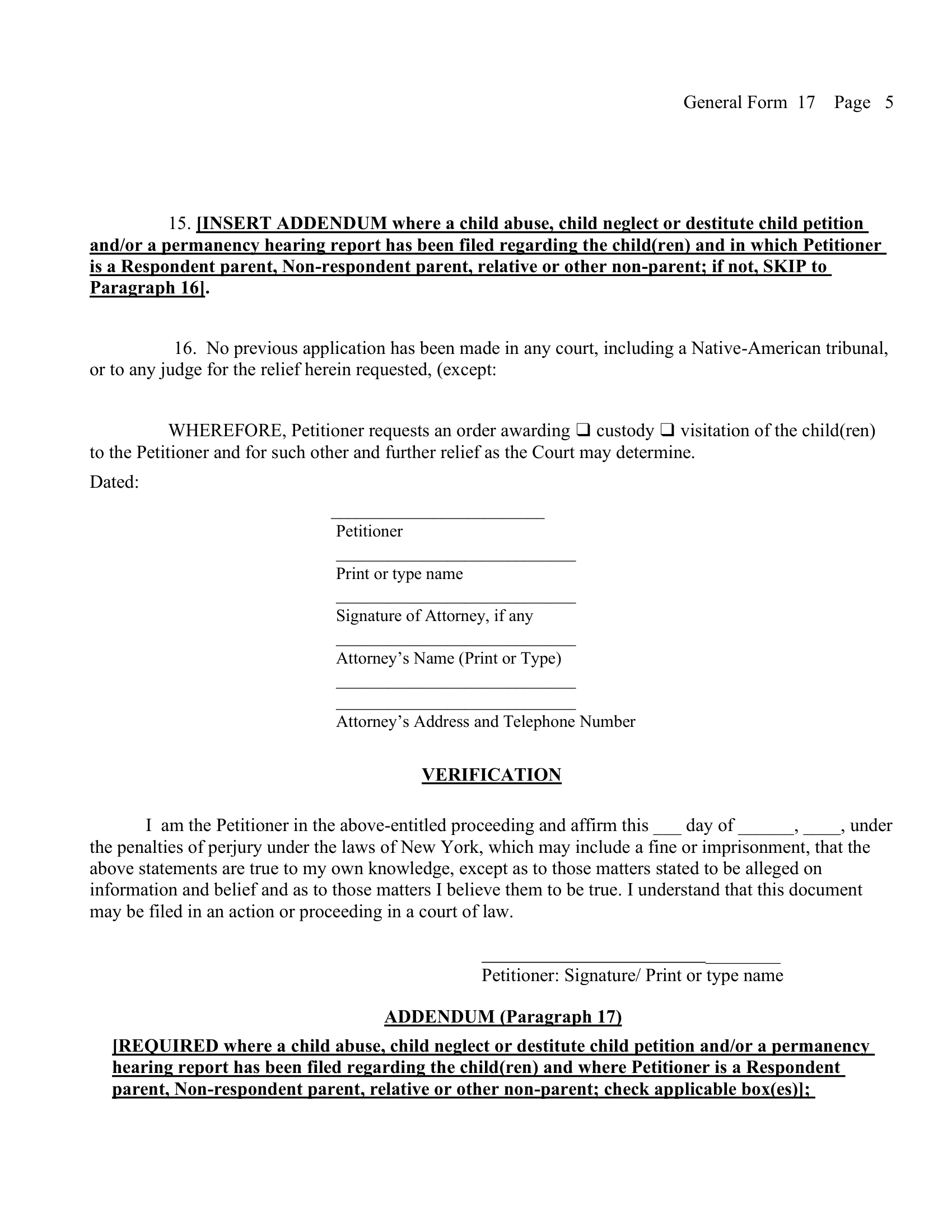
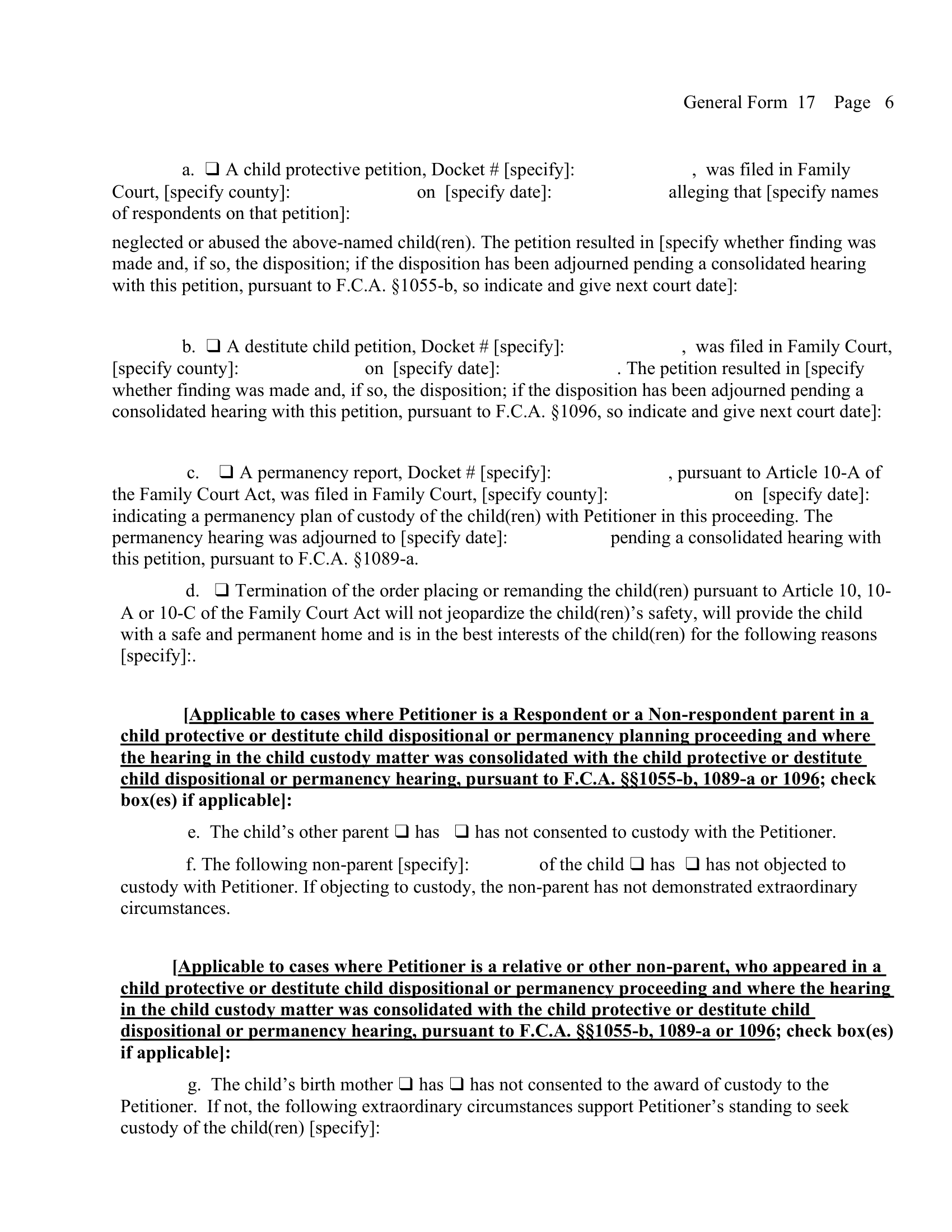
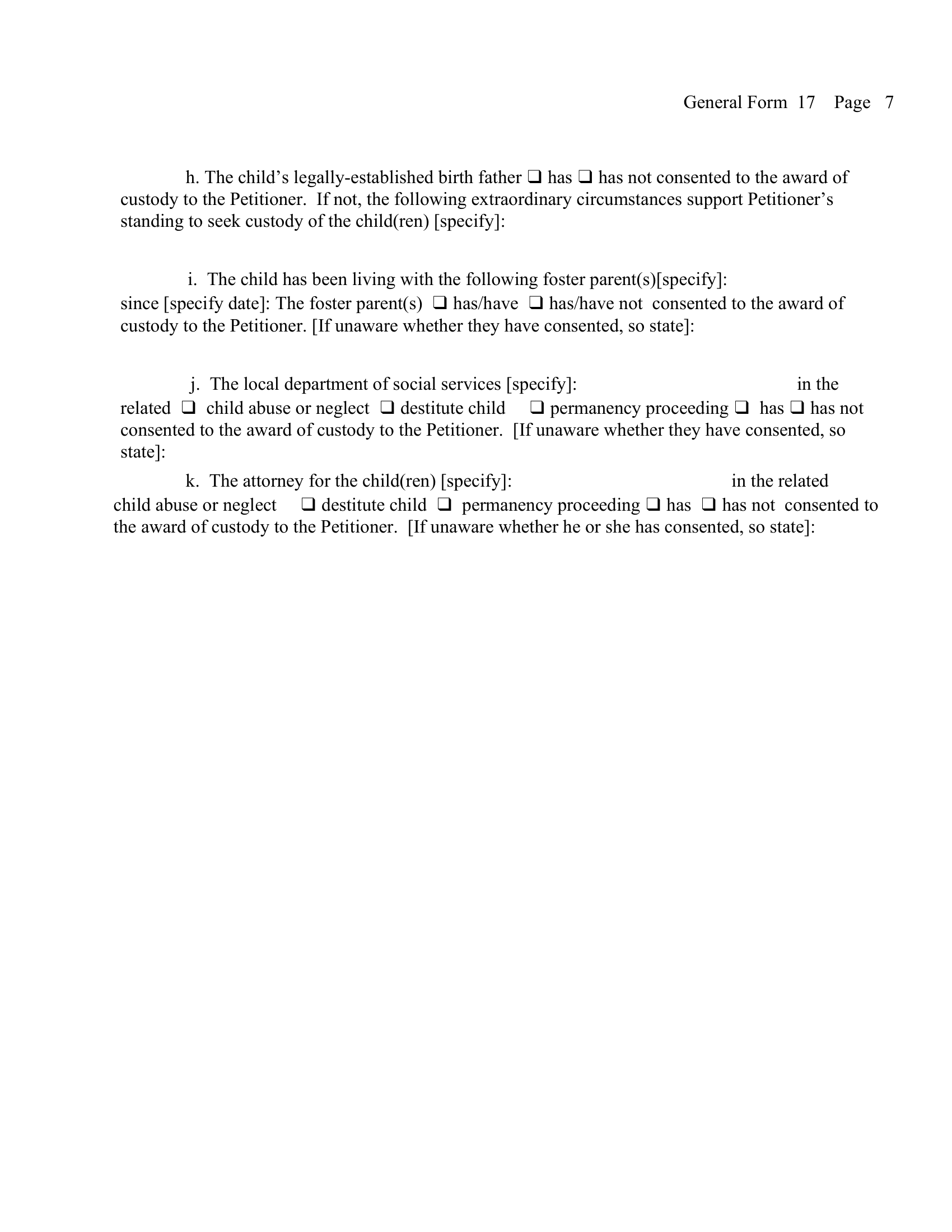
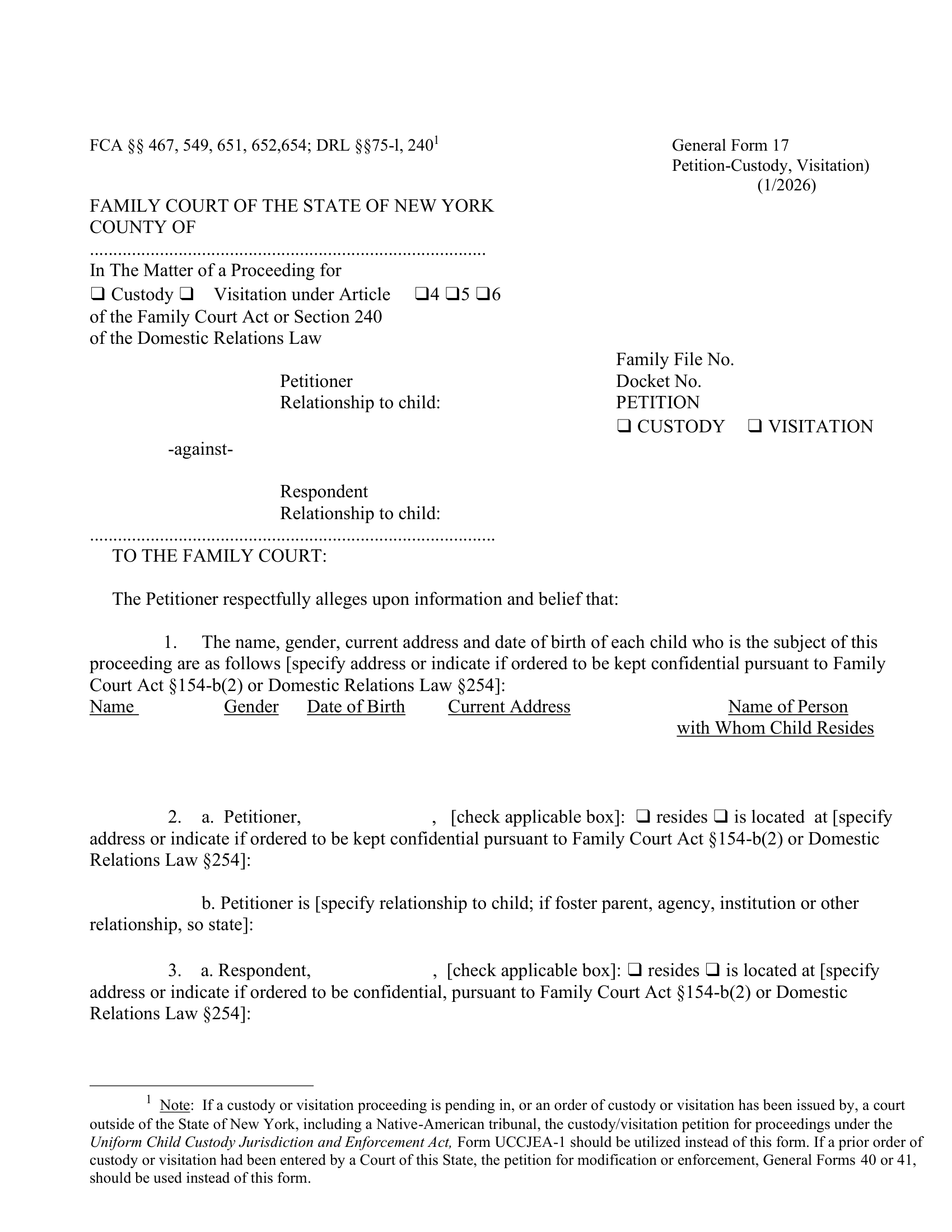
What GF-17 is, and the law printed at the top of it
GF-17 is one of the official Family Court forms. 22 NYCRR 205.7(a) says the forms designated “Forms of the Family Court of the State of New York” are the official forms of the court and shall, in substantially the same form as set forth, be uniformly used throughout the State. The court system’s custody forms listing names it “GF-17 Petition for (Custody) (Visitation)”; the matching order form is GF-18, Order Directing (Custody) (Visitation).
The statutes printed in the top left corner of the form read “FCA §§ 467, 549, 651, 652,654; DRL §§75-l, 240”. Those are the routes into a custody case, and they match the caption’s checkboxes for Article 4, 5 or 6 of the Family Court Act or Section 240 of the Domestic Relations Law. Family Court Act § 651(b) gives the Family Court jurisdiction over custody and visitation petitions initiated there, to be decided in accordance with Domestic Relations Law § 240(1). Section 467 (in Article 4) covers custody applications the Supreme Court refers from a divorce, separation or annulment, and § 652 (in Article 6) covers applications referred from those matrimonial actions. Section 549 (in Article 5) lets the Family Court make an order of custody or visitation after an order of filiation, in the absence of a Supreme Court custody order. The Senate’s published Family Court Act has no section 654 in Article 6, Part 3; section 653 is followed directly by section 655. Domestic Relations Law § 75-l is the military service section of the Uniform Child Custody Jurisdiction and Enforcement Act.
The standard is the child’s best interests. Domestic Relations Law § 240(1)(a) directs the court to enter custody orders having regard to the circumstances of the case and of the parties and to the best interests of the child, and says that in all cases there shall be no prima facie right to the custody of the child in either parent. CourtHelp lists what a judge looks at, such as which parent has been the main caregiver, each parent’s parenting skills and ability to meet the child’s special needs, the parents’ mental and physical health, any domestic violence, work schedules and child care plans, the child’s relationships with siblings and family, the child’s wishes depending on age, and each parent’s ability to cooperate and encourage a relationship with the other parent when it is safe to do so.
Anyone with an important role in a child’s life may file. CourtHelp says you do not have to be the child’s parent, but when a judge decides custody between a parent and a non-parent, the judge first considers whether there are extraordinary circumstances, and only then what is in the child’s best interest. It gives as examples a parent’s neglect or abuse of the child, abandonment, a parent in prison, or other serious acts that may affect the child’s well-being. That is why paragraphs 7 and 14 and the addendum ask more of a petitioner who is not a parent.
Before any permanent or initial temporary custody or visitation order, Family Court Act § 651(e) and Domestic Relations Law § 240(1)(a-1) require the court to review related child protective decisions, warrants, the statewide registry of orders of protection and the sex offender registry, and to notify the parties of the results. Once a custody or visitation hearing or trial begins, 22 NYCRR 205.14 says it shall proceed to conclusion within 90 days.
What to file with GF-17
- UCCJEA-3: Affirmation - UCCJEA. The court system’s form for the statement Domestic Relations Law § 76-h requires; its header prints “D.R.L. § 76-h” and the revision 1/2024. It asks for five years of the children’s addresses and caregivers, other custody cases, pending proceedings, and non-parties with custody or claims to it. Attach it, or another affidavit with the same information, when paragraph 4 does not cover five years; the clerk can tell you which your court wants.
- GF-40: Petition for Modification of Order of Custody or Visitation. Instead of GF-17, if a New York court has already entered a custody or visitation order you want changed, as footnote 1 says. Read the GF-40 walkthrough.
- GF-41: Petition for Enforcement of Order of Custody or Visitation Made by Supreme Court or Family Court. Instead of GF-17, if a New York order exists and is not being followed. Read the GF-41 walkthrough.
- UCCJEA-1: Petition for Custody/Visitation - UCCJEA. Instead of GF-17, if a custody or visitation case is pending in, or an order was issued by, a court outside New York, including a Native American tribunal, as footnote 1 says.
- Form 8-2: Petition - Family Offense. A separate petition, not an attachment. Paragraph 13b asks for a temporary order of protection within the custody case under Family Court Act § 655; a family offense case is its own proceeding with its own petition.
- GF-18: Order Directing (Custody) (Visitation). Not filed by you. It is the order form listed with GF-17 on the court system’s custody forms page.
CourtHelp says it is free to file a custody petition in Family Court, and that the court might also ask for documents such as photo identification, the children’s birth certificates or proof of income, so ask the clerk what your court needs. It also says every Family Court has a Help Center, and that before the hearing it helps to submit the Affidavit of Service and documents such as old court orders, photographs, police reports, receipts, bank statements and school records.