FL-320 Responsive Declaration to Request for Order (California): how to fill it out, line by line

A box-by-box walkthrough of the form you file when you have been served with an FL-300 — consent, do not consent, the order you want instead, and the facts behind it.

Researched by Dan Martin, Legal Researcher · Published by Onbello Legal

Quick answer

FL-320 is the California Judicial Council form you file after you are served with a Request for Order (FL-300). FL-320-INFO says to use it to let the court and the other party know that you agree or disagree with each of the requests made in the FL-300, and that if you disagree you use the form to describe the orders you would like the court to make. Its items 1 through 8 line up one-for-one with the items on the FL-300, each offering "I consent to the order requested" or "I do not consent to the order requested but I consent to the following order," and item 9 is the facts behind your answers. FL-320-INFO says you must file it with the clerk at least 9 court days before the hearing, and have it served at least 9 court days before the hearing, unless the court ordered a shorter time.

Summary: what FL-320 does, and what you need first

  • FL-320 is the mandatory response to a Request for Order (FL-300). FL-320-INFO says it is how you tell the court and the other party that you agree or disagree with each request, and how you describe the orders you want instead.
  • If you do not file and serve it, FL-320-INFO states plainly that the court can still make orders without your input.
  • Before you start, have the FL-300 you were served with in front of you. Its items are the items you are answering.
  • Copy the hearing date, time, and department from the FL-300 into the caption — FL-320-INFO item 5 says to print or type the same hearing date, time, and department that appears on the FL-300.
  • Decide, request by request, whether you consent, or do not consent and want a different order. FL-320-INFO says to mark the same box that is marked on the FL-300, then specify your answer.
  • Items 3, 4, and 6 each state that you filed a current FL-150 Income and Expense Declaration. FL-320-INFO adds that you may file one FL-150 to respond to items 3, 4, and 6.
  • Write your facts out. Item 9 states that the facts you write and attach to the form cannot be longer than 10 pages unless the court gives you permission.
  • File with the clerk at least 9 court days before the hearing, and have the papers served at least 9 court days before the hearing — or by the date in the court’s order, if it set a shorter time.
  • Make 2 copies of your original paperwork before filing, per FL-320-INFO item 7, and 3 copies of the completed proof of service per item 13.
  • Generally there is no fee to file the Responsive Declaration, but FL-320-INFO item 8 notes you may owe a first appearance fee if you have never filed any papers in the case — FW-001 and FW-003 are the fee waiver forms.

The full form

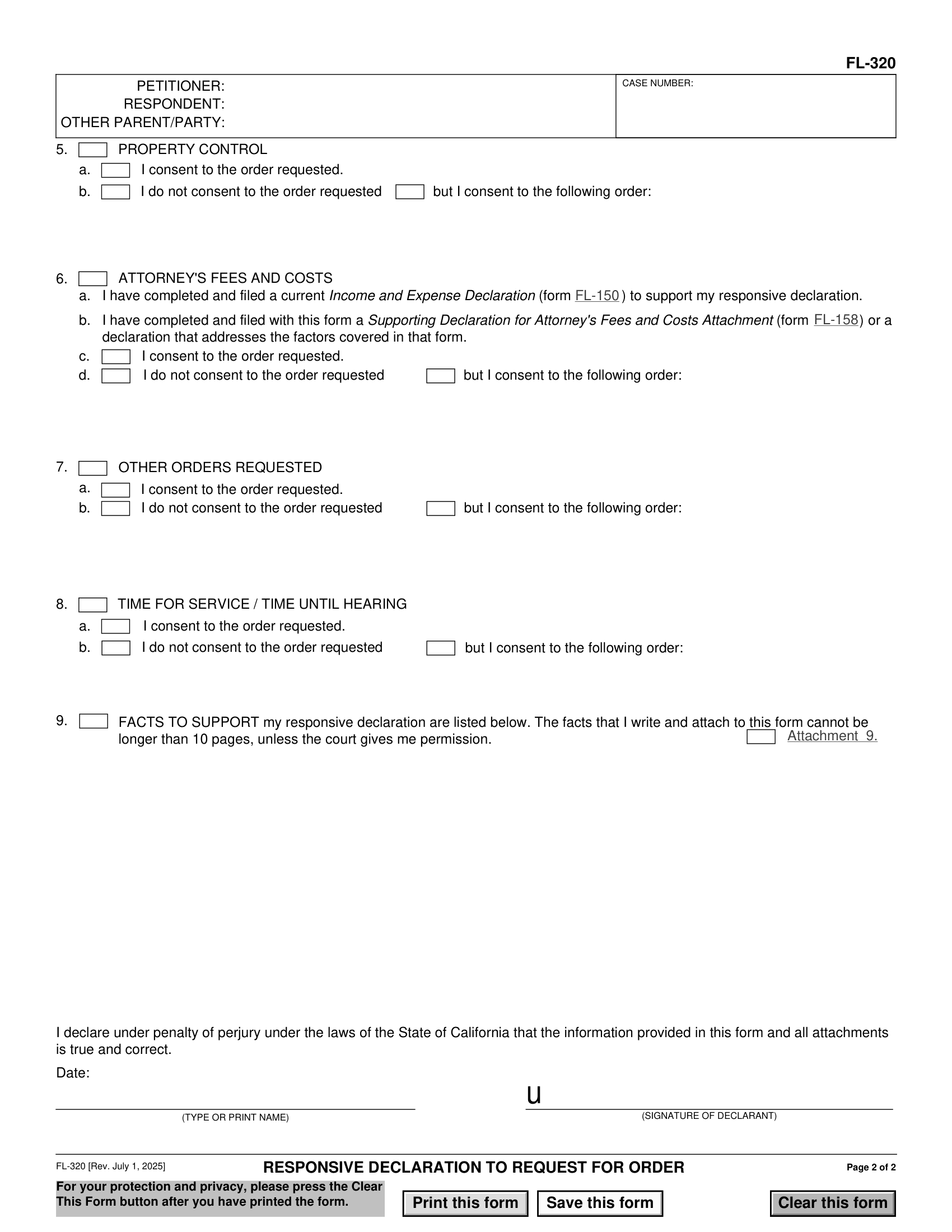
All 2 pages of FL-320 (Rev. July 1, 2025) as the court prints them. Open a page to read it full size; the walkthrough below shows the matching part of the form under each item.

What the FL-320 is, and when you need it

Responsive Declaration to Request for Order (form FL-320) is the mandatory Judicial Council form for answering an FL-300. It is a two-page form, and it is deliberately shaped like the thing it answers: FL-320-INFO item 6 says each item on the form matches the item numbers on the Request for Order, so item 3 on your FL-320 answers item 3 on their FL-300, and so on through item 8.

Every one of those items works the same way. You either consent to the order the other party asked for, or you do not consent — and if you do not consent, the form gives you a line to write in the order you want the court to make instead. That second half matters: FL-320-INFO says that if you disagree, you use form FL-320 to describe the orders you would like the court to make. Disagreeing without proposing anything leaves the judge with only one proposal in front of them.

There is also a deadline, and it is shorter than the one the filing party had. FL-320-INFO item 7 says you must file your paperwork with the court clerk at least 9 court days before the hearing, and item 11 says personal service or service by mail on the other party must be completed at least 9 court days before the hearing. If the court ordered a shorter time to file or serve your responsive papers, those dates control. The same nine-court-day rule is printed as a warning at item 3 of the FL-300 itself.

FL-320 is not a way to open new subjects. FL-320-INFO item 3 says do not use it to ask for court orders that were not requested in the FL-300 — for those you file and serve your own FL-300 — and do not use it to respond to a DV-100 (that is DV-120) or to a DV-300 or JV-255 request to change or end a restraining order (that is DV-320).

This page is public legal information, not legal advice, and Onbello is not a law firm. The item numbers and labels below are those printed on the Judicial Council form (FL-320, Rev. July 1, 2025). Procedures differ by county. If you can afford an attorney, we encourage you to hire one.

FL-320 box by box

The form runs caption, items 1 through 9, signature. Items 1 through 8 answer the matching items on the FL-300 you were served with; item 9 is where you explain all of it. FL-320-INFO item 6 says to complete item 1, then mark the same box that is marked on the FL-300 and specify whether you consent or do not consent.

When an item runs out of room

FL-320-INFO item 6 says that if you need more space for item 9, write your responses on a separate sheet of paper and attach it to the form, and that Attached Declaration (form MC-031) may be used for that purpose. The form marks the continuation box "Attachment 9."

Caption (page 1, top)

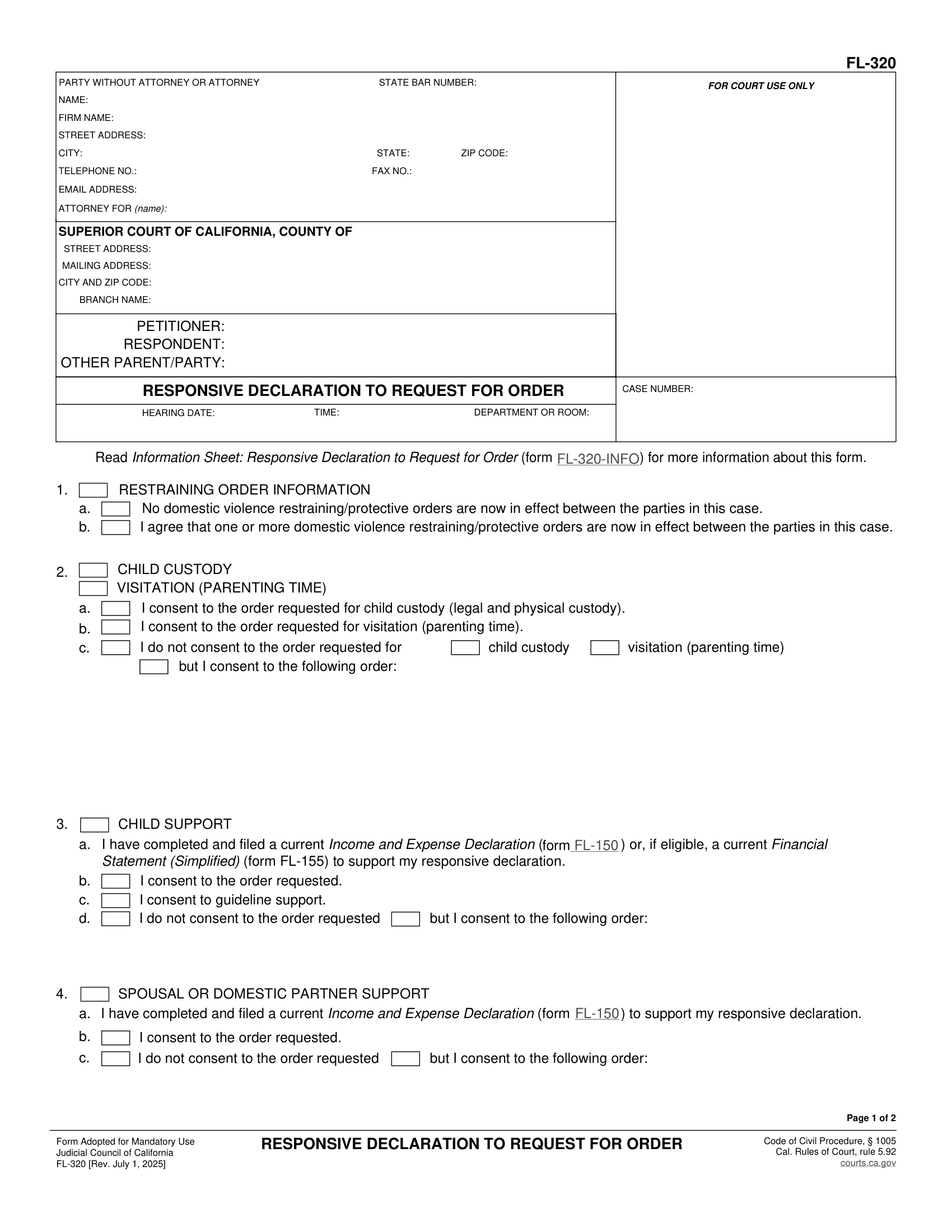
Party or attorney, court, party names, case number, and the hearing details
FL-320, page 1, caption, as printed on the form
FL-320, page 1, caption — tap to open the full page
What it asks
Your name, address, telephone and email in the top-left box; the Superior Court of California county and address; the PETITIONER, RESPONDENT and OTHER PARENT/PARTY names; the case number; and, on the title line, HEARING DATE, TIME, and DEPARTMENT OR ROOM.
What to put
Your own contact details if you are self-represented, the party names and case number exactly as they appear on the papers you were served, and — per FL-320-INFO item 5 — the same hearing date, time, and department that appears on the FL-300.
Common mistake
Leaving the hearing date, time and department blank. Those three fields are on your form precisely so the clerk and the court can match your response to a hearing that is already on the calendar.

Item 1

RESTRAINING ORDER INFORMATION

FL-320, page 1, item 1, as printed on the form
FL-320, page 1, item 1 — tap to open the full page
What it asks
One of two statements: (a) no domestic violence restraining or protective orders are now in effect between the parties in this case, or (b) you agree that one or more such orders are now in effect between the parties in this case.
What to put
Mark whichever is true. FL-320-INFO item 6 singles this item out: complete item 1, whatever else the FL-300 asked for.
Common mistake
Skipping item 1 because the FL-300 did not mark its own item 1. This is the one item you answer regardless, and it is a statement of fact rather than a consent.

Item 2

CHILD CUSTODY / VISITATION (PARENTING TIME)

FL-320, page 1, item 2, as printed on the form
FL-320, page 1, item 2 — tap to open the full page
What it asks
Three lines. 2a is consent to the order requested for child custody (legal and physical custody). 2b is consent to the order requested for visitation (parenting time). 2c is "I do not consent to the order requested for" — with separate boxes for child custody and visitation (parenting time) — "but I consent to the following order," followed by space to write it.
What to put
You can split your answer: consent at 2a to the custody labels and use 2c to object only to the visitation schedule, or the reverse. When you use 2c, write a schedule specific enough to be made into an order — days, times, exchange place, holidays, transportation — and continue on an attachment if it does not fit.
Common mistake
Marking 2c and leaving the "following order" space empty. The item is built to carry your counter-proposal, and FL-320-INFO says disagreeing is how you describe the orders you would like the court to make.

Item 3

CHILD SUPPORT

FL-320, page 1, item 3, as printed on the form
FL-320, page 1, item 3 — tap to open the full page
What it asks
Four lines. 3a states that you have completed and filed a current Income and Expense Declaration (form FL-150), or if eligible a current Financial Statement (Simplified) (form FL-155), to support your responsive declaration. 3b is consent to the order requested. 3c is consent to guideline support. 3d is "I do not consent to the order requested but I consent to the following order."
What to put
File the FL-150 (or FL-155, if you meet the requirements listed on page 2 of FL-155) and mark 3a. Then choose: consent to what they asked for, consent to guideline support, or write your own figure or arrangement at 3d. FL-320-INFO notes you may file one FL-150 to respond to items 3, 4, and 6.
Common mistake
Objecting to the support figure without filing the FL-150. FL-320-INFO is blunt about the consequence: you must give the court information about your finances, and if you do not, the child support order will be based on information about your income that the court receives from other sources.

Item 4

SPOUSAL OR DOMESTIC PARTNER SUPPORT

FL-320, page 1, item 4, as printed on the form
FL-320, page 1, item 4 — tap to open the full page
What it asks
Three lines. 4a states that you have completed and filed a current FL-150 to support your responsive declaration. 4b is consent to the order requested. 4c is "I do not consent to the order requested but I consent to the following order."
What to put
A current FL-150, then either consent at 4b or your own proposal at 4c — an amount, a duration, or a statement that no support should be ordered, with the reasons kept for item 9. FL-320-INFO item 4d also lists FL-157, Spousal or Partner Support Declaration Attachment, for use when the request is to change a support judgment.
Common mistake
Treating 4a as a box you can simply check. It is a statement that the FL-150 has actually been completed and filed; an unchecked or untrue 4a leaves a support response with no financial record behind it.

Item 5

PROPERTY CONTROL

FL-320, page 2, item 5, as printed on the form
FL-320, page 2, item 5 — tap to open the full page
What it asks
Two lines only: (a) consent to the order requested, or (b) "I do not consent to the order requested but I consent to the following order," with space to describe it.
What to put
If you want a different arrangement, identify the property as specifically as the order would have to — an address, a vehicle, an account, a listed debt with its payee and amount — and say who should use or pay for what while the order is in effect.
Common mistake
Answering a property request with a general objection. An order has to name the property, so a response that does not name it gives the court nothing to substitute for the other side’s version.

Item 6

ATTORNEY’S FEES AND COSTS

FL-320, page 2, item 6, as printed on the form
FL-320, page 2, item 6 — tap to open the full page
What it asks
Four lines. 6a states you filed a current FL-150 to support your responsive declaration. 6b states you filed with this form a Supporting Declaration for Attorney’s Fees and Costs Attachment (form FL-158), or a declaration that addresses the factors covered in that form. 6c is consent to the order requested. 6d is "I do not consent to the order requested but I consent to the following order."
What to put
The FL-150 and the FL-158 (or an equivalent declaration), then your position on the fee request. FL-320-INFO item 4e lists FL-150, FL-158 and FL-319 for attorney’s fees and costs, except in Domestic Violence Prevention Act cases.
Common mistake
Answering a fee request with the consent boxes alone. Items 6a and 6b are the record of what you filed to support your side of the fee question.

Item 7

OTHER ORDERS REQUESTED

FL-320, page 2, item 7, as printed on the form
FL-320, page 2, item 7 — tap to open the full page
What it asks
Two lines: (a) consent to the order requested, or (b) do not consent, but consent to the following order.
What to put
Answer whatever the other party put in item 7 of their FL-300, one response per request. If several unrelated orders were bundled there, address each one so the record shows which you agree to.
Common mistake
Using item 7 to ask for something new. FL-320-INFO item 3 says FL-320 is not for asking for orders that were not requested in the FL-300 — that takes your own FL-300.

Item 8

TIME FOR SERVICE / TIME UNTIL HEARING

FL-320, page 2, item 8, as printed on the form
FL-320, page 2, item 8 — tap to open the full page
What it asks
Two lines: (a) consent to the order requested, or (b) do not consent, but consent to the following order.
What to put
This answers item 8 of the FL-300, where the other party asked for a shortened service timeline or an earlier hearing. Mark it only if they asked; if you object, say what timeline you can work with and give the reason in item 9.
Common mistake
Leaving item 8 blank when the FL-300 asked for shortened time. An unanswered request for a compressed timeline reads as no objection to it.

Item 9

FACTS TO SUPPORT my responsive declaration

FL-320, page 2, item 9, as printed on the form
FL-320, page 2, item 9 — tap to open the full page
What it asks
The facts behind your answers. The item states that the facts you write and attach to the form cannot be longer than 10 pages unless the court gives you permission, and offers an "Attachment 9" box.
What to put
FL-320-INFO item 6 describes exactly what belongs here: use the space to explain your responses to items 1 through 8, including the reasons why you do not agree with the orders requested by the other party and why the court should make the orders you described. Write dated, specific facts, and continue on MC-031 if you run out of room.
Common mistake
Writing a narrative that never connects to a numbered item. Your consents and counter-proposals are in items 1 through 8; item 9 is where each one gets its reason.

Signature block (end of page 2)

I declare under penalty of perjury under the laws of the State of California…

FL-320, page 2, signature block, as printed on the form
FL-320, page 2, signature block — tap to open the full page
What it asks
The date, your typed or printed name, and your signature, under a declaration that the information provided in the form and all attachments is true and correct.
What to put
FL-320-INFO item 6 says to print your name, sign, and write the date you signed the form. Do it after every item and attachment is final.
Common mistake
Filing it unsigned. The whole form is a declaration under penalty of perjury, and the signature is what makes it one.

After you sign

File, serve, and file the proof of service

FL-320, page 1, the hearing date line, as printed on the form
FL-320, page 1, the hearing date line — tap to open the full page
What it asks
Nothing on the form. FL-320-INFO items 7 through 13 describe the sequence: make 2 copies, file with the clerk at least 9 court days before the hearing (the clerk keeps the original and returns stamped copies), have a copy served, and get the proof of service filed before the hearing.
What to put
You cannot serve the papers yourself — FL-320-INFO item 10 says someone else at least 18 years old must do it, and that server completes FL-330 after personal service or FL-335 after service by mail. Make three copies of the completed proof of service, take the original and copies to the clerk as soon as possible before the hearing, and bring a copy stamped "Filed" to the hearing.
Common mistake
Serving the original. FL-320-INFO warns to be sure the original documents are not served — serve a stamped copy, or an unstamped copy before you file the originals.

Common pitfalls

Not responding at all

FL-320-INFO states the consequence in one line: if you do not file and serve form FL-320, the court can still make orders without your input. The warning printed at item 3 of the FL-300 says the same thing from the other direction — the court may make the requested orders without you if you do not file an FL-320, serve a copy at least nine court days before the hearing, and appear.

Missing the 9-court-day deadline

Two separate nine-court-day requirements sit in FL-320-INFO: item 7, file your paperwork with the court clerk at least 9 court days before the hearing; and item 11, personal service or service by mail on the other party must be completed at least 9 court days before the hearing. If the court ordered a shorter time for your responsive papers, FL-320-INFO says to use the date specified in that order. FL-320-INFO item 1 also says to check whether the court ordered a specific date for filing and serving your response.

Disagreeing without proposing an alternative

Each "I do not consent" line on the form is followed by "but I consent to the following order" and space to write it. FL-320-INFO describes that space as how you describe the orders you would like the court to make. Left blank, the only concrete proposal in the file is the other party’s.

No FL-150 behind items 3, 4, or 6

Items 3a, 4a and 6a are statements that you completed and filed a current FL-150 (or, at 3a, a current FL-155 if eligible). FL-320-INFO notes you may file one FL-150 to respond to items 3, 4, and 6 — and, on child support, that if you do not give the court information about your finances the order will be based on income information the court receives from other sources.

Custody responses can need more than the FL-320

FL-320-INFO’s forms checklist lists FL-105, Declaration Under Uniform Child Custody Jurisdiction and Enforcement Act, among the forms you may need to complete for child custody or visitation (parenting time) orders, along with FL-311, FL-312, FL-341(C), FL-341(D) and FL-341(E).

Using the FL-320 to raise new requests

FL-320-INFO item 3 says do not use FL-320 to ask for court orders that were not requested in the FL-300 — file and serve your own FL-300 for those — and that a DV-100 is answered with DV-120, while a DV-300 or JV-255 request to change or end a restraining order is answered with DV-320.

What to file with FL-320

  • FL-300: Request for Order. The form you were served with. Its items 1 through 8 are the items your FL-320 answers, and its page 1 carries the hearing date you copy into your caption. Read the FL-300 walkthrough.
  • MC-031: Attached Declaration. For item 9 when your facts run past the space on the form. FL-320-INFO item 6 says MC-031 may be used for that purpose; label it "Attachment 9."
  • FL-150: Income and Expense Declaration. A current one whenever child support, spousal or partner support, or attorney’s fees and costs are at issue — items 3a, 4a and 6a each state you filed it. FL-320-INFO says one FL-150 can respond to items 3, 4, and 6, and that FL-155, Financial Statement (Simplified), may be used instead if you meet the requirements on page 2 of FL-155. Read the FL-150 walkthrough.
  • FL-105: Declaration Under Uniform Child Custody Jurisdiction and Enforcement Act. Listed in FL-320-INFO among the forms you may need for child custody or visitation (parenting time) orders, together with FL-311, FL-312, FL-341(C), FL-341(D) and FL-341(E).
  • FL-158 and FL-319: Supporting Declaration for Attorney’s Fees and Costs; Request for Attorney’s Fees and Costs Attachment. Listed in FL-320-INFO for attorney’s fees and costs, except in Domestic Violence Prevention Act cases. Item 6b states you filed FL-158 or a declaration addressing the same factors.
  • FL-157: Spousal or Partner Support Declaration Attachment. Listed in FL-320-INFO item 4d for use when the request is to change a support judgment.
  • FL-330 or FL-335: Proof of Personal Service; Proof of Service by Mail. Completed by your server, not by you — FL-330 after personal service, FL-335 after service by mail. FL-320-INFO item 13 says to make three copies, take the original and copies to the clerk as soon as possible before the hearing, and bring a copy stamped "Filed" to the hearing.
  • FL-321: Witness List. Listed in FL-320-INFO’s forms checklist if you plan on having witnesses testify at the hearing.

Local rules and local forms vary by county, and FL-320-INFO item 16 points you to the Family Law Facilitator or Self-Help Center for information, local rules, and referrals. Our courthouse lookup will tell you which Superior Court and branch handles your ZIP code so you can check that court’s requirements before you file.

Keep reading

Common questions

How long do I have to file and serve an FL-320?

FL-320-INFO gives two nine-court-day deadlines. Item 7: you must file your paperwork with the court clerk at least 9 court days before the hearing. Item 11: personal service or service by mail on the other party must be completed at least 9 court days before the court hearing. If the court ordered a shorter time to file or serve your responsive papers, FL-320-INFO says to use the date specified in that order, and item 1 tells you to check the papers you were served for such a date.

Is there a filing fee for an FL-320?

FL-320-INFO item 8 says that generally you do not have to pay a fee to file the Responsive Declaration — but if you have never filed any papers in the case, you may have to pay a first appearance fee, which in general everyone pays when filing court papers in a case for the first time. If you cannot afford it, you can ask the court to waive fees with FW-001, Request to Waive Court Fees, and FW-003, Order on Court Fee Waiver.

What happens if I do not respond?

FL-320-INFO says that if you do not file and serve form FL-320, the court can still make orders without your input. The warning at item 3 of the FL-300 puts it the same way: the court may make the requested orders without you if you do not file an FL-320, serve a copy on the other parties at least nine court days before the hearing, and appear at the hearing.

Can I ask for my own orders on the FL-320?

Only as an alternative to what was already requested. Each item lets you write the order you would like the court to make instead of the one requested. For a subject the other party did not raise, FL-320-INFO item 3 says do not use FL-320 — file and serve your own Request for Order (FL-300) to ask for orders about other issues.

What if I need more time before the hearing?

FL-320-INFO item 1 says that if you need more time before the hearing to prepare a responsive declaration or talk with a lawyer, you may ask the court to continue the hearing date, and points you to a lawyer or to the Family Law Facilitator or Self-Help Center in your court for how to do that.

Can I serve the FL-320 myself?

No. FL-320-INFO item 10 says you cannot serve the papers — have someone else who is at least 18 years old do it. That can be a friend, a relative who is not involved in your case, a county sheriff, or a professional process server, and for service by mail the server must live or work in the county where the mailing took place. The server is also the one who completes FL-330 or FL-335.

Get the California custody checklist

Two pages: what to gather, which forms, deadlines, what to bring to the hearing. Free, no account.

Ready to prepare your FL-320?

Our guided tool reads what was requested, asks plain questions about what you want instead, and fills out the Responsive Declaration and the forms that go with it.

Join the waitlist — $129 at launch

A family law attorney will always have the biggest impact on your case. If you can afford one, we encourage you to hire one.

Onbello prepares court-ready California family law filings for parents without a lawyer.