FL-150 Income and Expense Declaration (California): how to fill it out, line by line

A section-by-section walkthrough of the financial form behind every support and attorney’s fee request — employment, income, deductions, assets, expenses, and the child support page.

Researched by Dan Martin, Legal Researcher · Published by Onbello Legal

Quick answer

FL-150 is the California Judicial Council form that puts your finances in front of the court. It is required whenever child support, spousal or domestic partner support, or attorney’s fees and costs are requested or answered: the FL-300 states at items 3c, 4d and 6a that you filed a current one, and the FL-320 states the same at items 3a, 4a and 6a. The form runs 20 items over four pages — employment, age and education, tax information, the other party’s income, income, investment income, self-employment, deductions, assets, household members, monthly expenses, debts, attorney fees, and a child support information page — and its own instructions tell you to attach copies of your pay stubs for the last two months and to take your latest federal tax return to the hearing.

Summary: what FL-150 does, and what you need first

  • FL-150 is the Income and Expense Declaration — the financial record the court uses to decide support and attorney’s fee requests. Its footer cites Family Code sections 2030–2032, 2100–2113, 3552, 3620–3634, 4050–4076 and 4300–4339.
  • You need one if you are requesting or responding on child support, spousal or domestic partner support, or attorney’s fees and costs. FL-300 items 3c, 4d and 6a and FL-320 items 3a, 4a and 6a are each a statement that you completed and filed a current one.
  • It must be current. Every form and instruction sheet that calls for it calls for "a current" FL-150, not one filed earlier in the case.
  • Before you start: your pay stubs for the last two months. The instruction beside item 1 says to attach copies of them and to black out Social Security numbers.
  • Also gather proof of any other income, and your latest federal tax return — the page 2 instruction says to take a copy of it to the court hearing.
  • If you are self-employed, you need a profit and loss statement for the last two years or a Schedule C from your last federal tax return, per item 7.
  • If you own rental or investment property, item 6 asks you to attach a schedule showing gross receipts less cash expenses for each piece of property.
  • For item 5 you will need 12 months of figures: the instruction says to add up all the income you received in each category in the last 12 months and divide the total by 12.
  • Page 4 is headed CHILD SUPPORT INFORMATION and says to fill it out only if your case involves child support — so have your parenting-time percentage, the children’s health insurance details, and childcare and special-needs costs ready if it does.
  • If you meet the requirements listed on page 2 of FL-155, Financial Statement (Simplified), both FL-300-INFO and FL-320-INFO say you may use FL-155 instead of FL-150 for child support.

The full form

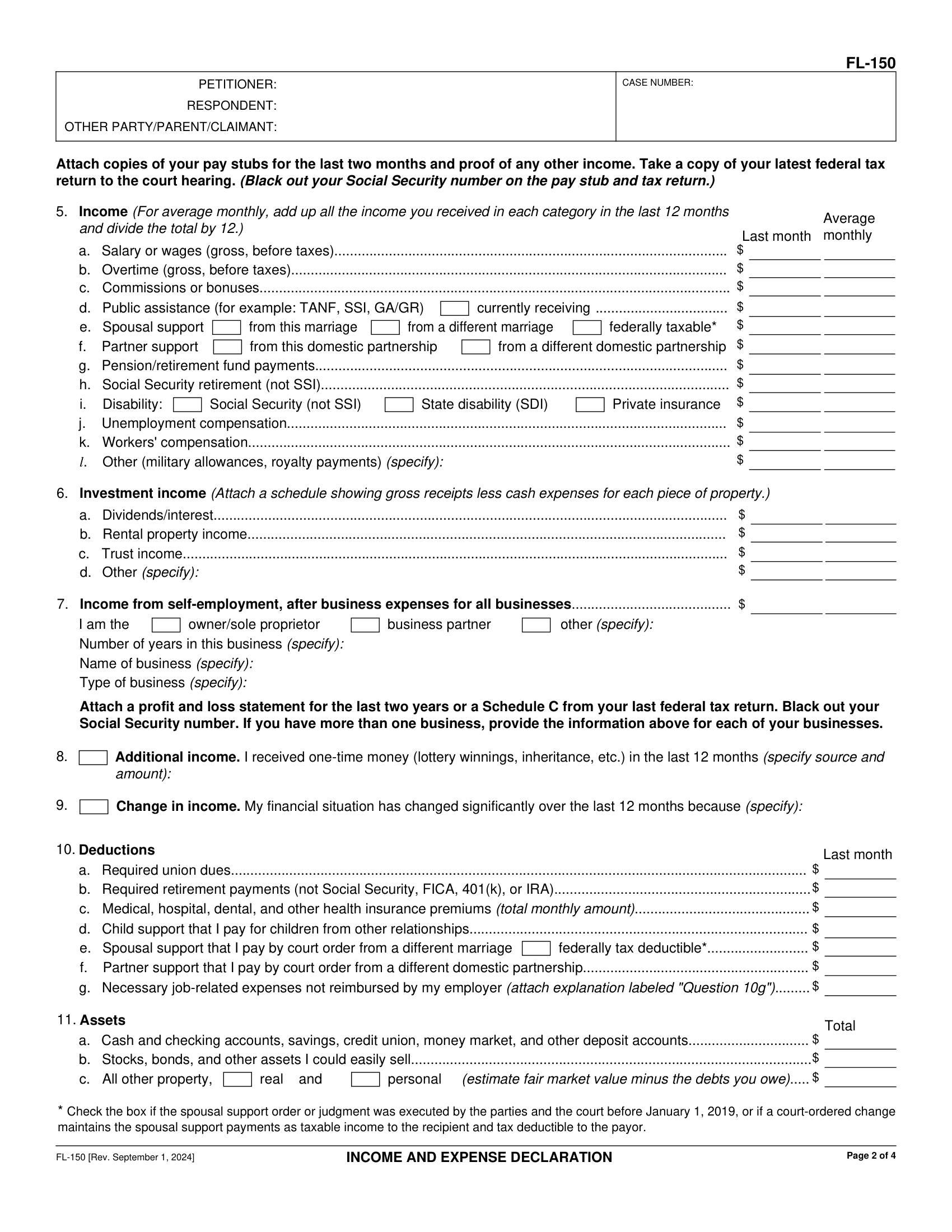
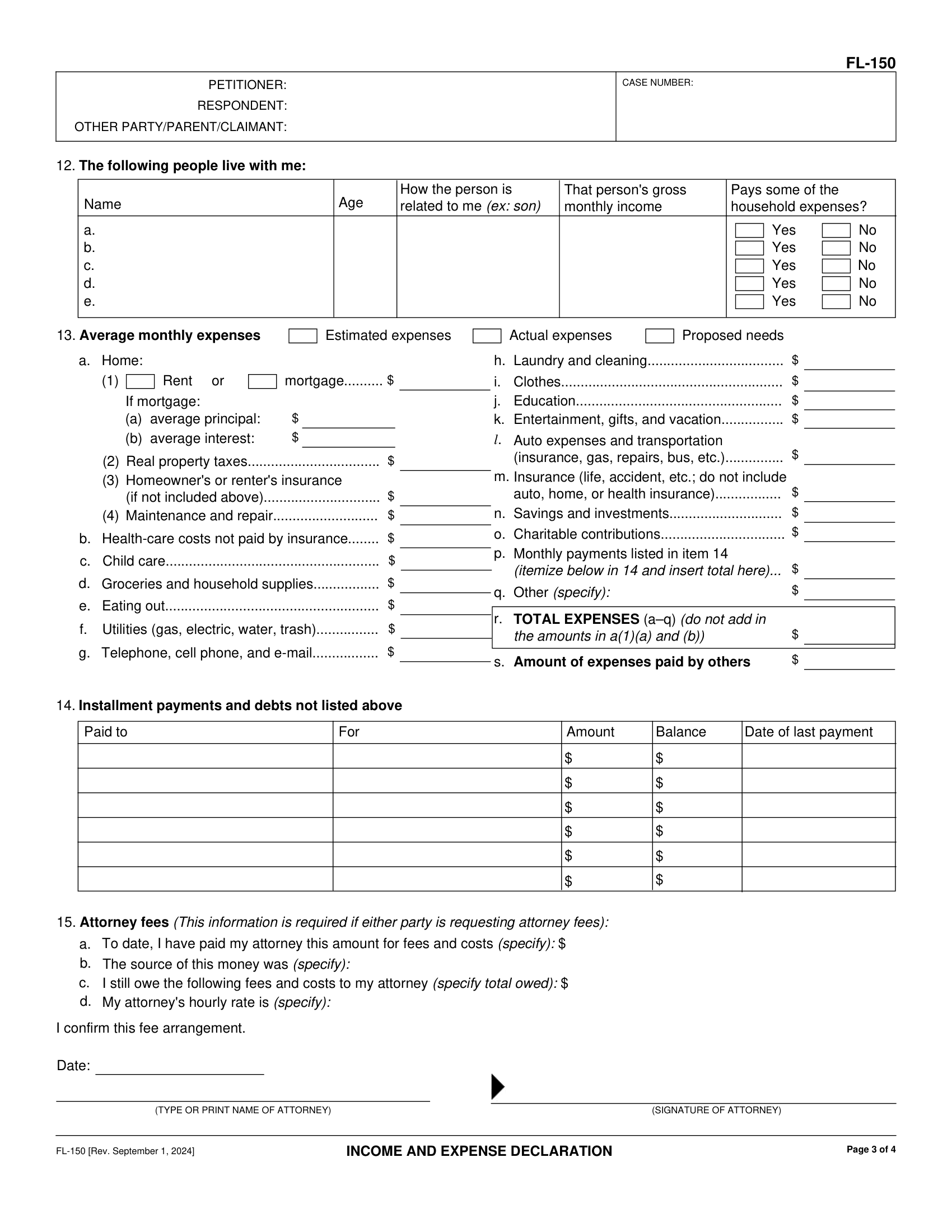
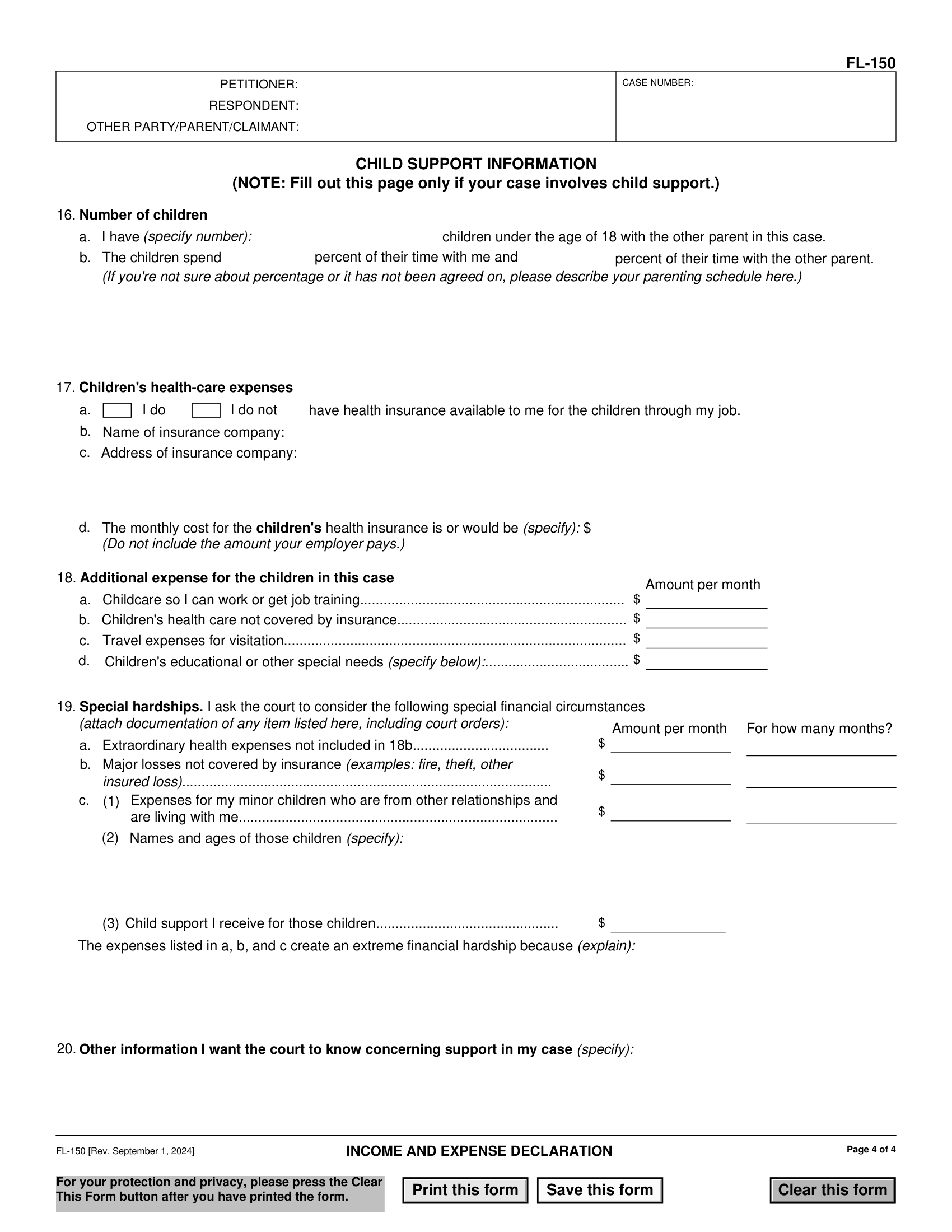
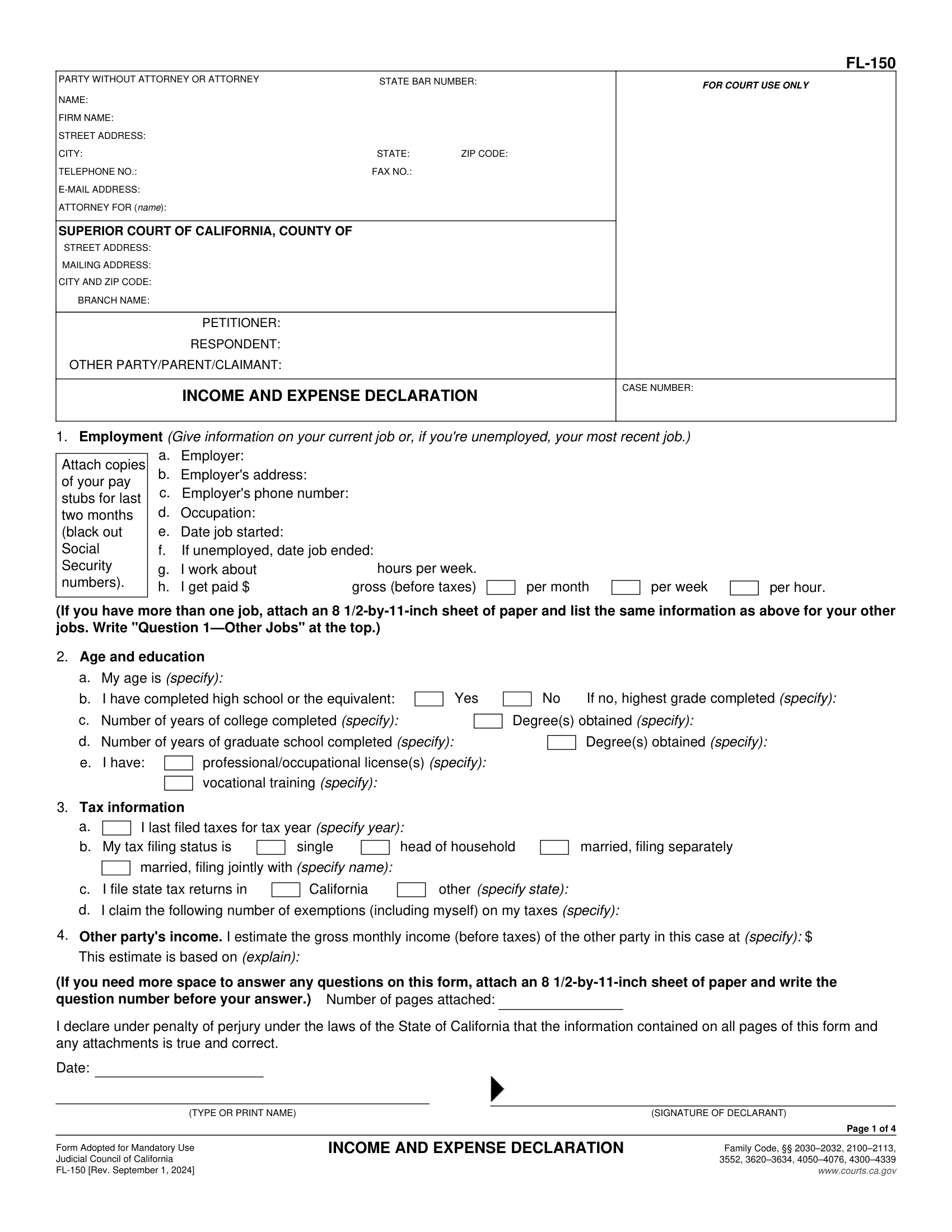
All 4 pages of FL-150 (Rev. September 1, 2024) as the court prints them. Open a page to read it full size; the walkthrough below shows the matching part of the form under each item.

What the FL-150 is, and who has to file one

Income and Expense Declaration (form FL-150) is the mandatory Judicial Council form that reports your finances to the court under penalty of perjury. California support is calculated from income figures, and this is the form those figures come from: FL-320-INFO says the court will order child support based on the income of the parents, and that you must give the court information about your finances.

It travels with a request, not on its own. FL-300-INFO’s forms checklist calls for a current FL-150 for child support (item 3c), for spousal or domestic partner support or orders about your finances (3d), and for attorney’s fees and costs (3e). FL-320-INFO’s checklist is the mirror image at items 4c, 4d and 4e. So the party asking for those orders files one, and so does the party responding — and FL-320-INFO adds that one FL-150 can respond to items 3, 4 and 6 of the FL-320.

The form is four pages and 20 items. Page 1 covers employment, age and education, tax information and your estimate of the other party’s income, and carries your signature. Page 2 is income: salary and wages through to investment and self-employment income, then deductions and assets. Page 3 is household members, average monthly expenses, debts, and attorney fees. Page 4 is the child support information page, which the form says to fill out only if your case involves child support.

Much of what makes an FL-150 complete is attached rather than written on it. The instruction beside item 1 and the header of page 2 call for copies of your pay stubs for the last two months and proof of any other income, with Social Security numbers blacked out. Item 6 calls for a property schedule, item 7 for a profit and loss statement or Schedule C, item 10g for a labeled explanation of job-related expenses, and item 19 for documentation of any special hardship, including court orders. The page 2 instruction also says to take a copy of your latest federal tax return to the court hearing.

This page is public legal information, not legal advice, and Onbello is not a law firm. The item numbers and labels below are those printed on the Judicial Council form (FL-150, Rev. September 1, 2024). Procedures differ by county. If you can afford an attorney, we encourage you to hire one.

FL-150 section by section

The form runs caption, items 1 through 4 and your signature on page 1, items 5 through 11 on page 2, items 12 through 15 on page 3, and items 16 through 20 on the child support information page. Dollar columns are labeled on the form itself — item 5 asks for both "Last month" and "Average monthly," item 10 and item 11 ask for one figure each, and item 13 has three columns: estimated expenses, actual expenses, and proposed needs.

When an item runs out of room

The note at the bottom of page 1 says that if you need more space to answer any question on the form, attach an 8½-by-11-inch sheet of paper and write the question number before your answer — then fill in "Number of pages attached." Item 1 gives the label for extra jobs: write "Question 1—Other Jobs" at the top. Item 10g uses the same pattern, labeled "Question 10g."

Caption (page 1, top)

Party or attorney, court, party names, case number
FL-150, page 1, caption, as printed on the form
FL-150, page 1, caption — tap to open the full page
What it asks
Your name, firm, street address, city, state, ZIP, telephone, fax and email in the top-left box, the party you represent, the Superior Court of California county and address, the PETITIONER, RESPONDENT and OTHER PARTY/PARENT/CLAIMANT names, and the case number.
What to put
Your own contact details if you are self-represented, and the party names and case number exactly as they appear on the other documents in the case. Note that FL-150’s third party line reads OTHER PARTY/PARENT/CLAIMANT, which is worded differently from the FL-300 and FL-320.
Common mistake
Filling the caption from memory rather than copying it. The FL-150 is matched to a case file and to a hearing by these fields.

Item 1

Employment

FL-150, page 1, item 1, as printed on the form
FL-150, page 1, item 1 — tap to open the full page
What it asks
Information on your current job or, if you are unemployed, your most recent one: (a) employer, (b) employer’s address, (c) employer’s phone number, (d) occupation, (e) date the job started, (f) if unemployed, the date it ended, (g) how many hours a week you work, and (h) what you are paid gross before taxes, with boxes for per month, per week, or per hour.
What to put
The gross figure — before taxes — and the pay period that matches your stubs. The instruction printed in the margin beside this item says to attach copies of your pay stubs for the last two months and to black out Social Security numbers. If you have more than one job, the item says to attach a sheet with the same information for the others, headed "Question 1—Other Jobs."
Common mistake
Writing a net or take-home figure at 1h. The item asks for gross, before taxes, and the deductions that get you to take-home pay have their own item at 10.

Item 2

Age and education

FL-150, page 1, item 2, as printed on the form
FL-150, page 1, item 2 — tap to open the full page
What it asks
(a) Your age; (b) whether you completed high school or the equivalent, and if not, the highest grade completed; (c) years of college completed and degrees obtained; (d) years of graduate school completed and degrees obtained; (e) any professional or occupational licenses, and any vocational training, each to be specified.
What to put
Your actual education and credentials. This section is short but it is not filler — earning capacity is part of how support questions get argued, and this is where the court reads your training and licenses.
Common mistake
Leaving 2e blank when you hold a license or completed vocational training. The item asks you to specify them, and an incomplete answer here is simply missing information.

Item 3

Tax information

FL-150, page 1, item 3, as printed on the form
FL-150, page 1, item 3 — tap to open the full page
What it asks
(a) The last tax year you filed for; (b) your tax filing status — single, head of household, married filing separately, or married filing jointly with a named person; (c) whether you file state tax returns in California or another state, to be specified; (d) the number of exemptions, including yourself, that you claim.
What to put
The year and status from your most recent return. Keep it consistent with the return itself, since the page 2 instruction says to take a copy of your latest federal tax return to the hearing.
Common mistake
Guessing the filing status or the number of exemptions. These feed the tax assumptions behind a support calculation, and the return you bring to the hearing will show the real answer.

Item 4

Other party’s income

FL-150, page 1, item 4, as printed on the form
FL-150, page 1, item 4 — tap to open the full page
What it asks
Your estimate of the other party’s gross monthly income before taxes, and an explanation of what the estimate is based on.
What to put
A figure and the basis for it — their pay stubs if you have seen them, a known hourly rate and schedule, their own filed FL-150, a business you know the size of. The item asks you to explain, so give the source rather than just the number.
Common mistake
Writing an amount with no explanation, or leaving the item blank. It is your one chance on this form to tell the court what you believe the other side earns and why.

Signature block (bottom of page 1)

I declare under penalty of perjury under the laws of the State of California…

FL-150, page 1, signature block, as printed on the form
FL-150, page 1, signature block — tap to open the full page
What it asks
The number of pages attached, then the date, your typed or printed name, and your signature, under a declaration that the information contained on all pages of the form and any attachments is true and correct.
What to put
Sign and date last, after pages 2 through 4 and every attachment are finished, and count the attached pages before you fill in that line. Note that this signature — the declarant’s — is on page 1, not at the end of the form.
Common mistake
Signing page 1 and then leaving later pages blank. The declaration covers all pages of the form and any attachments, so it is the whole document you are swearing to.

Item 5

Income

FL-150, page 2, item 5, as printed on the form
FL-150, page 2, item 5 — tap to open the full page
What it asks
Twelve categories, each with a "Last month" and an "Average monthly" column: (a) salary or wages gross before taxes, (b) overtime gross before taxes, (c) commissions or bonuses, (d) public assistance such as TANF, SSI or GA/GR with a box for currently receiving, (e) spousal support, from this marriage or a different one, with a box for federally taxable, (f) partner support, from this domestic partnership or a different one, (g) pension or retirement fund payments, (h) Social Security retirement, not SSI, (i) disability — Social Security not SSI, State disability (SDI), or private insurance, (j) unemployment compensation, (k) workers’ compensation, and (l) other, such as military allowances or royalty payments, to be specified.
What to put
Fill in every category that applies, in both columns. The instruction at the head of the item tells you how to get the average: add up all the income you received in each category in the last 12 months and divide the total by 12. The footnote on the form explains the "federally taxable" box at 5e — check it if the spousal support order or judgment was executed by the parties and the court before January 1, 2019, or if a court-ordered change maintains the payments as taxable to the recipient and deductible to the payor.
Common mistake
Putting last month’s figure in the average column as well. Overtime, commissions and bonuses are exactly where a single month misstates a year, which is why the item asks for both numbers.

Item 6

Investment income

FL-150, page 2, item 6, as printed on the form
FL-150, page 2, item 6 — tap to open the full page
What it asks
(a) Dividends and interest, (b) rental property income, (c) trust income, and (d) other, to be specified. The item heading instructs you to attach a schedule showing gross receipts less cash expenses for each piece of property.
What to put
The income figures, plus the per-property schedule the item asks for. Rental income in particular is reported here as a net-of-cash-expenses figure supported by that schedule, not as the rent you collect.
Common mistake
Reporting rental income without the attached schedule. The item asks for it by name, and without it there is nothing behind the number.

Item 7

Income from self-employment

FL-150, page 2, item 7, as printed on the form
FL-150, page 2, item 7 — tap to open the full page
What it asks
Your income from self-employment after business expenses for all businesses, whether you are the owner or sole proprietor, a business partner, or something else to be specified, the number of years in the business, and the business’s name and type. The item instructs you to attach a profit and loss statement for the last two years or a Schedule C from your last federal tax return, with your Social Security number blacked out, and to give the same information for each business if you have more than one.
What to put
The after-business-expenses figure, the business details, and the P&L or Schedule C. If you run more than one business, repeat the whole block for each.
Common mistake
Writing gross receipts instead of income after business expenses — or attaching nothing. The item asks for a net figure and names the document that has to support it.

Items 8 and 9

Additional income; Change in income

FL-150, page 2, items 8 and 9, as printed on the form
FL-150, page 2, items 8 and 9 — tap to open the full page
What it asks
Item 8 asks whether you received one-time money in the last 12 months — lottery winnings, an inheritance, and the like — with the source and amount to be specified. Item 9 asks whether your financial situation has changed significantly over the last 12 months, and why.
What to put
Disclose one-time money at 8 with its source and amount. Use item 9 for the thing a 12-month average hides: a layoff, a raise, a business that closed, hours cut, a new job that started last month.
Common mistake
Leaving item 9 blank after a real change. A support figure built on a 12-month average can be badly out of date, and item 9 is where the form invites you to say so.

Item 10

Deductions

FL-150, page 2, item 10, as printed on the form
FL-150, page 2, item 10 — tap to open the full page
What it asks
Last month’s amounts for: (a) required union dues, (b) required retirement payments that are not Social Security, FICA, 401(k) or IRA, (c) medical, hospital, dental and other health insurance premiums as a total monthly amount, (d) child support you pay for children from other relationships, (e) spousal support you pay by court order from a different marriage, with a federally tax deductible box, (f) partner support you pay by court order from a different domestic partnership, and (g) necessary job-related expenses not reimbursed by your employer, with an attached explanation labeled "Question 10g."
What to put
Only the listed categories. Note the exclusions written into the item: 10b excludes Social Security, FICA, 401(k) and IRA, and 10d and 10e are limited to other relationships and a different marriage — the support at issue in this case does not go here.
Common mistake
Marking 10g without the labeled attachment, or treating item 10 as a general list of bills. Ordinary living costs belong in item 13, not here.

Item 11

Assets

FL-150, page 2, item 11, as printed on the form
FL-150, page 2, item 11 — tap to open the full page
What it asks
Totals for (a) cash and checking accounts, savings, credit union, money market and other deposit accounts; (b) stocks, bonds and other assets you could easily sell; and (c) all other property, real and personal, with boxes for each — estimated at fair market value minus the debts you owe.
What to put
Current totals, and for 11c the fair market value minus the debts against it, as the item directs. The three lines are totals, not an inventory; a schedule can go on an attached sheet labeled with the question number.
Common mistake
Putting gross value in 11c and the mortgage in item 14 as well. The item already nets the debt out, so counting it twice misstates both lines.

Item 12

The following people live with me

FL-150, page 3, item 12, as printed on the form
FL-150, page 3, item 12 — tap to open the full page
What it asks
Up to five rows, each with the person’s name, age, how the person is related to you — the form’s example is "son" — that person’s gross monthly income, and a Yes or No for whether they pay some of the household expenses.
What to put
Everyone in the household, including a new partner or an adult child, with the income and expense-sharing answers the item asks for. Use an attached sheet labeled with the question number if there are more than five.
Common mistake
Leaving out an adult who contributes to the household. The item asks about contribution directly, and item 13s asks separately for the amount of expenses paid by others.

Item 13

Average monthly expenses

FL-150, page 3, item 13, as printed on the form
FL-150, page 3, item 13 — tap to open the full page
What it asks
Seventeen expense lines across three columns — estimated expenses, actual expenses, and proposed needs. The lines are: (a) home, split into rent or mortgage with average principal and average interest, real property taxes, homeowner’s or renter’s insurance if not included above, and maintenance and repair; (b) health-care costs not paid by insurance; (c) child care; (d) groceries and household supplies; (e) eating out; (f) utilities; (g) telephone, cell phone and email; (h) laundry and cleaning; (i) clothes; (j) education; (k) entertainment, gifts and vacation; (l) auto expenses and transportation; (m) insurance other than auto, home or health; (n) savings and investments; (o) charitable contributions; (p) the total of the monthly payments itemized in item 14; (q) other, to be specified; (r) TOTAL EXPENSES (a–q); and (s) amount of expenses paid by others.
What to put
Pick a column and be consistent — the three columns exist so you can report what you estimate, what you actually spend, or what you say you need. Item 13p must equal the total you itemize in item 14, and item 13r is the sum of a through q with one exclusion printed on the form: do not add in the amounts in a(1)(a) and (b), the mortgage principal and interest breakdown.
Common mistake
Adding the principal and interest sub-lines into the total at 13r. The form tells you not to, because they are already inside the mortgage figure at a(1).

Item 14

Installment payments and debts not listed above

FL-150, page 3, item 14, as printed on the form
FL-150, page 3, item 14 — tap to open the full page
What it asks
Six rows, each with who the debt is paid to, what it is for, the amount, the balance, and the date of the last payment.
What to put
Each debt not already captured in item 13, with all five columns filled in. Total them and carry the total up to item 13p, as that line directs.
Common mistake
Listing a debt in item 14 that is already in item 13 — a car payment counted again as an auto expense, say. The item’s own heading limits it to debts not listed above.

Item 15

Attorney fees

FL-150, page 3, item 15, as printed on the form
FL-150, page 3, item 15 — tap to open the full page
What it asks
Four lines, under a heading that states this information is required if either party is requesting attorney fees: (a) the amount you have paid your attorney to date for fees and costs, (b) the source of that money, (c) the total fees and costs you still owe your attorney, and (d) your attorney’s hourly rate. Below it, a line reading "I confirm this fee arrangement," with a date and the attorney’s printed name and signature.
What to put
The four figures whenever either party has asked for attorney’s fees — the heading makes it required in that situation, not optional. The confirmation line underneath is signed by the attorney, not by you.
Common mistake
Skipping item 15 because you are self-represented while the other party has asked the court to order fees. The item is keyed to either party requesting fees, and the FL-300 and FL-320 fee items both rest on a current FL-150.

Item 16

Number of children (child support information page)

FL-150, page 4, item 16, as printed on the form
FL-150, page 4, item 16 — tap to open the full page
What it asks
Page 4 is headed CHILD SUPPORT INFORMATION with a note that you fill out this page only if your case involves child support. Item 16 asks (a) how many children under 18 you have with the other parent in this case, and (b) what percent of their time the children spend with you and what percent with the other parent — adding that if you are not sure about the percentage, or it has not been agreed on, you should describe your parenting schedule there.
What to put
The number of children, and either the timeshare percentages or the schedule itself. Percentages drive guideline support, so if you do not know yours, use the space to set out the schedule rather than guessing a number.
Common mistake
Writing a round percentage nobody has agreed to. The item expressly gives you the alternative of describing the schedule, which is the more defensible answer when the figure is in dispute.

Item 17

Children’s health-care expenses

FL-150, page 4, item 17, as printed on the form
FL-150, page 4, item 17 — tap to open the full page
What it asks
(a) Whether you do or do not have health insurance available to you for the children through your job; (b) the name of the insurance company; (c) its address; and (d) the monthly cost for the children’s health insurance, or what it would be — with an instruction not to include the amount your employer pays.
What to put
The availability answer either way, the carrier details if there is one, and your own share of the monthly premium for the children. 17d asks for the cost even where the coverage is only available rather than in place.
Common mistake
Entering the full premium including the employer’s contribution. The item tells you to leave the employer’s share out.

Item 18

Additional expense for the children in this case

FL-150, page 4, item 18, as printed on the form
FL-150, page 4, item 18 — tap to open the full page
What it asks
Monthly amounts for (a) childcare so you can work or get job training, (b) children’s health care not covered by insurance, (c) travel expenses for visitation, and (d) children’s educational or other special needs, specified below the line.
What to put
Real monthly figures for the four listed categories, with the special needs described rather than just priced. These are add-ons to guideline support, which is why they get their own item.
Common mistake
Folding childcare and children’s uncovered medical costs into the household expenses at item 13 and leaving item 18 empty, where they are counted as children’s add-on expenses.

Item 19

Special hardships

FL-150, page 4, item 19, as printed on the form
FL-150, page 4, item 19 — tap to open the full page
What it asks
Financial circumstances you ask the court to consider, each with a monthly amount and a number of months: (a) extraordinary health expenses not already included in 18b, (b) major losses not covered by insurance, with fire and theft as the form’s examples, and (c) expenses for your minor children from other relationships who live with you — with their names and ages, and the child support you receive for them. Then a line to explain why the listed expenses create an extreme financial hardship. The item heading instructs you to attach documentation of any item listed here, including court orders.
What to put
Only circumstances that fit the listed categories, each with its amount, its duration, and the documentation the item asks for. Then use the explanation line to say why it amounts to an extreme financial hardship.
Common mistake
Claiming a hardship with no attached documentation. The item asks for it in its own heading, and court orders are named specifically.

Item 20

Other information I want the court to know concerning support

FL-150, page 4, item 20, as printed on the form
FL-150, page 4, item 20 — tap to open the full page
What it asks
A free-text item for anything about support in your case that the other 19 items did not capture.
What to put
The context a grid cannot hold: an income change that has not shown up in the averages yet, a seasonal business, an expense that is about to end, a figure on the form that needs explaining. Continue on an attached sheet labeled with the question number if you need more room.
Common mistake
Using item 20 to argue about custody or conduct. The item is limited by its own wording to information concerning support in your case.

Common pitfalls

Not filing one at all when support is at issue

FL-320-INFO states the consequence directly: the court will order child support based on the income of the parents, you must give the court information about your finances, and if you do not, the child support order will be based on information about your income that the court receives from other sources. The FL-300 and FL-320 items that reference the FL-150 are statements that you filed it.

Filing one that is not current

FL-300 items 3c, 4d and 6a, FL-320 items 3a, 4a and 6a, and both instruction sheets’ forms checklists all call for "a current" Income and Expense Declaration. A copy filed earlier in the case does not answer an item that asks for a current one.

Missing the attachments the form asks for by name

Pay stubs for the last two months and proof of any other income (the instruction beside item 1 and the header of page 2); a schedule of gross receipts less cash expenses for each property (item 6); a profit and loss statement for the last two years or a Schedule C (item 7); an explanation labeled "Question 10g"; documentation of any special hardship, including court orders (item 19). Each is written into the item itself.

Leaving Social Security numbers unredacted

The form says it twice: black out Social Security numbers on the pay stubs beside item 1, and black out your Social Security number on the pay stub and tax return in the page 2 instruction. Item 7 repeats it for the Schedule C.

Arithmetic the form tells you how to do

Item 5 says to average by adding up all the income you received in each category in the last 12 months and dividing by 12. Item 13r says TOTAL EXPENSES (a–q) and not to add in the amounts in a(1)(a) and (b). Item 13p has to match the total you itemize in item 14. A form that fails its own instructions invites questions about every other figure on it.

Skipping item 15 or page 4 when they apply

Item 15 states that the attorney fee information is required if either party is requesting attorney fees — not only if you are. Page 4 says to fill it out only if your case involves child support, which also means that when the case does involve child support, items 16 through 20 are part of the form.

What to file with FL-150

  • FL-300: Request for Order. The FL-150 is filed with it whenever you request child support, spousal or partner support, or attorney’s fees and costs — FL-300 items 3c, 4d and 6a each state that you did. Read the FL-300 walkthrough.
  • FL-320: Responsive Declaration to Request for Order. The FL-150 is filed with it when you respond on support or fees. FL-320 items 3a, 4a and 6a state that you filed a current one, and FL-320-INFO notes one FL-150 can respond to items 3, 4 and 6. Read the FL-320 walkthrough.
  • Pay stubs: Copies for the last two months, Social Security numbers blacked out. Required by the form itself — the instruction beside item 1 and the header of page 2, which also asks for proof of any other income.
  • Federal tax return: A copy of your latest return, Social Security number blacked out. The page 2 instruction says to take a copy of your latest federal tax return to the court hearing. It is not listed as an attachment to the form itself.
  • Profit and loss statement or Schedule C: Two years of profit and loss, or the Schedule C from your last return. Required by item 7 if you have self-employment income, for each business you have.
  • Property schedule: Gross receipts less cash expenses, per piece of property. Asked for in the heading of item 6, covering rental and other investment property.
  • FL-155: Financial Statement (Simplified). An alternative to FL-150 for child support if you meet the requirements listed on page 2 of FL-155, per both FL-300-INFO and FL-320-INFO. FL-320 item 3a offers it "if eligible."
  • FL-157, FL-158 and FL-319: Spousal or Partner Support Declaration Attachment; Supporting Declaration for Attorney’s Fees and Costs; Request for Attorney’s Fees and Costs Attachment. The attachments that sit alongside the FL-150 on support and fee requests — FL-157 where the request is to change a support judgment, and FL-158 and FL-319 for attorney’s fees and costs, except in Domestic Violence Prevention Act cases.

Some counties have local financial forms or local rules about what must be served with an FL-150, and FL-300-INFO says to complete the forms required by local court rules. Our courthouse lookup will tell you which Superior Court and branch handles your ZIP code so you can check that court’s requirements before you file.

Keep reading

Common questions

Who has to file an FL-150?

Anyone requesting or responding on support or attorney’s fees. FL-300-INFO’s forms checklist calls for a current FL-150 for child support, for spousal or domestic partner support or orders about your finances, and for attorney’s fees and costs; FL-320-INFO’s checklist says the same for the responding party. The forms themselves carry the statement: FL-300 items 3c, 4d and 6a and FL-320 items 3a, 4a and 6a each say you completed and filed a current one.

What do I have to attach to it?

The form names its own attachments. Copies of your pay stubs for the last two months and proof of any other income, with Social Security numbers blacked out (the instruction beside item 1 and the header of page 2). A schedule showing gross receipts less cash expenses for each piece of property (item 6). A profit and loss statement for the last two years or a Schedule C from your last federal tax return, for each business (item 7). An explanation labeled "Question 10g" for unreimbursed job-related expenses. Documentation of any special hardship listed at item 19, including court orders.

Do I have to hand over my tax return?

The page 2 instruction says to take a copy of your latest federal tax return to the court hearing, with your Social Security number blacked out. The return is not listed among the documents attached to the form itself, and item 3 asks only for your last filed tax year, filing status, state of filing, and number of exemptions.

Can I file the simplified FL-155 instead?

For child support, yes, if you qualify. Both FL-300-INFO and FL-320-INFO say you may use form FL-155, Financial Statement (Simplified), instead of form FL-150 if you meet the requirements listed on page 2 of FL-155, and FL-320 item 3a offers it "if eligible." Note that the spousal or partner support and attorney’s fees items on the FL-300 and FL-320 name only the FL-150.

Do I have to fill out all four pages?

Not always. Page 4 is headed CHILD SUPPORT INFORMATION and carries the note "Fill out this page only if your case involves child support," so items 16 through 20 apply when it does. Item 15, the attorney fee information, states that it is required if either party is requesting attorney fees. Pages 1 through 3 are the financial picture itself.

What if I am unemployed, or self-employed, or need more space?

Item 1 says to give information on your current job or, if you are unemployed, your most recent job, and 1f asks the date that job ended. Self-employment income goes at item 7, reported after business expenses, with the business details and a profit and loss statement or Schedule C attached. For more room anywhere on the form, the note at the bottom of page 1 says to attach an 8½-by-11-inch sheet of paper, write the question number before your answer, and fill in the number of pages attached.

Get the California custody checklist

Two pages: what to gather, which forms, deadlines, what to bring to the hearing. Free, no account.

Ready to prepare your FL-150?

Our guided tool walks through income, deductions and expenses in plain questions, does the averaging the form asks for, and fills out the Income and Expense Declaration alongside your other paperwork.

Join the waitlist — $129 at launch

A family law attorney will always have the biggest impact on your case. If you can afford one, we encourage you to hire one.

Onbello prepares court-ready California family law filings for parents without a lawyer.