CC 320 Domestic Relations Verified Financial Information Form (Michigan): how to fill it out, section by section

A walkthrough of the seven-page Michigan financial disclosure the parties exchange in a domestic relations case: personal and employment information, other income, assets, debts, the miscellaneous questions, and the signed declaration.

Researched by Dan Martin, Legal Researcher · Published by Onbello Legal

Quick answer

CC 320, the Domestic Relations Verified Financial Information Form, is the State Court Administrative Office form each party serves on the other in a Michigan domestic relations case under MCR 3.206(C)(2). Unless the parties waive it in writing, or a settlement agreement, consent judgment or other final order is signed by both parties when the case is filed, each party must serve it within 28 days after the date of service of the defendant’s initial responsive pleading. It is seven pages: personal, employment and income information in every case, and assets, debts and the closing miscellaneous questions in divorce, separate maintenance and annulment cases. It is signed under the penalties of perjury, served on the other party, and not filed with the court; a proof of service is filed instead.

Summary: what CC 320 does, and what you need first

  • CC 320 is the Verified Financial Information Form MCR 3.206(C)(2) requires each party to serve. It is separate from the Verified Statement the party seeking relief gives the friend of the court under MCR 3.206(C)(1).
  • The deadline is 28 days after the date of service of the defendant’s initial responsive pleading, per MCR 3.206(C)(2) and the instructions printed on page 1.
  • It is not required if the parties agreed in writing not to exchange it, or if a settlement agreement, consent judgment, or other final order resolving the case was signed by both parties when the case was filed.
  • Gather your four most recent paycheck stubs, or an employer statement of wages, deductions and year-to-date earnings, and your last federal and state income tax returns with all schedules. The note on page 2 says to attach them.
  • If you are self-employed, also gather your three most recent business tax returns and/or corporate returns, per the same note.
  • In a divorce, separate maintenance, or annulment case, gather the asset and debt details: real estate, account balances now and 90 days before, pensions, life insurance, vehicles, personal property, and debts. For debts, the form says to attach the last three statements for all accounts.
  • If you are a victim of domestic violence, sexual assault, or stalking by the other party, you may leave out information that could lead to where you live or work or where a child may be found, but the note on page 1 says you must explain the reasons in a verified statement filed with the court by the date the form is due; MCR 3.206(C)(4) allows the explanation in the form or in a separate verified statement.
  • Sign the declaration on page 7. Serve the form on the other party, do not file it with the court, and file a proof of service, per MCR 3.206(C)(2) and the instructions printed on page 1.
  • Keep it current. MCR 3.206(C)(5) says a party who learns the form is incomplete or incorrect in a material respect must supplement or correct it in a timely manner.

The full form

All 7 pages of CC 320 (Rev. 9/24) as the court prints them. Open a page to read it full size; the walkthrough below shows the matching part of the form under each item.

What CC 320 is, and how it differs from the Verified Statement

Domestic Relations Verified Financial Information Form (CC 320) is the State Court Administrative Office form for the financial disclosure in MCR 3.206(C)(2). That subrule says that unless waived in writing by the parties, or unless a settlement agreement or consent judgment of divorce or other final order disposing of the case has been signed by both parties at the time of filing, each party must serve a Verified Financial Information Form within 28 days following the date of service of the defendant’s initial responsive pleading. The form prints the same rule as its third instruction on page 1.

It is a different document from the Verified Statement. MCR 3.206(C)(1) requires the party seeking relief, in an action involving a minor or a support request, to give the friend of the court a Verified Statement with personal identifying, financial, and health care coverage information, and to serve a copy on the other party. CC 320 goes the other way: each party serves it on the other, and the form’s last instruction on page 1 says not to file it with the court. MCR 3.206(C)(2) says a proof of service must be filed when the forms are served.

The information is confidential. MCR 3.206(C)(3) says it is not to be released other than to the court, the parties, or the attorneys for the parties, except on court order, and that for good cause the addresses of a party and minors may be omitted from the copy served on the other party; a party who omits an address for good cause must either submit to electronic filing and service under MCR 1.109(G) or provide an alternative address for mail. MCR 3.206(C)(2) adds that a victim of domestic violence, sexual assault or stalking by another party may omit any information that might lead to where the victim lives or works or where a minor child may be found, and MCR 3.206(C)(4) requires the reasons for any omission to be explained in the form or in a separate statement verified under MCR 1.109(D)(3)(b), filed with the court by the form’s due date.

Not serving it has consequences. MCR 3.206(C)(2) says failing to provide the form may be addressed by the court or by motion consistent with MCR 2.313, which governs discovery sanctions, and the first instruction on page 1 says the same. The subrule also says the form does not preclude other discovery. MCR 3.206(C)(2) ties the deadline to the defendant’s initial responsive pleading in the case and does not separately address postjudgment motions.

This page is public legal information, not legal advice, and Onbello is not a law firm. The item numbers and labels below are those printed on the Michigan State Court Administrative Office (SCAO) form (CC 320, Rev. 9/24). Procedures differ by county. If you can afford an attorney, we encourage you to hire one.

CC 320 section by section

CC 320 is seven pages, each printed “Page N of ___.” Page 1 carries the caption, the instructions, Personal Information, and the start of Employment Information; page 2 finishes employment and covers Other Income; pages 3 to 6 are Asset Information and Debts, which the form says are for divorce, separate maintenance, and annulment cases only (DO and DM case types); page 7 covers court-ordered obligations, the closing Miscellaneous questions, and the declaration. Section headings and wording below are the ones printed on the form.

When an item runs out of room

Most sections print “Use additional sheets if necessary.” Label each additional sheet with the section heading it continues, and count it in the “Page N of ___” total. The documents the form asks you to attach, such as paycheck stubs, tax returns and account statements, are attached to the form you serve.

Caption

Circuit, case number and judge, plaintiff and defendant
CC 320, page 1, caption, as printed on the form
CC 320, page 1, caption — tap to open the full page
What it asks
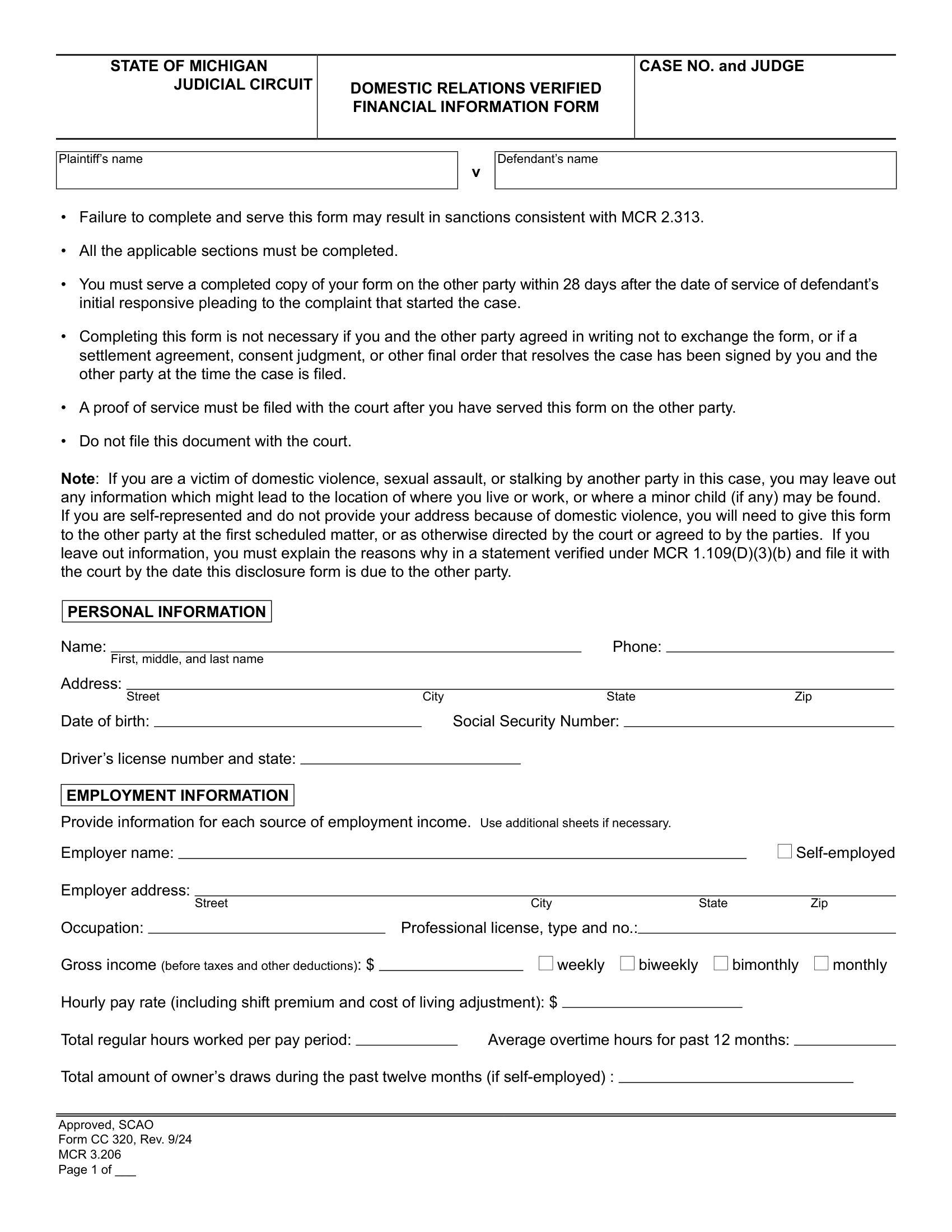
STATE OF MICHIGAN, the JUDICIAL CIRCUIT, the form title, CASE NO. and JUDGE, and the Plaintiff’s name v Defendant’s name. Each page also prints “Page N of ___” and pages 2 to 7 repeat the case number at the top.
What to put
The circuit, case number and judge exactly as on the complaint, and the parties as captioned. For example, Maria Lopez v Daniel Reyes. Fill in the case number at the top of every page and the total number of pages in each “Page N of ___” blank.
Common mistake
Leaving the case number off pages 2 to 7. Each of those pages prints its own Case No. line.

Instructions on page 1

The printed instructions and the domestic violence note

CC 320, page 1, printed instructions, as printed on the form
CC 320, page 1, printed instructions — tap to open the full page
What it asks
Six printed instructions: failure to complete and serve may result in sanctions under MCR 2.313; all applicable sections must be completed; serve within 28 days after service of the defendant’s initial responsive pleading; when the form is not necessary; a proof of service must be filed; and do not file the form with the court. Then a note for victims of domestic violence, sexual assault, or stalking.
What to put
Nothing to fill in, but read the note before you start. It says you may leave out information that might lead to where you live or work or where a child may be found; that if you are self-represented and do not give your address because of domestic violence, you give the form to the other party at the first scheduled matter or as the court directs or the parties agree; and that you must explain the reasons for any omission in a statement verified under MCR 1.109(D)(3)(b), filed with the court by the date the form is due. Those are the terms of MCR 3.206(C)(2) and (C)(4).
Common mistake
Leaving information out without filing the explanation. MCR 3.206(C)(4) requires the verified statement by the form’s due date.

Personal Information

PERSONAL INFORMATION

CC 320, page 1, Personal Information, as printed on the form
CC 320, page 1, Personal Information — tap to open the full page
What it asks
Name (first, middle, and last), phone, address, date of birth, Social Security Number, and driver’s license number and state.
What to put
Your own information. MCR 3.206(C)(3) says the form’s contents are confidential and not released other than to the court, the parties, or their attorneys except on court order, and that for good cause your address may be omitted from the copy served on the other party, if you then submit to electronic filing and service or give an alternative mailing address.
Common mistake
Leaving the Social Security Number blank without a reason. If you omit required information, MCR 3.206(C)(4) requires you to explain why in the form or in a verified statement filed with the court.

Employment Information

EMPLOYMENT INFORMATION and employment benefits

CC 320, page 1, Employment Information, as printed on the form
CC 320, page 1, Employment Information — tap to open the full page
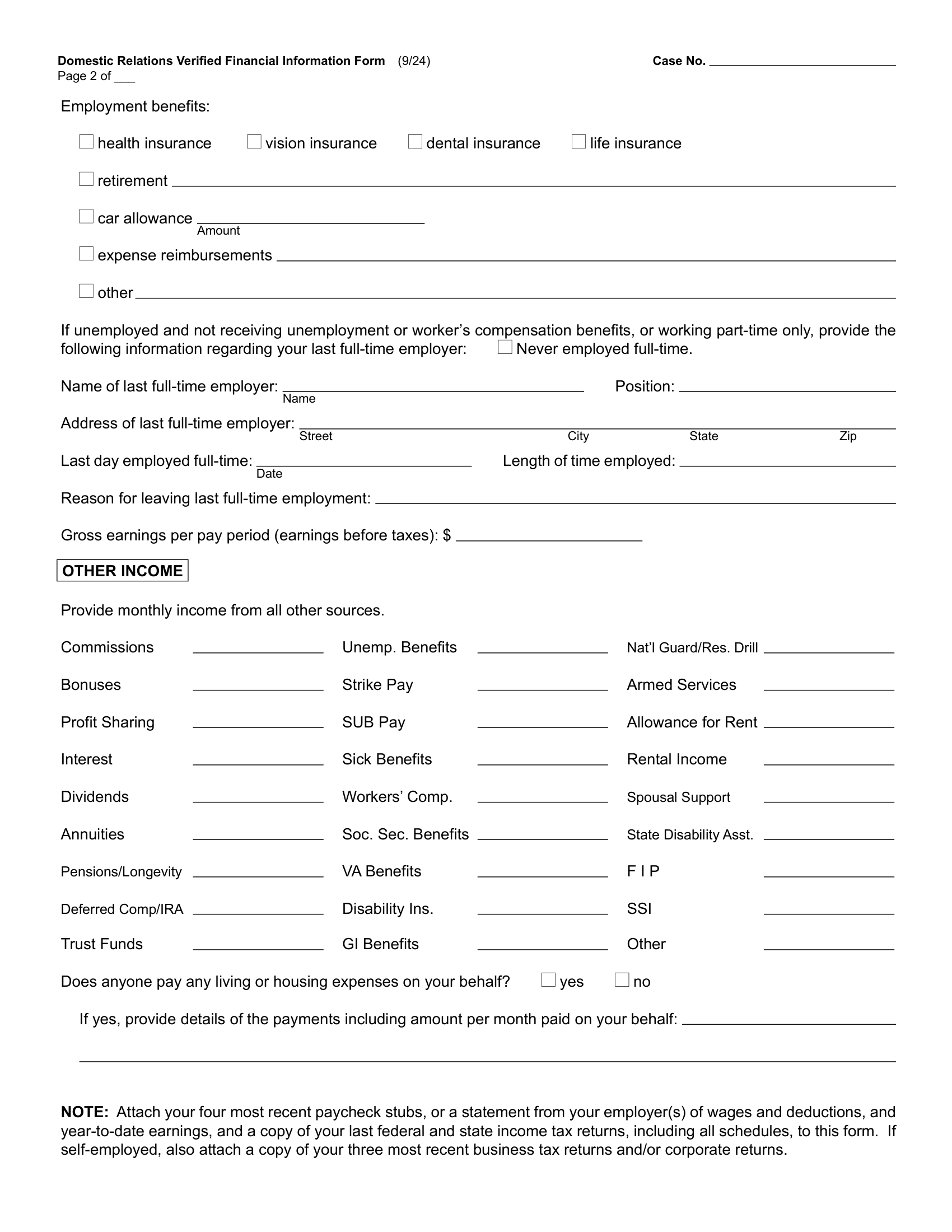
CC 320, page 2, Employment Information (continued), as printed on the form
CC 320, page 2, Employment Information (continued) — tap to open the full page
What it asks
For each source of employment income: employer name or self-employed, employer address, occupation, professional license type and number, gross income before taxes and deductions with its pay period (weekly, biweekly, bimonthly, or monthly), hourly pay rate including shift premium and cost of living adjustment, regular hours per pay period, average overtime hours for the past 12 months, and owner’s draws in the past twelve months if self-employed. Page 2 continues with employment benefits: health, vision, dental and life insurance, retirement, car allowance, expense reimbursements, and other, with amounts.
What to put
One set of answers per job, on additional sheets if you have more than one, as the form says. Use gross figures, before taxes and other deductions, and check the pay period that matches the figure. List each benefit with its amount.
Common mistake
Writing take-home pay. The form asks for gross income before taxes and other deductions.

Last full-time employer

If unemployed and not receiving unemployment or worker’s compensation benefits, or working part-time only

CC 320, page 2, last full-time employer, as printed on the form
CC 320, page 2, last full-time employer — tap to open the full page
What it asks
Information about your last full-time employer, or a box for Never employed full-time: the employer’s name and address, your position, the last day employed full-time, the length of time employed, the reason for leaving, and gross earnings per pay period.
What to put
Complete it only if the heading applies to you: unemployed without unemployment or worker’s compensation benefits, or working part-time only. Otherwise leave it blank.
Common mistake
Skipping it when you work part-time. The heading covers working part-time only, not just unemployment.

Other Income

OTHER INCOME

CC 320, page 2, Other Income, as printed on the form
CC 320, page 2, Other Income — tap to open the full page
What it asks
Monthly income from all other sources, on a printed list that includes commissions, bonuses, profit sharing, interest, dividends, annuities, pensions, deferred compensation or IRA, trust funds, unemployment, strike pay, SUB pay, sick benefits, workers’ compensation, Social Security, VA, disability insurance, GI benefits, National Guard or Reserve drill, armed services, allowance for rent, rental income, spousal support, state disability assistance, FIP, SSI, and other. Then whether anyone pays any living or housing expenses on your behalf, and if yes, the details and monthly amount.
What to put
A monthly figure for each source that applies. For the living expenses question, include anyone who pays rent, a mortgage, utilities, or similar costs for you, with the amount per month.
Common mistake
Answering “no” to the living expenses question when a partner or relative pays part of your housing. The question asks about any living or housing expenses paid on your behalf.

The attachments note

NOTE: Attach your four most recent paycheck stubs

CC 320, page 2, the attachments note, as printed on the form
CC 320, page 2, the attachments note — tap to open the full page
What it asks
The printed note: attach your four most recent paycheck stubs, or a statement from your employer of wages and deductions and year-to-date earnings, and a copy of your last federal and state income tax returns, including all schedules; if self-employed, also attach your three most recent business tax returns and/or corporate returns.
What to put
Attach every document the note lists to the form you serve. MCR 3.206(C)(3) says the information in the form is confidential and is not to be released other than to the court, the parties, or their attorneys, except on court order.
Common mistake
Attaching the federal return without the state return, or without its schedules. The note asks for both, including all schedules.

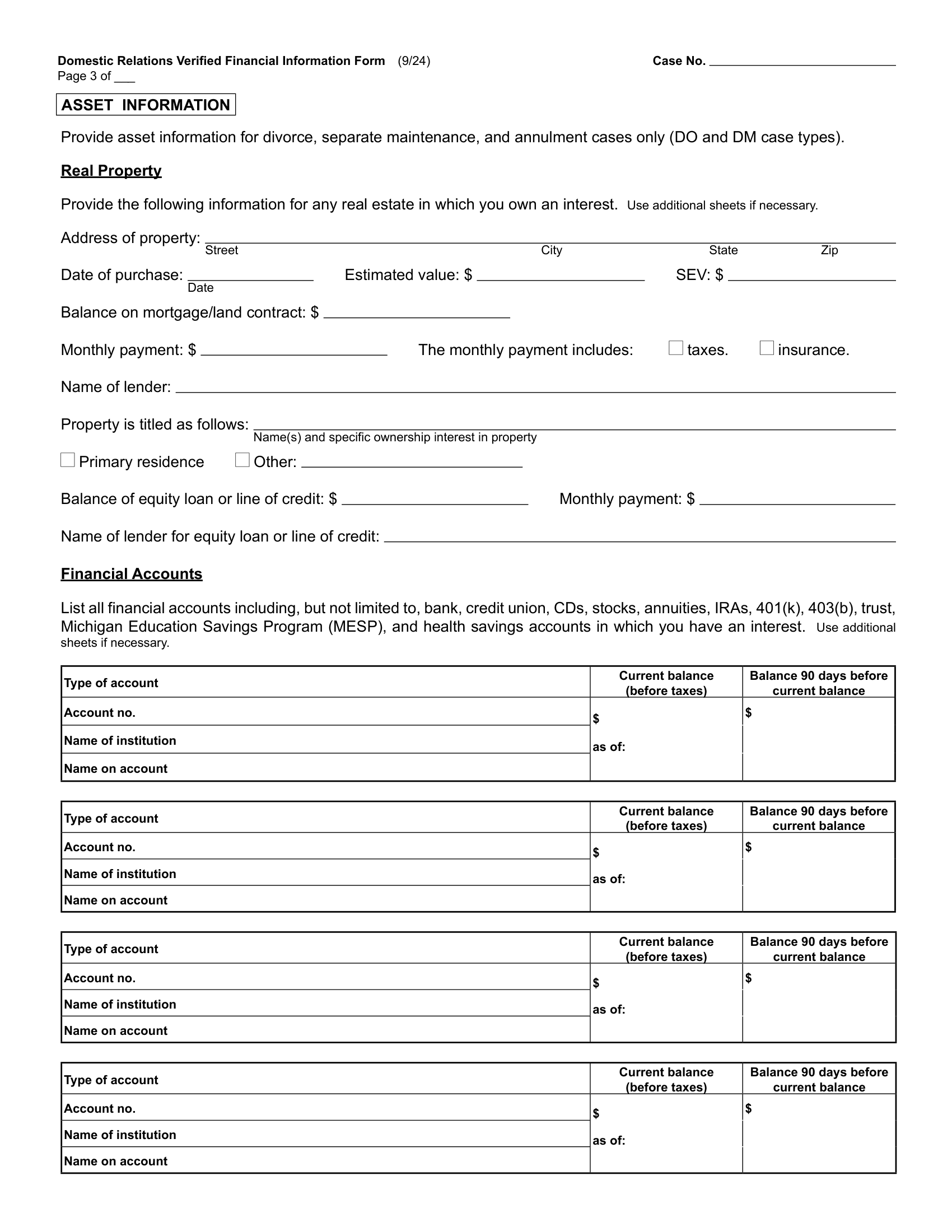
Real Property

ASSET INFORMATION: Real Property

CC 320, page 3, Real Property, as printed on the form
CC 320, page 3, Real Property — tap to open the full page
What it asks
For any real estate in which you own an interest: the address, date of purchase, estimated value, SEV, balance on the mortgage or land contract, monthly payment and whether it includes taxes and insurance, the lender, how the property is titled, whether it is the primary residence or other, and any equity loan or line of credit with its balance, payment and lender.
What to put
Complete it only in a divorce, separate maintenance, or annulment case; the section heading says asset information is for those cases only (DO and DM case types). One set of answers per property, on additional sheets as needed.
Common mistake
Filling in asset pages in a paternity or support case. The form limits Asset Information to divorce, separate maintenance, and annulment cases.

Financial Accounts

Financial Accounts

CC 320, page 3, Financial Accounts, as printed on the form
CC 320, page 3, Financial Accounts — tap to open the full page
What it asks
All financial accounts in which you have an interest, including bank, credit union, CDs, stocks, annuities, IRAs, 401(k), 403(b), trust, Michigan Education Savings Program (MESP), and health savings accounts: the type, account number, institution, name on the account, the current balance before taxes, and the balance 90 days before the current balance, with the date.
What to put
Every account, with both balances. The form asks for the balance 90 days before the current balance, so you will need an older statement as well as the current one.
Common mistake
Listing only accounts in your own name. The section asks for accounts in which you have an interest.

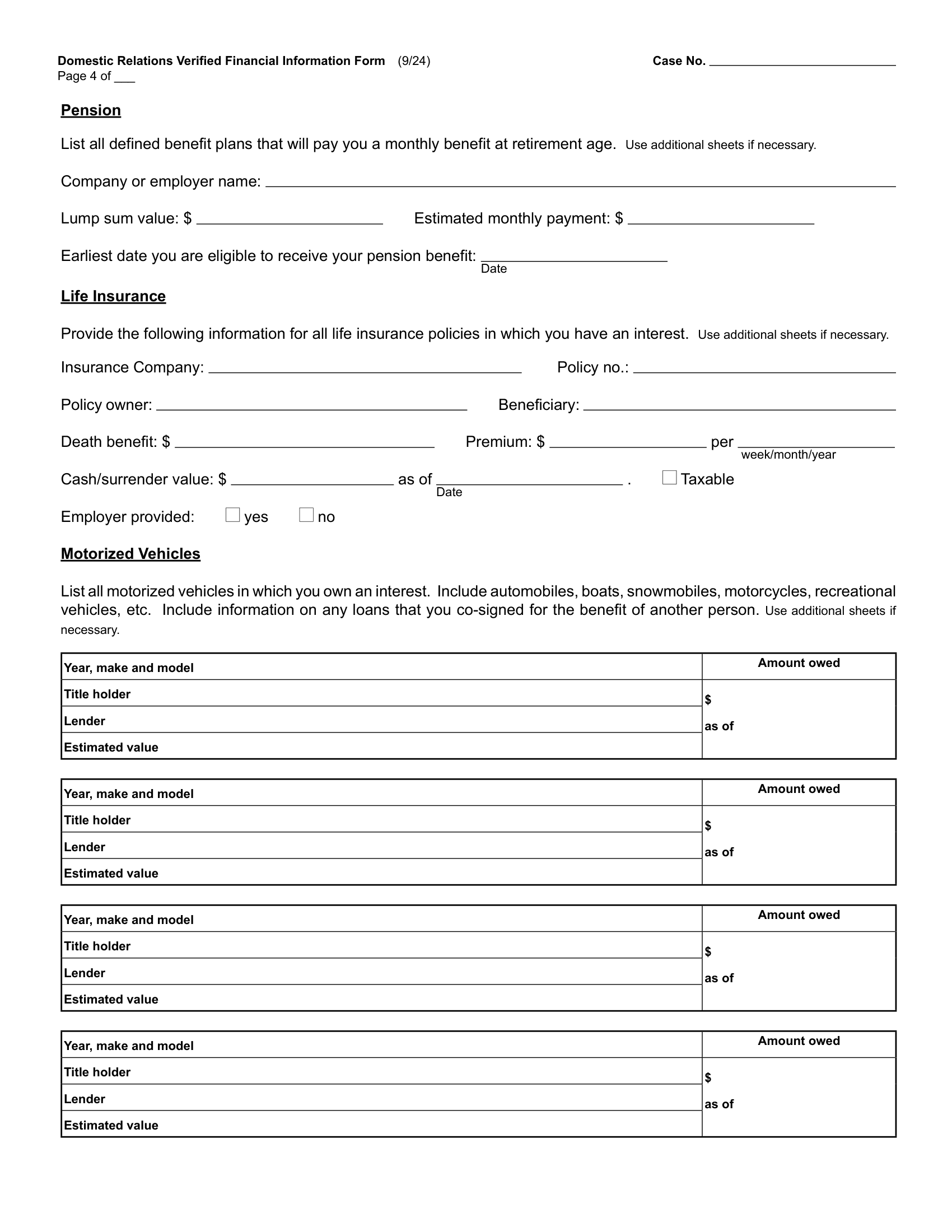
Pension

Pension

CC 320, page 4, Pension, as printed on the form
CC 320, page 4, Pension — tap to open the full page
What it asks
All defined benefit plans that will pay you a monthly benefit at retirement age: the company or employer, the lump sum value, the estimated monthly payment, and the earliest date you are eligible to receive the benefit.
What to put
Defined benefit plans only. A 401(k), 403(b) or IRA is an account, listed under Financial Accounts.
Common mistake
Listing a 401(k) here and nowhere else. The Financial Accounts section names 401(k) and 403(b) accounts.

Life Insurance

Life Insurance

CC 320, page 4, Life Insurance, as printed on the form
CC 320, page 4, Life Insurance — tap to open the full page
What it asks
For each life insurance policy in which you have an interest: the insurance company, policy number, policy owner, beneficiary, death benefit, premium and how often, cash or surrender value as of a date, whether it is taxable, and whether it is employer provided.
What to put
Every policy, including one provided through work, with the cash or surrender value as of a stated date.
Common mistake
Leaving out an employer-provided policy. The section asks whether a policy is employer provided, so it expects those too.

Motorized Vehicles

Motorized Vehicles

CC 320, page 4, Motorized Vehicles, as printed on the form
CC 320, page 4, Motorized Vehicles — tap to open the full page
What it asks
All motorized vehicles in which you own an interest, including automobiles, boats, snowmobiles, motorcycles and recreational vehicles: year, make and model, title holder, lender, amount owed as of a date, and estimated value. The form says to include loans you co-signed for another person.
What to put
One row per vehicle, including any you co-signed for someone else.
Common mistake
Leaving out a vehicle you co-signed for a child or relative. The section asks for those loans.

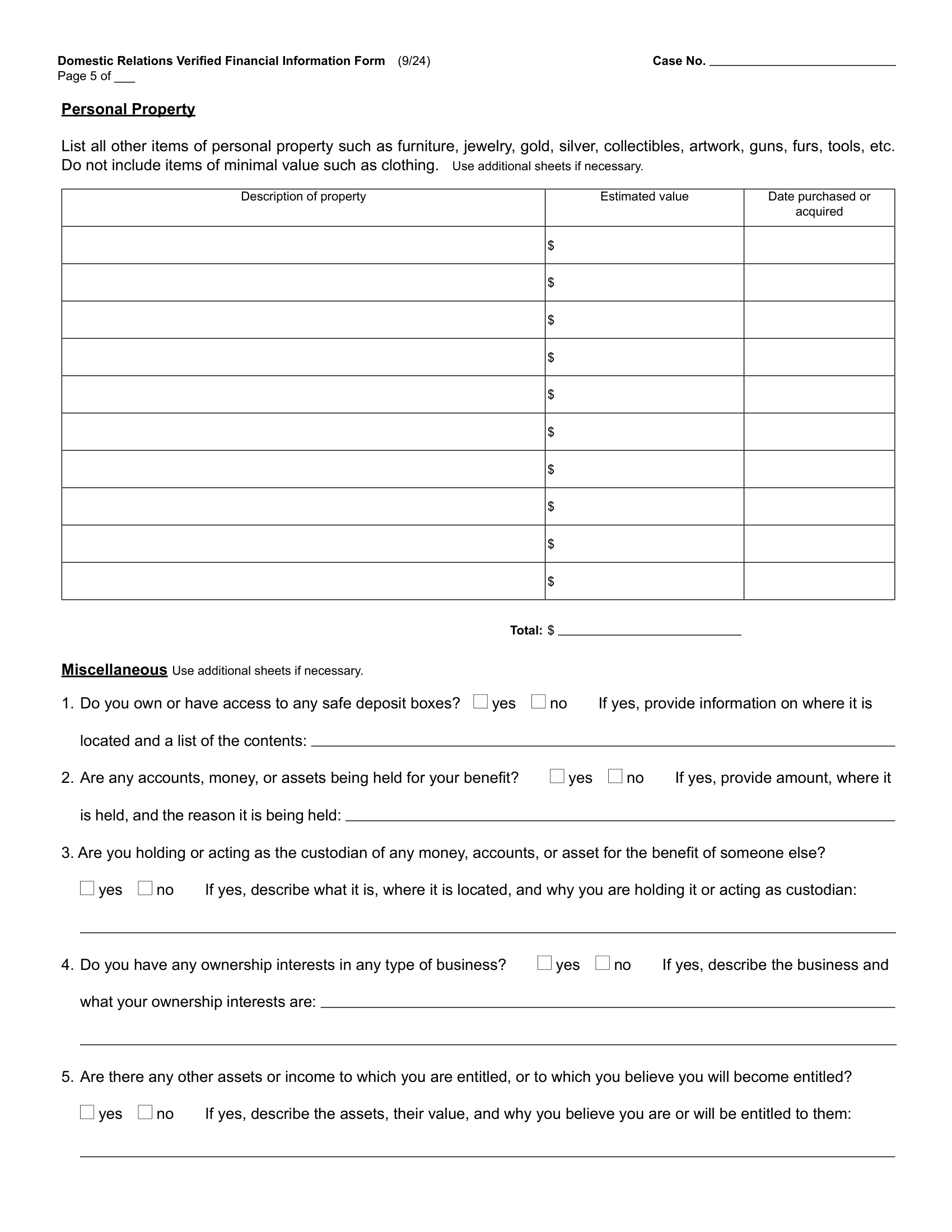
Personal Property

Personal Property

CC 320, page 5, Personal Property, as printed on the form
CC 320, page 5, Personal Property — tap to open the full page
What it asks
All other personal property, such as furniture, jewelry, gold, silver, collectibles, artwork, guns, furs, and tools: a description, the estimated value, and the date purchased or acquired, with a total. The form says not to include items of minimal value such as clothing.
What to put
Items of real value, with a total at the bottom.
Common mistake
Listing everything in the house. The form says to leave out items of minimal value.

Miscellaneous questions 1 to 8

Miscellaneous

CC 320, page 5, Miscellaneous questions 1 to 8, as printed on the form
CC 320, page 5, Miscellaneous questions 1 to 8 — tap to open the full page
CC 320, page 6, Miscellaneous questions 1 to 8 (continued), as printed on the form
CC 320, page 6, Miscellaneous questions 1 to 8 (continued) — tap to open the full page
What it asks
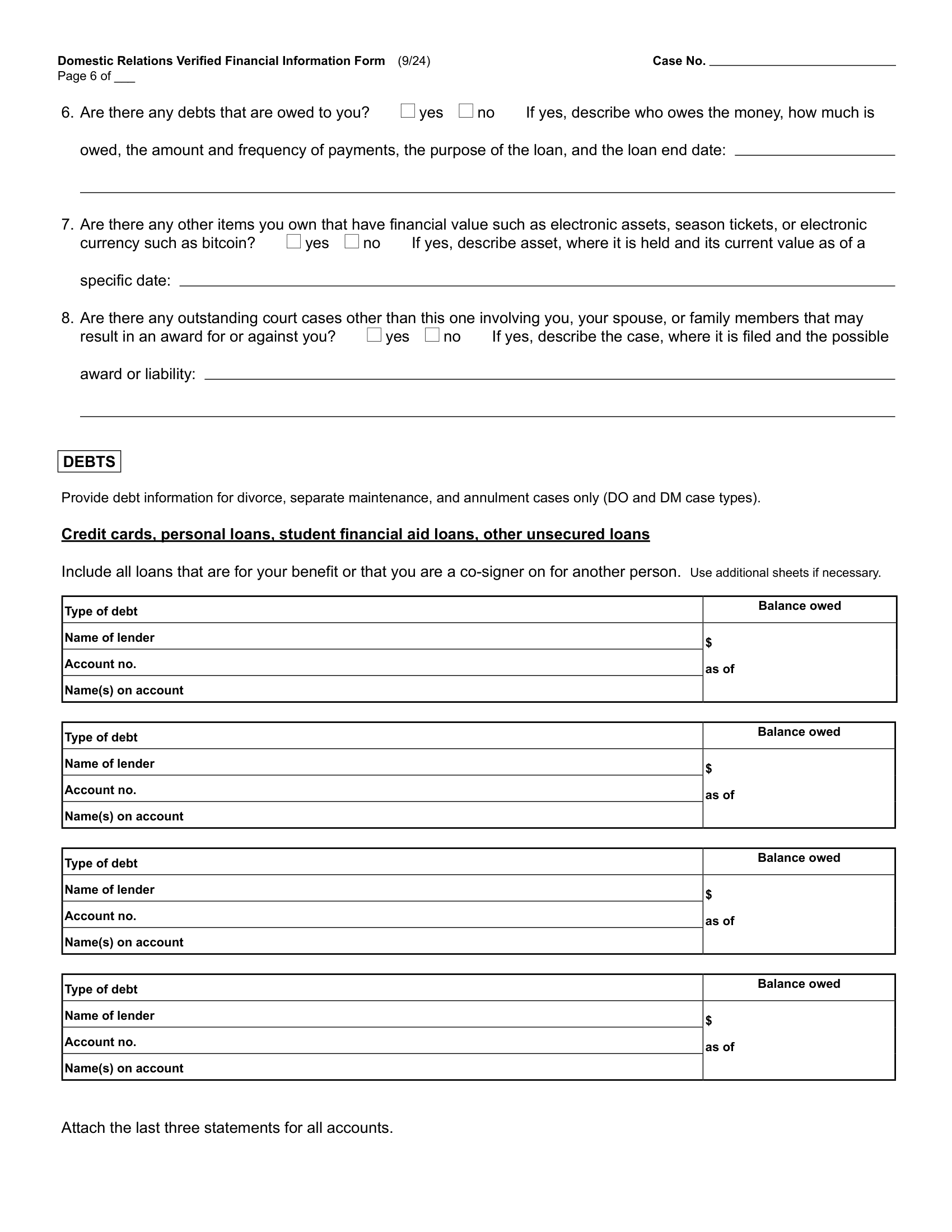
Eight yes or no questions, each with a line to explain a yes: 1, safe deposit boxes and their contents; 2, accounts, money, or assets held for your benefit; 3, money or assets you hold as custodian for someone else; 4, ownership interests in any business; 5, other assets or income you are or believe you will become entitled to; 6, debts owed to you; 7, other items with financial value, such as electronic assets, season tickets, or electronic currency such as bitcoin; 8, outstanding court cases involving you, your spouse, or family members that may result in an award for or against you.
What to put
Answer every question yes or no, and explain each yes on the line or an additional sheet. Questions 1 to 5 are on page 5 and 6 to 8 on page 6.
Common mistake
Leaving a question unanswered. The second instruction on page 1 says all applicable sections must be completed.

Debts

DEBTS: Credit cards, personal loans, student financial aid loans, other unsecured loans

CC 320, page 6, Debts, as printed on the form
CC 320, page 6, Debts — tap to open the full page
What it asks
Each unsecured debt for your benefit or that you co-signed for another person: the type of debt, the lender, the account number, the name or names on the account, and the balance owed as of a date. The form says to attach the last three statements for all accounts.
What to put
Complete it only in a divorce, separate maintenance, or annulment case; the section heading says so. Attach the last three statements for every account listed.
Common mistake
Leaving out a co-signed loan. The section asks for loans you co-signed for another person.

Court ordered financial obligations

Court ordered financial obligations

CC 320, page 7, Court ordered financial obligations, as printed on the form
CC 320, page 7, Court ordered financial obligations — tap to open the full page
What it asks
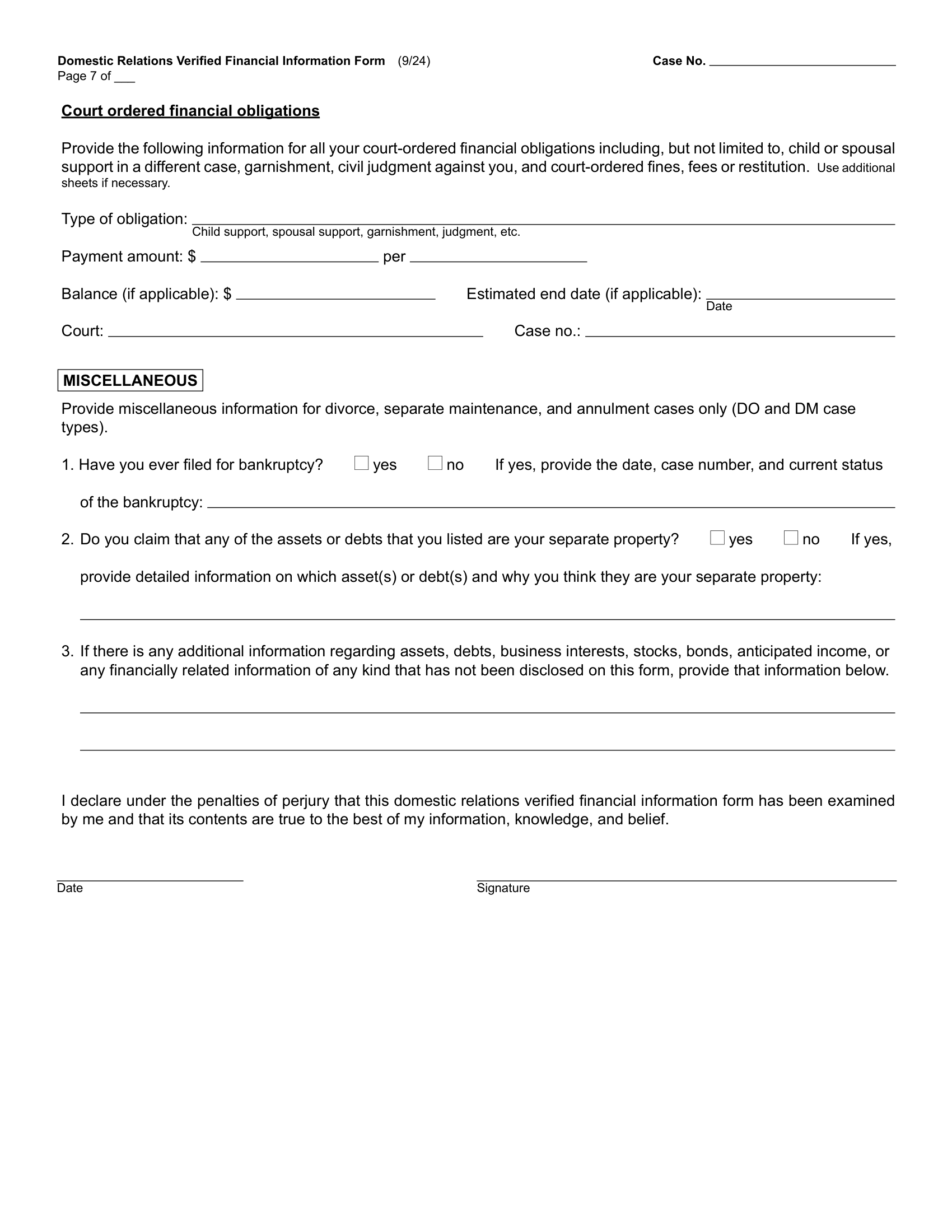
All your court-ordered financial obligations, including child or spousal support in a different case, garnishment, a civil judgment against you, and court-ordered fines, fees, or restitution: the type, payment amount and how often, balance and estimated end date if applicable, the court, and the case number.
What to put
Every court-ordered financial obligation you have. The list is “including, but not limited to,” and only the support example is limited to a different case. The section is printed after the Debts section, whose heading limits debt information to divorce, separate maintenance, and annulment cases; the form does not say whether this section is limited the same way.
Common mistake
Leaving out support for a child from another relationship. The section names child support in a different case.

Miscellaneous questions 1 to 3

MISCELLANEOUS

CC 320, page 7, Miscellaneous questions 1 to 3, as printed on the form
CC 320, page 7, Miscellaneous questions 1 to 3 — tap to open the full page
What it asks
For divorce, separate maintenance, and annulment cases only: 1, whether you have ever filed for bankruptcy, with the date, case number, and status; 2, whether you claim any of the assets or debts you listed are your separate property, and why; 3, any additional information about assets, debts, business interests, stocks, bonds, anticipated income, or any financially related information not disclosed elsewhere on the form.
What to put
For question 2, the form asks for detailed information on which assets or debts you claim as separate property and why you think they are. Name each one and give the facts.
Common mistake
Leaving question 3 blank when you know of something the form did not ask about. It is the catch-all, and the declaration below it covers the whole form.

Declaration and signature

I declare under the penalties of perjury

CC 320, page 7, declaration and signature, as printed on the form
CC 320, page 7, declaration and signature — tap to open the full page
What it asks
The printed declaration that the form has been examined by you and that its contents are true to the best of your information, knowledge, and belief, then the date and your signature.
What to put
Date and sign it. The declaration is the verification MCR 1.109(D)(3)(b) allows in place of an oath, and that rule says a person who knowingly makes a false declaration may be found in contempt of court, in addition to other sanctions. Then serve the form, and file a proof of service, not the form.
Common mistake
Filing the form with the clerk. The last instruction on page 1 says not to file it with the court.

Common pitfalls

Missing the 28-day deadline

MCR 3.206(C)(2) says each party must serve the form within 28 days following the date of service of the defendant’s initial responsive pleading, and that failing to provide it may be addressed by the court or by motion consistent with MCR 2.313. The clock is set by service of the defendant’s initial responsive pleading, not by when the case was filed.

Filing it instead of serving it

The instructions on page 1 say not to file the form with the court and that a proof of service must be filed after you serve it. MCR 3.206(C)(2) says a proof of service must be filed when Verified Financial Information forms are served.

Confusing it with the Verified Statement

MCR 3.206(C)(1) is a different requirement: the party seeking relief in a case involving a minor or a support request gives the friend of the court a Verified Statement with identifying, financial, and health care coverage information and serves a copy on the other party. Serving CC 320 does not satisfy it.

Omitting information without the explanation

MCR 3.206(C)(4) says that if any required information is omitted, the party seeking relief must explain the reasons in the form or in a separate statement verified under MCR 1.109(D)(3)(b), filed with the court by the due date of the form. The note on page 1 of CC 320 tells anyone who leaves information out for safety to file a verified statement explaining why.

Never updating it

MCR 3.206(C)(5) says a party who has served the form must supplement or correct it as ordered by the court or otherwise in a timely manner if the party learns that in some material respect it is incomplete or incorrect, unless the additional or corrective information has otherwise been made known to the other parties during the action or in writing. A new job or a sold asset is the usual reason.

Treating it as the only discovery

MCR 3.206(C)(2) says the Verified Financial Information form does not preclude other discovery, so serving it does not end the other party’s ability to ask for more.

What to file with CC 320

  • FOC 23: Verified Statement. A separate requirement under MCR 3.206(C)(1) for the party seeking relief in a case involving a minor, or if support is requested: given to the friend of the court and served on the other party.
  • Proof of service: Proof that you served CC 320. Filed with the court after you serve the form, per MCR 3.206(C)(2) and the instructions on page 1.
  • Verified statement of omissions: Explanation of information left out. Required under MCR 3.206(C)(4) if you omit information, verified under MCR 1.109(D)(3)(b) and filed with the court by the form’s due date.

CC 320 has no instructions packet; its instructions are the six printed on page 1 and the domestic violence note under them. MCR 3.206(C)(6) says a party is not required to serve it when the action is to establish paternity or child support and the pleadings are generated from Michigan’s automated child support enforcement system, though the party may.

Keep reading

Common questions

When is the CC 320 due in Michigan?

MCR 3.206(C)(2) says each party must serve the Verified Financial Information Form within 28 days following the date of service of the defendant’s initial responsive pleading, unless the parties waived it in writing or a settlement agreement, consent judgment, or other final order disposing of the case was signed by both parties at the time of filing.

Do I file the CC 320 with the court?

No. The instructions printed on page 1 say not to file it with the court and that a proof of service must be filed after you serve it on the other party. MCR 3.206(C)(2) says a proof of service must be filed when the forms are served.

What do I attach to the CC 320?

The note on page 2 says to attach your four most recent paycheck stubs, or an employer statement of wages and deductions and year-to-date earnings, and your last federal and state income tax returns, including all schedules; if self-employed, also your three most recent business tax returns and/or corporate returns. In a divorce, separate maintenance, or annulment case, the Debts section says to attach the last three statements for all accounts.

Can I leave my address off the CC 320?

MCR 3.206(C)(3) says that for good cause the addresses of a party and minors may be omitted from the copy served on the other party, if the party then submits to electronic filing and service or provides an alternative mailing address. MCR 3.206(C)(2) lets a victim of domestic violence, sexual assault, or stalking by another party omit any information that might lead to where the victim lives or works or where a child may be found. MCR 3.206(C)(4) requires the reasons to be explained in the form or in a separate verified statement filed with the court by the form’s due date, and the note on page 1 of the form asks for the verified statement.

What happens if I do not serve the CC 320?

MCR 3.206(C)(2) says failing to provide the form may be addressed by the court or by motion consistent with MCR 2.313, the discovery sanctions rule, and the first instruction on page 1 says failure to complete and serve it may result in sanctions consistent with MCR 2.313.

Who sees the information on the CC 320?

MCR 3.206(C)(3) says the information is confidential and is not to be released other than to the court, the parties, or the attorneys for the parties, except on court order.

Ready to prepare your Verified Financial Information Form?

Our guided tool helps you prepare an affidavit in your own words and fills out your court paperwork.

Join the waitlist — $129 at launch

A family law attorney will always have the biggest impact on your case. If you can afford one, we encourage you to hire one.

Onbello prepares court-ready California family law filings for parents without a lawyer.