MC 416 Uniform Child Custody Jurisdiction Enforcement Act Affidavit (Michigan): how to fill it out, item by item

A walkthrough of the two-page Michigan UCCJEA affidavit filed with a custody or parenting time case or motion: the five-year residence history, other proceedings, other claimants, the home state, the confidentiality statement, and the notary block.

Researched by Dan Martin, Legal Researcher · Published by Onbello Legal

Quick answer

MC 416, the Uniform Child Custody Jurisdiction Enforcement Act Affidavit, is the State Court Administrative Office form that gives a Michigan court the information MCL 722.1209(1) requires in every child-custody proceeding: the child’s present address, the places the child has lived during the last 5 years, the people the child lived with, any other custody proceeding you took part in, any pending proceeding that could affect this one, and anyone else who claims custody or parenting time. MCR 3.206(B) says the filing party must file it when custody or parenting time is to be determined or modified, so it is attached to FOC 87 and FOC 65 motions. It is two pages, with eight numbered items, and it is signed under oath before a notary public or deputy clerk.

Summary: what MC 416 does, and what you need first

  • MC 416 is filed whenever custody or parenting time of a minor is to be determined or modified. MCR 3.206(B) requires it on a form approved by the State Court Administrative Office, as required by MCL 722.1209(1).
  • Gather five years of history for each child: every city, state or country, the dates, the addresses if available, and who the child lived with. Items 2 and 3 ask for it.
  • List every other custody case you know of or took part in, in Michigan or anywhere else, with the court, case number and date. Item 4 asks for those.
  • List any pending case that could affect this one, such as an enforcement case, a domestic violence or protective order case, a termination case, or an adoption. Item 5 asks for those.
  • Know the child’s home state. Item 7 asks for it, and the form prints the definition from MCL 722.1102(g): the state where the child lived with a parent or a person acting as a parent for at least 6 consecutive months immediately before the proceeding began.
  • If disclosing addresses would put a party or child at risk, check item 8. MCL 722.1209(5) then requires the court to seal that information unless it orders disclosure after a hearing.
  • Do not sign it at home. Page 2 is sworn: it has a “Subscribed and sworn to before me” block for a deputy clerk or notary public.
  • Your duty does not end at filing. MCL 722.1209(4) gives each party a continuing duty to inform the court of a proceeding in Michigan or another state that could affect the current custody proceeding, and the form repeats it above your signature.

The full form

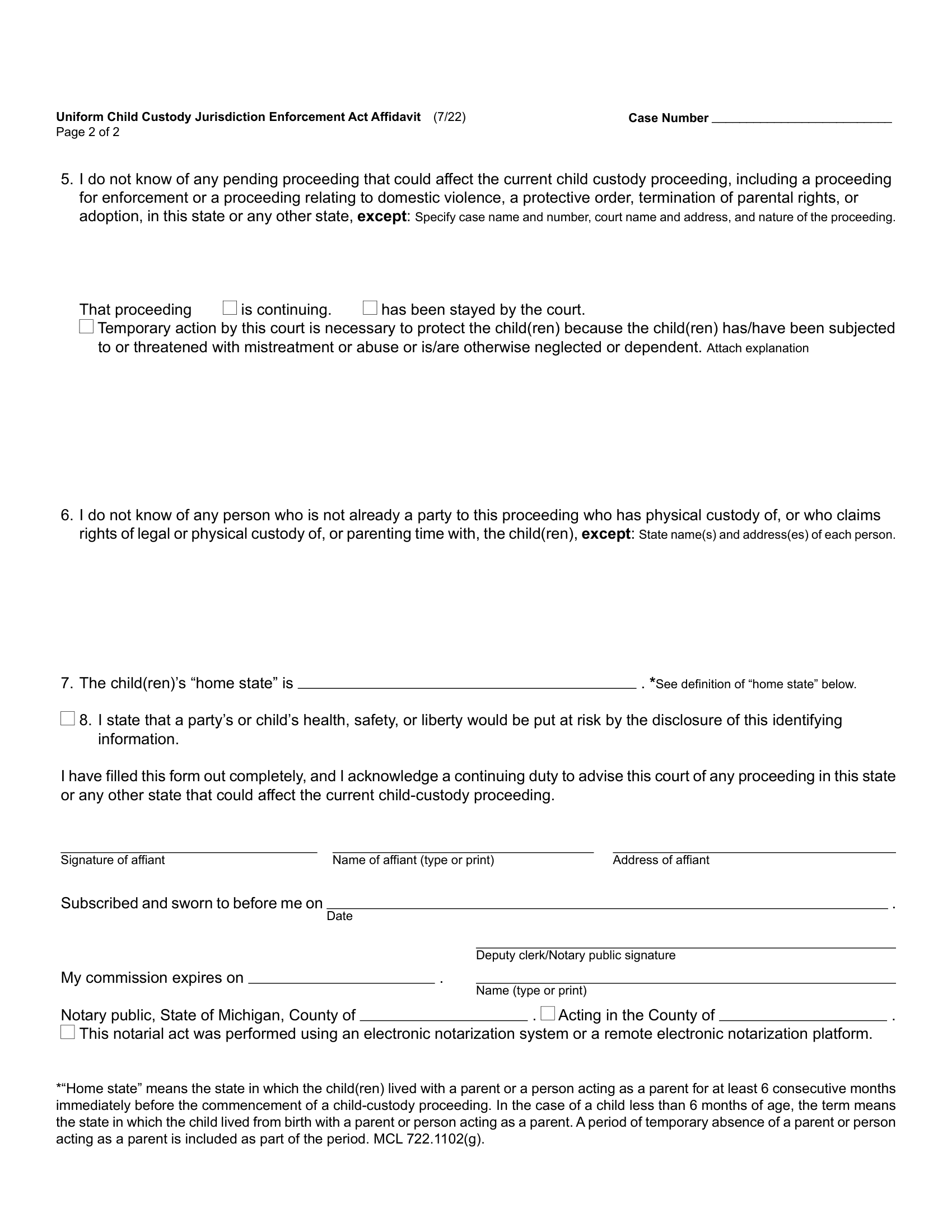
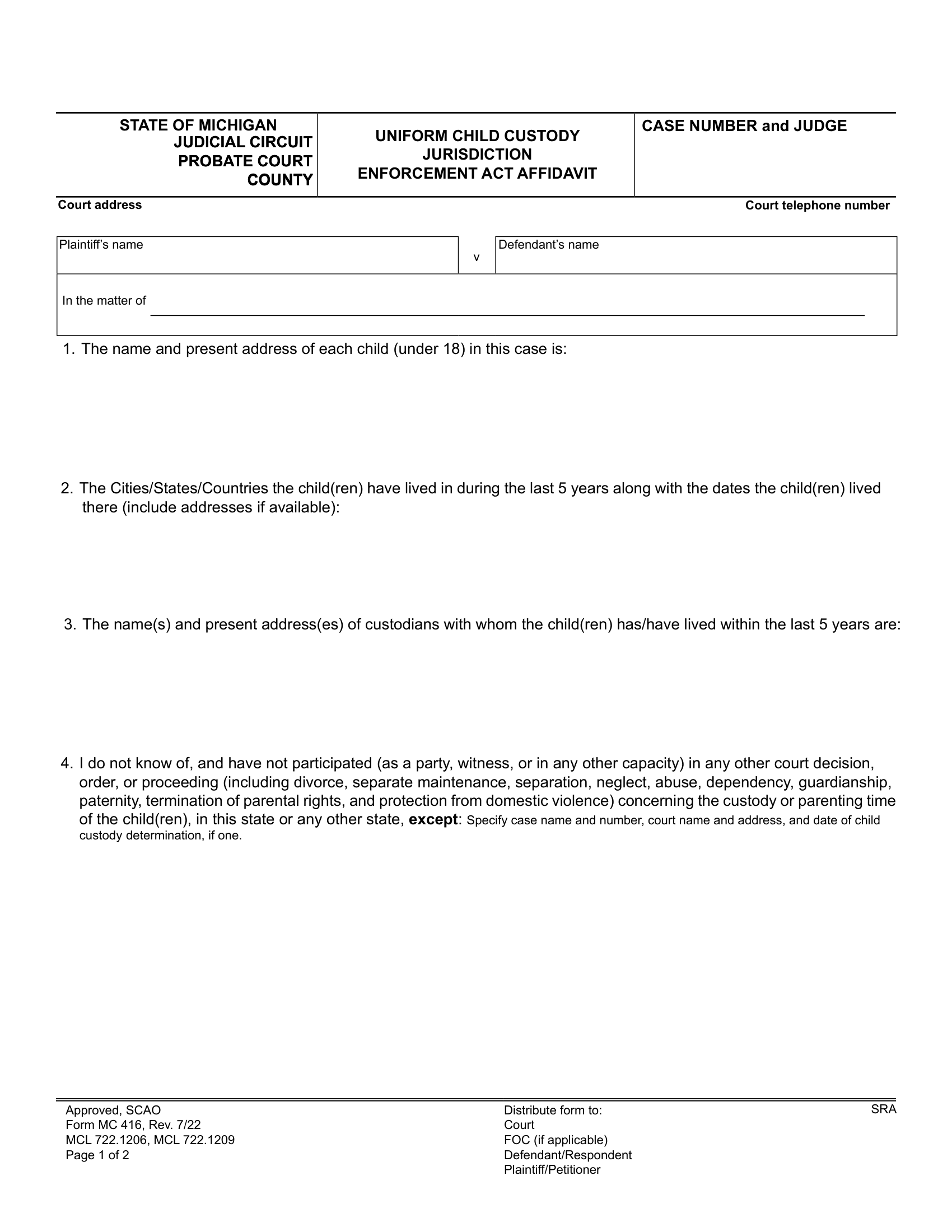
All 2 pages of MC 416 (Rev. 7/22) as the court prints them. Open a page to read it full size; the walkthrough below shows the matching part of the form under each item.

What MC 416 is, and why the court needs it

Uniform Child Custody Jurisdiction Enforcement Act Affidavit (MC 416) is how a party in a Michigan custody case supplies the sworn information the Uniform Child-Custody Jurisdiction and Enforcement Act requires. MCL 722.1209(1) says that in a child-custody proceeding, each party, in its first pleading or in an attached sworn statement, shall give information, if reasonably ascertainable, under oath as to the child’s present address, the places where the child has lived during the last 5 years, and the names and present addresses of the persons with whom the child has lived during that period, and must state whether the party has taken part in another custody proceeding, knows of a proceeding that could affect this one, and knows of anyone else who has physical custody or claims custody or parenting time.

MCR 3.206(B) turns that into a filing rule: in a case in which the custody or parenting time of a minor is to be determined or modified, the filing party shall file a UCCJEA Affidavit on a form approved by the State Court Administrative Office. That is why FOC 87 and FOC 65 each print an item stating that a completed MC 416 is attached, and why their certificates of mailing say the affidavit was mailed with the motion.

The court uses it to check its own jurisdiction. The form’s footer cites MCL 722.1206 and MCL 722.1209. MCL 722.1206(2) says that, except in a temporary emergency under section 204, before hearing a child-custody proceeding a Michigan court shall examine the court documents and other information supplied by the parties under section 209, and that if a proceeding was already commenced in another state with jurisdiction substantially in accordance with the act, the Michigan court shall stay its proceeding and communicate with the court of the other state. MCL 722.1206(3) says that in a proceeding to modify a custody determination, the court shall determine whether a proceeding to enforce it has been commenced in another state.

Missing information has consequences. MCL 722.1209(2) says that if the information is not furnished, the court may stay the proceeding until it is, on a party’s motion or its own. MCL 722.1209(3) says that if you answer any item in the affirmative, you must give additional information under oath as the court requires, and the court may examine the parties under oath about the details.

This page is public legal information, not legal advice, and Onbello is not a law firm. The item numbers and labels below are those printed on the Michigan State Court Administrative Office (SCAO) form (MC 416, Rev. 7/22). Procedures differ by county. If you can afford an attorney, we encourage you to hire one.

MC 416 item by item

Page 1 carries the caption and items 1 through 4; page 2 carries items 5 through 8, the acknowledgment and signature, the notary block, and the printed definition of “home state.” Item numbers and wording below are the ones printed on the form.

When an item runs out of room

The form gives each item a few lines and item 5 says to attach an explanation for temporary action. If any answer does not fit, continue it on a separate sheet labeled with the item number, and attach it to the affidavit before you sign in front of the notary or deputy clerk.

Caption

Circuit or probate court, county, case number and judge, parties
MC 416, page 1, caption, as printed on the form
MC 416, page 1, caption — tap to open the full page
What it asks
STATE OF MICHIGAN, JUDICIAL CIRCUIT or PROBATE COURT, COUNTY, CASE NUMBER and JUDGE, court address and telephone number, then Plaintiff’s name v Defendant’s name, or In the matter of.
What to put
In a divorce, custody, paternity or support case, the circuit, county, case number and the plaintiff and defendant exactly as on the motion or complaint the affidavit goes with. Use In the matter of only if the case you are filing in is captioned that way. For example, Maria Lopez v Daniel Reyes.
Common mistake
Leaving the case number off because the motion has it. The affidavit is a separate document, and page 2 asks for the case number again.

Item 1

The name and present address of each child (under 18)

MC 416, page 1, item 1, as printed on the form
MC 416, page 1, item 1 — tap to open the full page
What it asks
The name and present address of each child under 18 in this case.
What to put
Each child’s full name and current address. If disclosure would put someone at risk, still answer, and check item 8 on page 2; MCL 722.1209 says the information is given subject to the law providing for confidentiality of addresses and identifying information.
Common mistake
Listing only the child the motion is about when the case involves more than one. The item asks for each child in this case.

Item 2

Where the children have lived in the last 5 years

MC 416, page 1, item 2, as printed on the form
MC 416, page 1, item 2 — tap to open the full page
What it asks
The cities, states and countries the children have lived in during the last 5 years, with the dates they lived there, and addresses if available.
What to put
A complete five-year list, oldest to newest, with month and year for each move. MCL 722.1209(1) asks for the places the child has lived during the last 5 years, so short stays count if the child lived there.
Common mistake
Starting the list at the last court order. The five years run back from now, not from the last order.

Item 3

Custodians the children have lived with in the last 5 years

MC 416, page 1, item 3, as printed on the form
MC 416, page 1, item 3 — tap to open the full page
What it asks
The names and present addresses of the custodians the children have lived with within the last 5 years.
What to put
Every adult the children lived with as a custodian in that period, with each person’s present address, not the address where the child lived with them. MCL 722.1209(1) asks for the names and present addresses of the persons with whom the child has lived.
Common mistake
Leaving out a grandparent or other relative the child lived with for part of the period.

Item 4

Other custody proceedings you know of or took part in

MC 416, page 1, item 4, as printed on the form
MC 416, page 1, item 4 — tap to open the full page
What it asks
The printed statement that you do not know of, and have not participated in (as a party, witness, or in any other capacity), any other court decision, order, or proceeding concerning the custody or parenting time of the children, in this state or any other state, except the ones you list, with the case name and number, court name and address, and date of the custody determination, if one.
What to put
Every other proceeding concerning the children’s custody or parenting time: the form names divorce, separate maintenance, separation, neglect, abuse, dependency, guardianship, paternity, termination of parental rights, and protection from domestic violence. If there are none, write none. MCL 722.1209(1)(a) asks whether you have participated, as a party or witness or in another capacity, in another custody proceeding with the child.
Common mistake
Listing only Michigan cases. The item covers proceedings in this state or any other state, and names guardianship, paternity and protection from domestic violence among them.

Item 5

Pending proceedings that could affect this one

MC 416, page 2, item 5, as printed on the form
MC 416, page 2, item 5 — tap to open the full page
What it asks
The printed statement that you do not know of any pending proceeding that could affect the current child custody proceeding, including one for enforcement or relating to domestic violence, a protective order, termination of parental rights, or adoption, in this state or any other state, except the ones you list, with the case name and number, court name and address, and nature of the proceeding. Then: That proceeding is continuing, or has been stayed by the court, and a box for Temporary action by this court is necessary to protect the child(ren).
What to put
Any case still open anywhere that could affect custody, with its details, and whether it is continuing or stayed. Check the temporary action box only if the children have been subjected to or threatened with mistreatment or abuse or are otherwise neglected or dependent, and attach an explanation, as the form says.
Common mistake
Leaving out a personal protection order case because it is between the adults. Item 5 names proceedings relating to domestic violence and protective orders.

Item 6

Other people who have or claim custody or parenting time

MC 416, page 2, item 6, as printed on the form
MC 416, page 2, item 6 — tap to open the full page
What it asks
The printed statement that you do not know of any person not already a party to this proceeding who has physical custody of, or claims rights of legal or physical custody of, or parenting time with, the children, except the people you list, with names and addresses.
What to put
Anyone outside the case who has the children or claims custody or parenting time, such as a relative caring for them. If there is no one, write none. MCL 722.1209(1)(c) asks for the name and address of each such person.
Common mistake
Listing the other parent here. Item 6 is for people who are not already parties.

Item 7

The child(ren)’s “home state”

MC 416, page 2, item 7, as printed on the form
MC 416, page 2, item 7 — tap to open the full page
What it asks
The children’s home state, using the definition printed at the foot of page 2.
What to put
The state where the children lived with a parent or a person acting as a parent for at least 6 consecutive months immediately before the custody proceeding began, or, for a child under 6 months old, the state where the child has lived since birth with a parent or person acting as a parent. The definition is MCL 722.1102(g), and it counts temporary absences as part of the period.
Common mistake
Writing the state you live in now when the children moved there less than 6 months ago. Use the definition, not the current address.

Item 8

Health, safety, or liberty at risk from disclosure

MC 416, page 2, item 8, as printed on the form
MC 416, page 2, item 8 — tap to open the full page
What it asks
A box for the statement that a party’s or child’s health, safety, or liberty would be put at risk by the disclosure of this identifying information.
What to put
Check it only if that is true. MCL 722.1209(5) says that if a party alleges this in a sworn statement, the court shall seal the information and not disclose it to the other party or the public unless the court orders disclosure after a hearing in which it considers the party’s or child’s health, safety, and liberty and determines that disclosure is in the interest of justice.
Common mistake
Leaving items 1 through 3 blank instead of checking item 8. MCL 722.1209(5) protects the information by having the court seal it.

Acknowledgment and signature

I have filled this form out completely, and I acknowledge a continuing duty

MC 416, page 2, affiant’s signature, as printed on the form
MC 416, page 2, affiant’s signature — tap to open the full page
What it asks
The printed acknowledgment that you have filled the form out completely and have a continuing duty to advise the court of any proceeding in this state or any other state that could affect the current child-custody proceeding, then the Signature of affiant, Name of affiant (type or print), and Address of affiant.
What to put
Your printed name and address; sign in front of the notary or deputy clerk. MCL 722.1209(4) is the source of the continuing duty you acknowledge.
Common mistake
Signing before you reach the notary. The block below is the officer’s statement that you swore to it in their presence.

Notary block

Subscribed and sworn to before me

MC 416, page 2, notary block, as printed on the form
MC 416, page 2, notary block — tap to open the full page
What it asks
The date sworn, the deputy clerk’s or notary public’s signature and printed name, the commission expiration, the county of the notary and the county acting in, and a box if the notarial act was performed using an electronic notarization system or a remote electronic notarization platform.
What to put
Completed by the notary public or deputy clerk, not by you. Bring identification.
Common mistake
Filling in the notary block yourself. It is the officer’s certification.

Common pitfalls

Filing the motion without it

MCR 3.206(B) requires the filing party to file a UCCJEA Affidavit whenever custody or parenting time is to be determined or modified, and FOC 87 and FOC 65 each state that it is attached. MCL 722.1209(2) lets the court stay the proceeding until the information is furnished.

Answering “none” without checking

The affidavit is sworn. If an item’s answer is yes, MCL 722.1209(3) says you must give additional information under oath as the court requires, and the court may examine the parties under oath about the details. An omitted earlier case can come out at that point.

Treating it as a one-time form

MCL 722.1209(4) gives each party a continuing duty to inform the court of a proceeding in this or another state that could affect the current custody proceeding. If a protective order case or a case in another state starts later, tell the court.

Getting the home state wrong after a move

Home state is a defined term. MCL 722.1102(g) says it is the state where the child lived with a parent or a person acting as a parent for at least 6 consecutive months immediately before the commencement of the custody proceeding, counting temporary absences. A recent move may mean the home state is still the old one.

Leaving out a case in another state

MCL 722.1206(2) says that, except in a temporary emergency under section 204, a Michigan court must examine the parties’ section 209 information before hearing the case, and must stay its proceeding and communicate with the other court if a custody proceeding was already commenced in a state with jurisdiction substantially in accordance with the act. The affidavit is how the court learns of it.

What to file with MC 416

  • FOC 87: Motion Regarding Custody. Item 2 of FOC 87 states that a completed MC 416 is attached. Read the FOC 87 walkthrough.
  • FOC 65: Motion Regarding Parenting Time. Item 2 of FOC 65 states that a completed MC 416 is attached. Read the FOC 65 walkthrough.
  • FOC 88 and FOC 66: Responses to the custody and parenting time motions. Neither response form mentions MC 416. MCL 722.1209(1) puts the UCCJEA information on each party, in its first pleading or in an attached sworn statement. Read the FOC 88 and FOC 66 walkthrough.

The form’s distribution line sends copies to the court, the friend of the court (if applicable), the defendant or respondent, and the plaintiff or petitioner. The FOC 87 and FOC 65 instructions say to mail a copy of MC 416 with the motion to the other party and to any other custodian or guardian.

Keep reading

Common questions

When do I have to file MC 416 in Michigan?

MCR 3.206(B) says that in a case in which the custody or parenting time of a minor is to be determined or modified, the filing party shall file a Uniform Child Custody Jurisdiction Enforcement Act Affidavit on a form approved by the State Court Administrative Office, as required by MCL 722.1209(1). The custody and parenting time motions, FOC 87 and FOC 65, each state that a completed MC 416 is attached.

What is a child’s “home state” on MC 416?

The form prints the definition from MCL 722.1102(g): the state in which the child lived with a parent or a person acting as a parent for at least 6 consecutive months immediately before the commencement of a child-custody proceeding. For a child less than 6 months old, it is the state where the child has lived since birth with a parent or person acting as a parent. Temporary absences count as part of the period.

Can I keep my address off MC 416 for safety?

Item 8 is for that. MCL 722.1209(5) says that if a party alleges in a sworn statement that a party’s or child’s health, safety, or liberty would be put at risk by disclosure of identifying information, the court shall seal that information and not disclose it to the other party or the public unless it orders disclosure after a hearing.

Does MC 416 have to be notarized?

It is a sworn affidavit. Page 2 has a “Subscribed and sworn to before me” block for a deputy clerk or notary public, with a box for a notarial act performed using an electronic notarization system or a remote electronic notarization platform. MCL 722.1209(1) requires the information to be given under oath.

What happens if I leave MC 416 incomplete?

MCL 722.1209(2) says that if the required information is not furnished, the court may stay the proceeding until it is, on a party’s motion or on its own. The acknowledgment above your signature says you have filled the form out completely.

Ready to prepare your UCCJEA Affidavit?

Our guided tool helps you prepare an affidavit in your own words and fills out your court paperwork.

Join the waitlist — $129 at launch

A family law attorney will always have the biggest impact on your case. If you can afford one, we encourage you to hire one.

Onbello prepares court-ready California family law filings for parents without a lawyer.