Form 12.905(a) Supplemental Petition to Modify Parental Responsibility or Time-Sharing (Florida): how to fill it out, line by line

A paragraph-by-paragraph walkthrough of the Florida form for changing an existing parenting plan or time-sharing schedule: the caption, paragraphs 1 through 11, the oath, and the notary block.

Researched by Dan Martin, Legal Researcher · Published by Onbello Legal

Quick answer

Form 12.905(a) is the Florida Supreme Court approved form for asking the circuit court to change an existing order on parental responsibility, visitation, or a Parenting Plan and time-sharing schedule after a final judgment of dissolution of marriage or paternity. It is a supplemental petition, not a motion: Florida Family Law Rule of Procedure 12.110(h) says a proceeding to modify a final judgment must be started by supplemental petition and then proceeds as though it were the first pleading in the case, including any needed process. The form is three pages with 11 numbered paragraphs, it is signed under oath before a notary public or deputy clerk, and the form instructions say that after personal service the other party has 20 days to answer.

Summary: what 12.905(a) does, and what you need first

  • Form 12.905(a) asks the court to change the current parental responsibility, visitation, or Parenting Plan/time-sharing schedule set by a final judgment or a later modification.
  • It starts a new round of pleadings in your case. Rule 12.110(h) says modification must be started by supplemental petition and not by motion, and that the case then proceeds as though the supplemental petition were the initial pleading.
  • Have a copy of the final judgment and every modification of it. Paragraph 1 states that a copy is attached, and paragraph 2 asks which paragraph of that order describes the current arrangement.
  • Write out the change in circumstances since the last order, the change you are asking for, and why it is in the child’s best interests. Those are paragraphs 3, 4 and 5.
  • The instructions say to file in the county where the original order or judgment was entered. If the order was entered in another state, or the child lives in another state, the instructions say to speak with an attorney about where to file.
  • Do not sign it at home. The instructions say to sign the form before a notary public or deputy clerk.
  • File it with a UCCJEA Affidavit (12.902(d)), a Parenting Plan (12.995(a) or 12.995(b)), a Notice of Social Security Number (12.902(j)) if one is not already in the file, and a Family Law Financial Affidavit (12.902(b) or 12.902(c)).
  • If you are also asking to change child support, the instructions add a Child Support Guidelines Worksheet (12.902(e)) and a Certificate of Compliance with Mandatory Disclosure (12.932).
  • A filing fee applies. If you cannot pay it, the instructions say you may get an Application for Determination of Civil Indigent Status from the clerk, and the clerk decides whether fees can be deferred.
  • Plan for service. If you know where the other party lives, the instructions say to use personal service; the other party then has 20 days to answer.

The full form

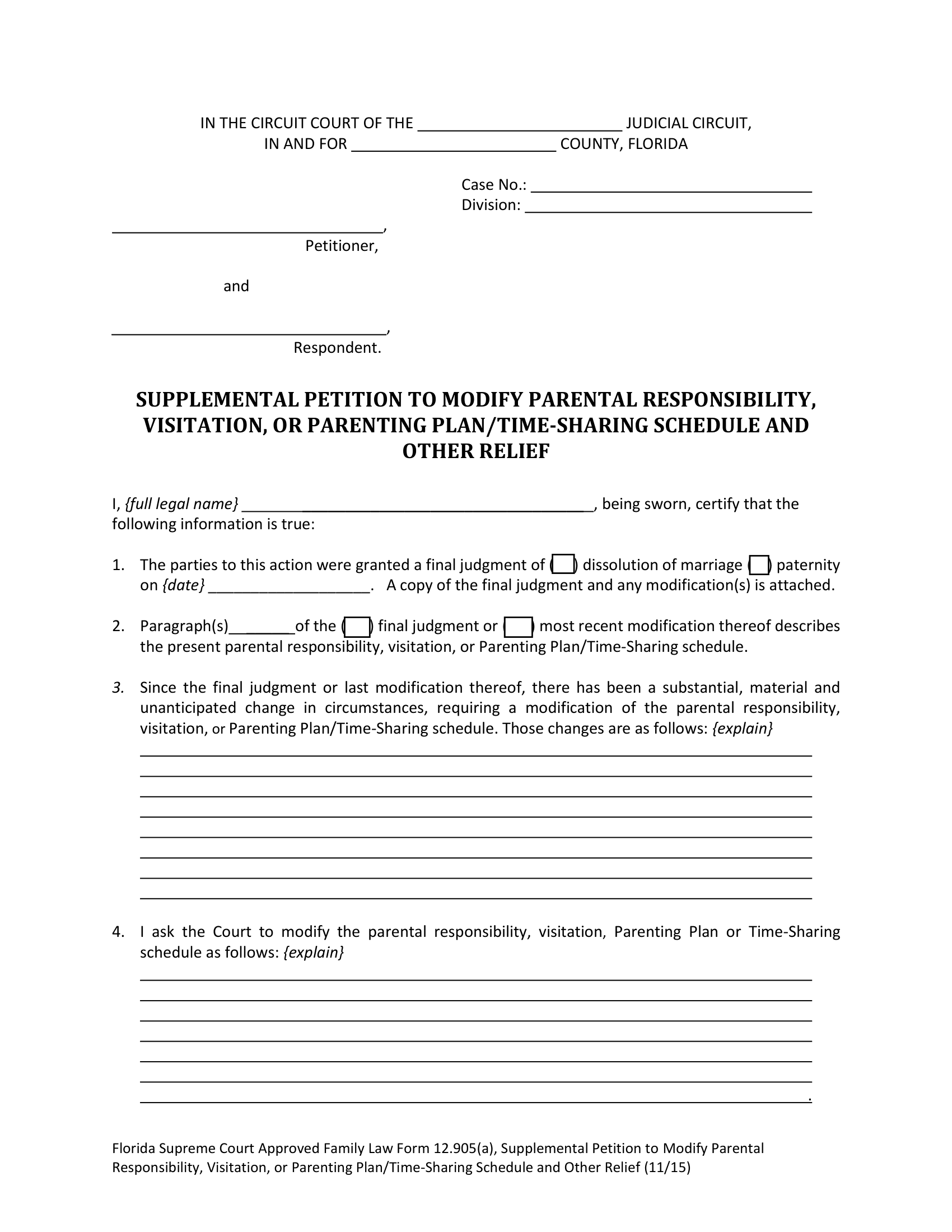
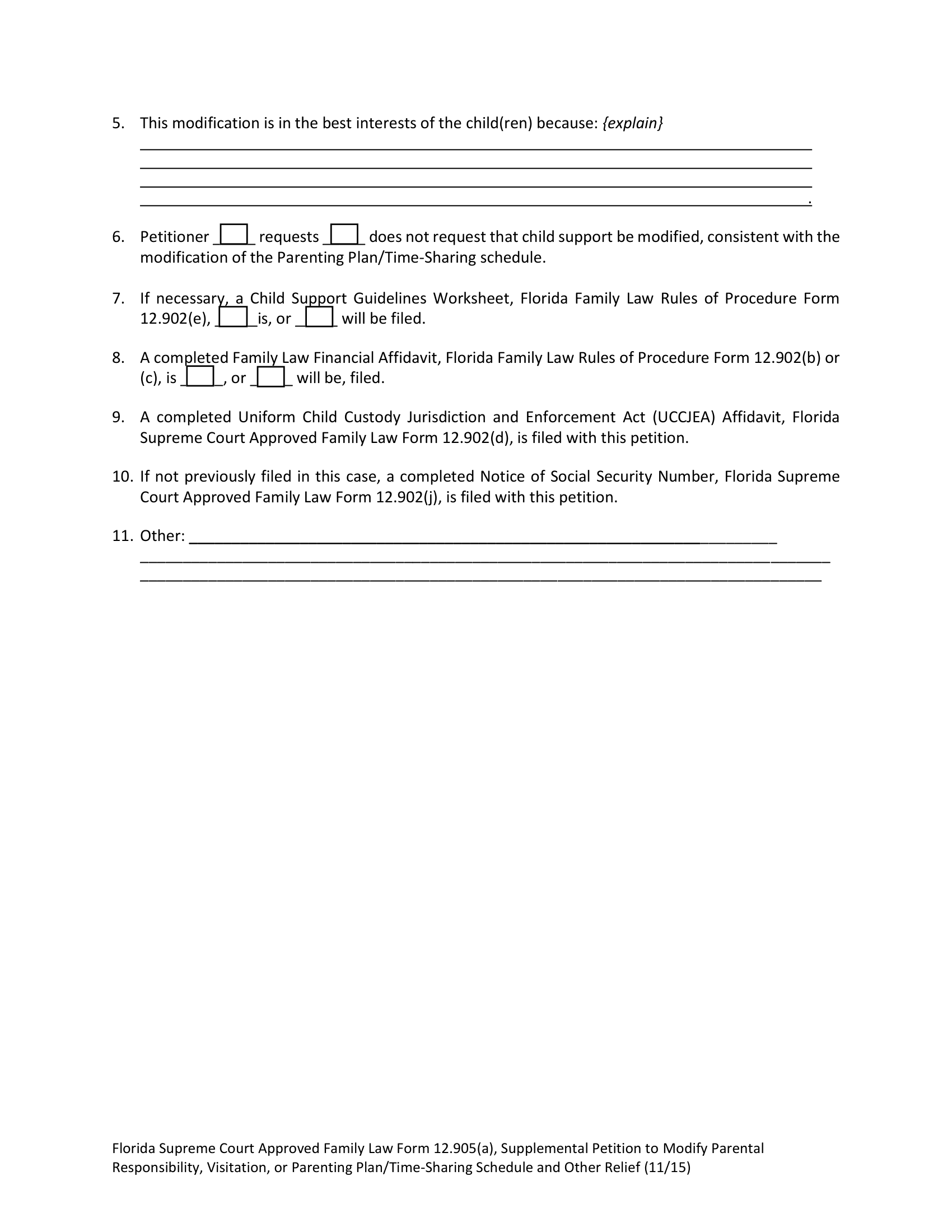
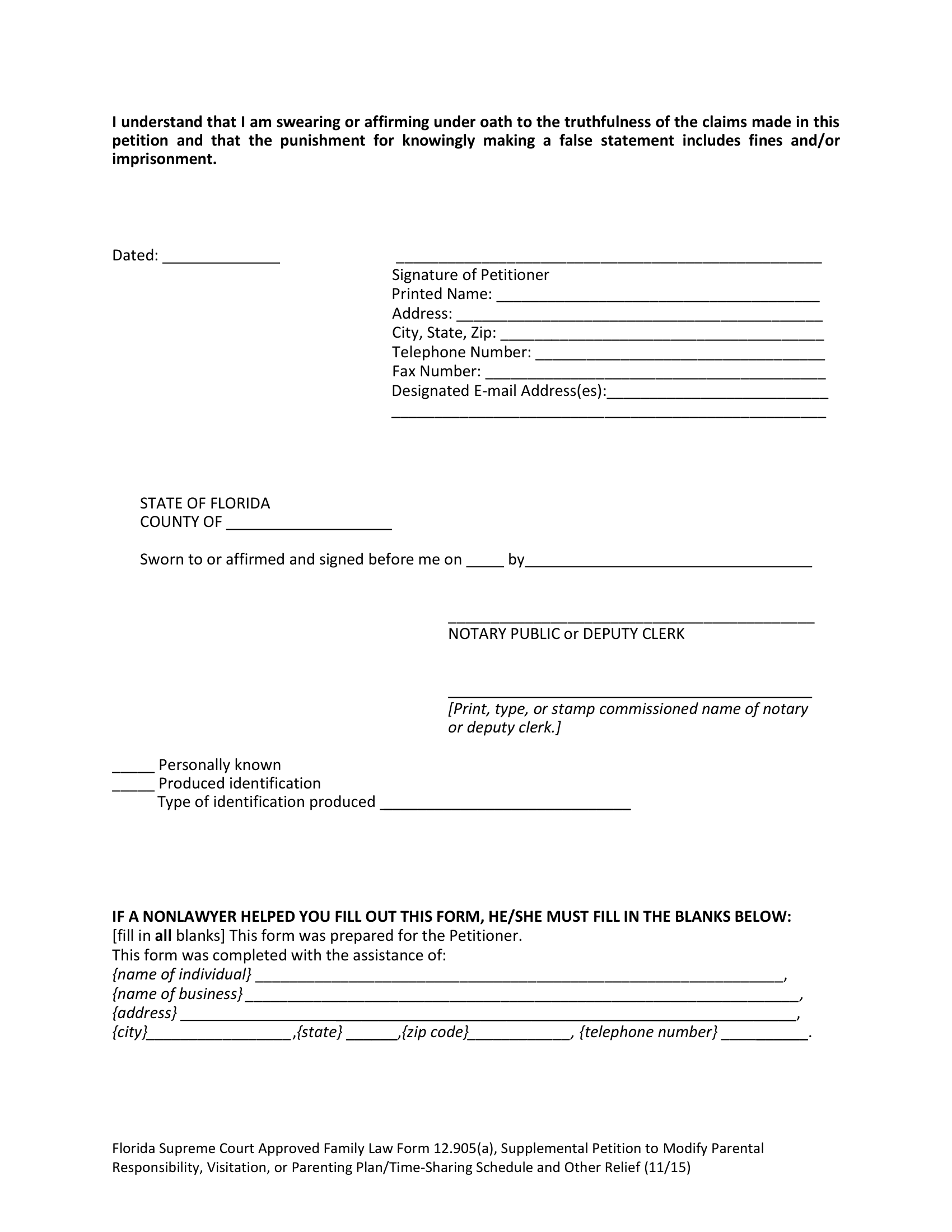
All 3 pages of Form 12.905(a) (Rev. 11/15) as the court prints them. Open a page to read it full size; the walkthrough below shows the matching part of the form under each item.

What Form 12.905(a) is, and how a Florida modification works

Supplemental Petition to Modify Parental Responsibility, Visitation, or Parenting Plan/Time-Sharing Schedule and Other Relief (Form 12.905(a)) is the form Florida provides for changing parenting orders after a final judgment. The PDF published on flcourts.gov is eight pages: five pages of instructions, then the three-page petition. Florida’s vocabulary is parental responsibility (decision-making) and time-sharing (the schedule), set out in a Parenting Plan.

Florida does not change a final judgment by motion. Rule 12.110(h) of the Florida Family Law Rules of Procedure says that when pleadings are allowed after final judgment, the first one must be designated a supplemental petition, that the action then proceeds in the same manner and time as though the supplemental petition were the initial pleading, including the issuance of any needed process, and that proceedings to modify a final judgment must be started only that way and not by motion. There is no hearing date on this form. The other party is served, has time to answer, and the case then moves toward a final hearing.

Service is the step that starts the clock. The instructions say to use personal service if you know where the other party lives, and that constructive service may be possible if you truly do not know, or if the other party lives in another state or country, but that the court may then grant only limited relief. Rule 12.140(a)(1) gives a respondent 20 days after service of original process and the initial pleading to serve a response, and the form instructions say the same for this petition. After that, the instructions describe three paths: default if no answer is filed, uncontested if the answer agrees, and contested if it disagrees.

The legal standard is in section 61.13(3), Florida Statutes. As published for 2026, it says a determination of parental responsibility, a parenting plan, or a time-sharing schedule may not be modified without a showing of a substantial and material change in circumstances and a determination that the modification is in the best interests of the child. The form, revised in November 2015, still prints “substantial, material and unanticipated” in its instructions and in paragraph 3.

On October 1, 2026, the Florida Supreme Court redesignated every Florida family law form as a “Florida Supreme Court Approved Family Law Form” (In re: Amendments to Florida Family Law Rules of Procedure, No. SC2026-1262). The opinion says form titles will be updated in later amendments, that existing forms remain valid in the meantime however they are titled, and that cross-references to the old “Florida Family Law Rules of Procedure” forms, which this petition still prints for 12.902(b), (c) and (e), are read as references to the corresponding approved forms.
This page is public legal information, not legal advice, and Onbello is not a law firm. The item numbers and labels below are those printed on the Florida Supreme Court Approved Family Law form (12.905(a), Rev. 11/15). Procedures differ by county. If you can afford an attorney, we encourage you to hire one.

Form 12.905(a) paragraph by paragraph

The petition starts on page 6 of the PDF. Page 6 carries the caption, the opening statement and paragraphs 1 through 4; page 7 carries paragraphs 5 through 11; page 8 carries the oath, your signature, the notary block and the nonlawyer block. Paragraph numbers below are the ones printed on the form.

When an item runs out of room

Paragraphs 3, 4 and 5 each end with {explain} and a few blank lines. The form has no attachment page of its own. Rule 12.130(b) says any exhibit attached to a pleading is considered part of the pleading, so if you continue an answer on an extra sheet, label it with the paragraph number it continues.

Caption

Circuit, county, case number, division, Petitioner and Respondent

Form 12.905(a), page 6, caption, as printed on the form
Form 12.905(a), page 6, caption — tap to open the full page
What it asks
IN THE CIRCUIT COURT OF THE ___ JUDICIAL CIRCUIT, IN AND FOR ___ COUNTY, FLORIDA, then the case number, the division, and the names of the Petitioner and the Respondent.
What to put
The judicial circuit and county where the original order or judgment was entered, since the instructions say to file there. Copy the case number, division and party names from your final judgment, and ask the clerk if you are unsure whether the supplemental petition goes under the existing case number. For example, Petitioner Maria Lopez and Respondent Daniel Reyes.
Common mistake
Filling in the county but not the circuit. Florida’s circuit courts are numbered, and the caption asks for both.

Opening statement

I, {full legal name}, being sworn, certify

Form 12.905(a), page 6, opening statement, as printed on the form
Form 12.905(a), page 6, opening statement — tap to open the full page
What it asks
Your full legal name, followed by the printed statement that, being sworn, you certify that the following information is true.
What to put
Your full legal name as it appears in the case. Everything after this line is sworn, which is why the form ends with an oath and a notary block.
Common mistake
Treating the petition like an unsworn letter to the judge. The oath on page 8 states that the punishment for knowingly making a false statement includes fines and/or imprisonment.

Paragraph 1

The final judgment

Form 12.905(a), page 6, paragraph 1, as printed on the form
Form 12.905(a), page 6, paragraph 1 — tap to open the full page
What it asks
Whether the parties were granted a final judgment of ( ) dissolution of marriage or ( ) paternity, and the date. The paragraph states that a copy of the final judgment and any modification(s) is attached.
What to put
Check one box, write the date the final judgment was entered, and attach a copy of the final judgment and of every order that modified it.
Common mistake
Leaving the attachment out. The paragraph you sign says it is attached.

Paragraph 2

Where the current arrangement is written

Form 12.905(a), page 6, paragraph 2, as printed on the form
Form 12.905(a), page 6, paragraph 2 — tap to open the full page
What it asks
Which paragraph(s) of the ( ) final judgment or ( ) most recent modification describe the present parental responsibility, visitation, or Parenting Plan/Time-Sharing schedule.
What to put
The paragraph numbers from the most recent order that sets the current arrangement, and the box that says which order that is.
Common mistake
Citing the original judgment when a later modification replaced the schedule. Check the box for the order that actually governs today.

Paragraph 3

The change in circumstances

Form 12.905(a), page 6, paragraph 3, as printed on the form
Form 12.905(a), page 6, paragraph 3 — tap to open the full page
What it asks
The form states that since the final judgment or last modification there has been a substantial, material and unanticipated change in circumstances requiring modification, and asks you to explain those changes.
What to put
Specific facts, with dates, about what changed after the last order: a move, a new work schedule, a change in the child’s schooling or needs. Section 61.13(3), Florida Statutes, as published for 2026, states the standard as a substantial and material change in circumstances, and it provides that if the parents lived more than 50 miles apart when the last time-sharing order was entered and one parent moves within 50 miles of the other, that move may be considered a substantial and material change.
Common mistake
Describing things that were already true when the last order was entered. The paragraph asks what changed since then.

Paragraph 4

The modification you are asking for

Form 12.905(a), page 6, paragraph 4, as printed on the form
Form 12.905(a), page 6, paragraph 4 — tap to open the full page
What it asks
How you ask the court to modify the parental responsibility, visitation, Parenting Plan or time-sharing schedule.
What to put
The concrete change: who has which days and overnights, holidays, exchanges, and whether you ask for shared or sole parental responsibility. Keep it consistent with the Parenting Plan you file with the petition; the instructions say a proposed Parenting Plan may be filed if you have not reached an agreement.
Common mistake
Writing “more time” or “primary custody.” Florida orders a Parenting Plan with a time-sharing schedule, so describe the schedule itself.

Paragraph 5

Why it is in the child’s best interests

Form 12.905(a), page 7, paragraph 5, as printed on the form
Form 12.905(a), page 7, paragraph 5 — tap to open the full page
What it asks
Why the modification is in the best interests of the child(ren).
What to put
Facts tied to the child, not to the parents’ dispute. Section 61.13(3) says the determination of best interests must be made by evaluating all of the factors affecting the welfare and interests of the particular child and the circumstances of that family, and it lists those factors.
Common mistake
Restating paragraph 3. Paragraph 3 is what changed; paragraph 5 is why the new arrangement serves the child.

Paragraph 6

Child support

Form 12.905(a), page 7, paragraph 6, as printed on the form
Form 12.905(a), page 7, paragraph 6 — tap to open the full page
What it asks
Whether the Petitioner _____ requests or _____ does not request that child support be modified, consistent with the modification of the Parenting Plan/Time-Sharing schedule.
What to put
Mark one blank. The instructions explain that Florida’s guidelines take into account both parents’ incomes and the number of overnights the child spends with each parent, which is why a time-sharing change can affect support. A change to child support alone, without a parenting change, has its own form, 12.905(b), Supplemental Petition for Modification of Child Support.
Common mistake
Marking “requests” without filing the financial pieces. Paragraphs 7 and 8 and the instructions’ filing list follow from this choice.

Paragraph 7

Child Support Guidelines Worksheet

Form 12.905(a), page 7, paragraph 7, as printed on the form
Form 12.905(a), page 7, paragraph 7 — tap to open the full page
What it asks
If necessary, whether a Child Support Guidelines Worksheet, Form 12.902(e), _____ is, or _____ will be filed.
What to put
Mark one blank if child support is in play. Rule 12.285(k) requires a Child Support Guidelines Worksheet to be filed at or before a hearing to establish or modify child support, and says that requirement cannot be waived by the parties. The instructions add that if you do not know the other party’s income, you may file the worksheet after the other party’s financial affidavit has been served on you.
Common mistake
Leaving both blanks empty when paragraph 6 says you request a support change.

Paragraph 8

Family Law Financial Affidavit

Form 12.905(a), page 7, paragraph 8, as printed on the form
Form 12.905(a), page 7, paragraph 8 — tap to open the full page
What it asks
Whether a completed Family Law Financial Affidavit, Form 12.902(b) or (c), is _____, or _____ will be, filed.
What to put
Mark one blank. The instructions list the financial affidavit among the documents you must file with this form. Rule 12.285(e)(1) sets the line: Form 12.902(b) if your gross annual income is less than $50,000, Form 12.902(c) if it is $50,000 or more.
Common mistake
Choosing the short form because your take-home pay is under $50,000. The rule measures gross annual income.

Paragraph 9

UCCJEA Affidavit

Form 12.905(a), page 7, paragraph 9, as printed on the form
Form 12.905(a), page 7, paragraph 9 — tap to open the full page
What it asks
The printed statement that a completed Uniform Child Custody Jurisdiction and Enforcement Act (UCCJEA) Affidavit, Form 12.902(d), is filed with this petition.
What to put
There is nothing to check. You are stating that the UCCJEA Affidavit goes in with the petition, so complete it before you file.
Common mistake
Filing the petition first and the UCCJEA Affidavit later. The sworn paragraph says it is filed with the petition.

Paragraph 10

Notice of Social Security Number

Form 12.905(a), page 7, paragraph 10, as printed on the form
Form 12.905(a), page 7, paragraph 10 — tap to open the full page
What it asks
The printed statement that, if not previously filed in this case, a completed Notice of Social Security Number, Form 12.902(j), is filed with this petition.
What to put
If the notice is already in the case file, nothing more is needed. If it is not, file it with the petition.
Common mistake
Writing a Social Security number into the petition itself. It belongs on Form 12.902(j).

Paragraph 11

Other

Form 12.905(a), page 7, paragraph 11, as printed on the form
Form 12.905(a), page 7, paragraph 11 — tap to open the full page
What it asks
A single line for any other relief or statement.
What to put
Anything else you are asking for that the paragraphs above do not cover, stated briefly. Rule 12.110(b) says a petition must contain a short and plain statement of the relief requested and the ultimate facts that support it.
Common mistake
Using the line to ask for a change to alimony. Alimony modification has its own form, 12.905(c).

Oath and signature

Swearing or affirming, date, and your contact information

Form 12.905(a), page 8, oath and signature, as printed on the form
Form 12.905(a), page 8, oath and signature — tap to open the full page
What it asks
The statement that you are swearing or affirming under oath to the truthfulness of the claims in the petition, the date, the Signature of Petitioner, and your printed name, address, city, state and ZIP, telephone, fax, and designated e-mail address(es).
What to put
Fill in your contact details; leave the signature until you are in front of the notary or deputy clerk. If you choose to serve and receive documents by e-mail, the instructions say to designate your e-mail address on Form 12.915 and to provide it on every form you sign.
Common mistake
Signing before you reach the notary. The instructions say to sign the form before a notary public or deputy clerk.

Notary block

STATE OF FLORIDA, COUNTY OF

Form 12.905(a), page 8, notary block, as printed on the form
Form 12.905(a), page 8, notary block — tap to open the full page
What it asks
The county, and the notary public’s or deputy clerk’s statement that the petition was sworn to or affirmed and signed before them on a date and by a named person, whether you are personally known or produced identification, and the type of identification.
What to put
Completed by the notary public or deputy clerk, not by you. Bring identification.
Common mistake
Filling in the notary block yourself. It is the officer’s certification.

Nonlawyer block

If a nonlawyer helped you fill out this form

Form 12.905(a), page 8, nonlawyer block, as printed on the form
Form 12.905(a), page 8, nonlawyer block — tap to open the full page
What it asks
The name, business, address, city, state, ZIP and telephone number of any nonlawyer who helped complete the form, and a statement that the form was prepared for the Petitioner.
What to put
Left blank if no one helped you. If a nonlawyer did, the instructions say that person must give you a Disclosure from Nonlawyer, Form 12.900(a), before helping, and must put their name, address and telephone number on the last page of every form they help with.
Common mistake
Leaving it blank when someone did help you complete the form. The block says the nonlawyer must fill it in.

Common pitfalls

Treating it like a motion

Rule 12.110(h) says proceedings to modify a final judgment must be started by supplemental petition and not by motion, and that the case then proceeds as though the supplemental petition were the initial pleading, including the issuance of any needed process. There is no hearing date to pick on this form. The other party is served and the answer period runs first.

Serving it by mail

The instructions say that if you know where the other party lives you should use personal service, and that if constructive service is used the court may grant only limited relief. E-mail service under Florida Rule of General Practice and Judicial Administration 2.516 applies, per the instructions, after the initial service of process of the petition or supplemental petition by the sheriff or a certified process server.

Reading the printed standard as the whole story

Paragraph 3, printed in 2015, says “substantial, material and unanticipated.” Section 61.13(3), Florida Statutes, as published for 2026, says “substantial and material change in circumstances” and adds the 50-mile provision for parents who move closer together. The paragraph you sign is the form’s; the standard the statute states is the current text of section 61.13(3).

Checking “requests” for child support without the paperwork

Rule 12.285(e)(1) requires a financial affidavit in any supplemental request for permanent financial relief, including child support, and says that requirement cannot be waived by the parties. Rule 12.285(k) requires a Child Support Guidelines Worksheet at or before the hearing. The instructions also call for a Certificate of Compliance with Mandatory Disclosure, Form 12.932, within 45 days of service if you are seeking to modify child support.

Forgetting mandatory disclosure in a modification

Rule 12.285(b)(2) says documents required by the mandatory disclosure rule in an initial or supplemental proceeding must be served within 45 days of service of the initial pleading on the respondent. When the supplemental petition includes a request for financial relief such as child support, rule 12.285(e)(15) adds that in any modification proceeding each party must serve all written agreements between them entered into since the order to be modified.

Expecting a hearing without asking for one

The instructions say that after an uncontested answer you call the clerk, family law intake staff, or judicial assistant to set a final hearing and notify the other party with a Notice of Hearing (General), Form 12.923. In a contested case they say to file a Notice for Trial, Form 12.924, after mandatory disclosure, and that some circuits require mediation before a final hearing can be set.

What to file with 12.905(a)

  • 12.902(d): Uniform Child Custody Jurisdiction and Enforcement Act (UCCJEA) Affidavit. Filed with the petition. Paragraph 9 states that it is.
  • 12.995(a) or 12.995(b): Parenting Plan. Listed in the instructions as filed with this form: signed by both parties if you have reached an agreement, or a proposed Parenting Plan if you have not.
  • 12.902(b) or 12.902(c): Family Law Financial Affidavit (Short Form or Long Form). Listed in the instructions as filed with this form. Rule 12.285(e)(1): short form under $50,000 gross annual income, long form at $50,000 or more. Read the 12.902(b) or 12.902(c) walkthrough.
  • 12.902(j): Notice of Social Security Number. Filed with the petition if not previously filed in the case, per paragraph 10.
  • 12.902(e) and 12.932: Child Support Guidelines Worksheet; Certificate of Compliance with Mandatory Disclosure. If you are seeking to modify child support. The instructions say the certificate must be filed within 45 days of service of the supplemental petition on the respondent if not filed with it, unless both parties agreed not to exchange these documents.
  • 12.903(e): Answer to Supplemental Petition. Not filed by you. It is the form the other party uses to answer this petition within 20 days of service. Read the 12.903(e) walkthrough.
  • 12.947(a): Motion for Temporary Support, Time-Sharing, and Other Relief With Dependent or Minor Child(ren). The 12.905(a) instructions point to it if you need temporary relief on parental responsibility, time-sharing, or child support while the petition is pending. Its own instructions describe use in a pending dissolution of marriage or support action, so ask the clerk or family law intake staff how your circuit handles temporary relief in a modification.
  • 12.993(a): Supplemental Final Judgment Modifying Parental Responsibility, Visitation, or Parenting Plan/Time-Sharing Schedule and Other Relief. A form the judge may use. The instructions say to check with the clerk, family law intake staff, or judicial assistant whether to bring it to the hearing with the heading filled in and the rest left blank.

Procedures differ by circuit. The instructions say that if you file electronically you must follow the procedures of the judicial circuit where you file, that some circuits require mediation before a final hearing, and that you should ask the clerk, family law intake staff, or judicial assistant about parenting course and mediation requirements where you live.

Keep reading

Common questions

Is a Florida supplemental petition the same as a motion to modify?

No. Florida Family Law Rule of Procedure 12.110(h) says proceedings to modify a final judgment must be started only by supplemental petition and not by motion. The case then proceeds in the same manner and time as though the supplemental petition were the initial pleading, including the issuance of any needed process.

How long does the other parent have to respond to Form 12.905(a)?

The form instructions say that if personal service is used, the other party has 20 days to answer after being served. Rule 12.140(a)(1) sets the same 20 days after service of original process and the initial pleading. If no answer is filed after 20 days, the instructions say you may file a Motion for Default, Form 12.922(a).

Does Form 12.905(a) have to be notarized?

Yes. The instructions say to sign the form before a notary public or deputy clerk, and page 8 of the form has the notary block. The petition is sworn: the oath states that the punishment for knowingly making a false statement includes fines and/or imprisonment.

Which county do I file the supplemental petition in?

The instructions say to file it in the county where the original order or judgment was entered. If the order or judgment was entered in another state, or if the child lives in another state, the instructions say to speak with an attorney about where to file.

Can I change child support on the same form?

Paragraph 6 lets you request that child support be modified consistent with the change to the Parenting Plan and time-sharing schedule, and the instructions then add the Child Support Guidelines Worksheet and the Certificate of Compliance with Mandatory Disclosure. A child support change without a parenting change uses Form 12.905(b), Supplemental Petition for Modification of Child Support.

Do I have to file it electronically?

The instructions say self-represented litigants may file petitions and other documents electronically but are not required to. If you do file electronically, they say you must follow Florida Rule of General Practice and Judicial Administration 2.525 and the procedures of the judicial circuit where you file.

Ready to prepare your Supplemental Petition?

Our guided tool helps you prepare an affidavit in your own words and fills out your court paperwork.

Join the waitlist — $129 at launch

A family law attorney will always have the biggest impact on your case. If you can afford one, we encourage you to hire one.

Onbello prepares court-ready California family law filings for parents without a lawyer.