Form 12.902(c) Family Law Financial Affidavit, Long Form (Florida): how to fill it out, line by line
A section-by-section walkthrough of Florida’s financial affidavit for a party with individual gross annual income of $50,000 or more: employment and income, 124 numbered expense and summary lines, the asset and liability tables, net worth, and contingent items.
Researched by Dan Martin, Legal Researcher · Published by Onbello Legal
Quick answer
Form 12.902(c) is the Florida financial affidavit for a party whose individual gross annual income is $50,000 or more. Rule 12.285(e)(1) of the Florida Family Law Rules of Procedure requires a financial affidavit in any initial or supplemental request for permanent financial relief and says it cannot be waived by the parties; at $50,000 or more it is this form, and the rule lets the other party or the court require it of a party under $50,000 too. The affidavit runs 15 pages: Section I income and deductions (lines 1 through 27), Section II monthly expenses in seven groups and the surplus or deficit (lines 1 through 124), and Section III assets, liabilities, net worth, contingent items, and the child support worksheet statement. All amounts are monthly, and it is signed under penalties of perjury.
Summary: what 12.902(c) does, and what you need first
Form 12.902(c) is the long-form financial affidavit, for an individual gross annual income of $50,000 or more under rule 12.285(e)(1).
A party under $50,000 may be required to use it as well. Rule 12.285(e)(1) lets the other party request it through the Standard Family Law Interrogatories, and lets the court order it on its own motion.
Every figure in Sections I and II is monthly. The instructions give the conversions: weekly pay times 52, divided by 12; every-two-weeks pay times 26, divided by 12; twice-a-month pay times 2.
Have last year’s gross income figure ready. Section I asks for your income for the prior year and, if known, the other party’s.
Gather 6 months of pay stubs, 3 years of tax returns, and 12 months of account statements. Those are among the documents rule 12.285(e) requires you to serve, and (e)(1) says the documents supporting the affidavit’s figures must be produced.
If you hold virtual currency, the asset table asks you to attach a schedule showing the number of units held and the unit value when you prepare the form.
In Section III, list only the last four digits of account numbers, as the form instructs.
Know which kind of case you are in. Section III tells original dissolution cases to use column B (marital) and column C (nonmarital), and every other matter, including a modification, to use column C only.
Timing: the instructions say a copy must be served on the other party within 45 days of being served with the petition, if not served with your initial papers, and filed with the court. Rule 12.285(b)(2) sets the same 45 days.
It is signed, not notarized. The last page is a declaration under penalties of perjury, followed by your signature.
The full form
All 15 pages of Form 12.902(c) (Rev. 06/25) as the court prints them. Open a page to read it full size; the walkthrough below shows the matching part of the form under each item.
Family Law Financial Affidavit (Long Form), Form 12.902(c), is the sworn statement of a party’s income, expenses, assets and liabilities in a Florida family case for a party whose individual gross annual income is $50,000 or more. The PDF published on flcourts.gov is eighteen pages: three pages of instructions and a fifteen-page affidavit.
Rule 12.285(e)(1) of the Florida Family Law Rules of Procedure requires, in any initial or supplemental request for permanent financial relief, including child support, alimony, equitable distribution of assets or debts, or attorneys’ fees, suit money, or costs, a financial affidavit in substantial conformity with Form 12.902(b) if the party’s gross annual income is less than $50,000, or Form 12.902(c) if it is $50,000 or more, and says the requirement cannot be waived by the parties. Subdivision (d)(1) sets the same line for temporary financial relief.
The instructions list three exceptions: a simplified dissolution of marriage under rule 12.105 where both parties waived financial affidavits; no minor children, no support issues, and a written settlement agreement disposing of all financial issues; or a court without jurisdiction over any financial issue.
The long form asks much more than the short form. It has seven groups of expenses, separate tables for marital and nonmarital assets and liabilities, a net worth calculation, and a contingent assets and liabilities table. It also asks for things the short form does not: your age, your retirement status and any DROP or deferred compensation plan, last year’s gross income for you and, if known, the other party, digital wallets and virtual currency, and student loans listed one by one.
The form’s footer still reads “Florida Family Law Rules of Procedure Form 12.902(c).” Effective October 1, 2026, the Florida Supreme Court redesignated every family law form, including 12.902(c), as a “Florida Supreme Court Approved Family Law Form” (No. SC2026-1262). The opinion says titles will be updated in later amendments and that existing forms remain valid in the meantime, however they are titled.
This page is public legal information, not legal advice, and Onbello is not a law firm. The item numbers and labels below are those printed on the Florida Supreme Court Approved Family Law form (12.902(c), Rev. 06/25). Procedures differ by county. If you can afford an attorney, we encourage you to hire one.
Form 12.902(c) section by section
The affidavit starts on page 4 of the PDF and is numbered 1 of 15 through 15 of 15. Section I runs from page 1 to the top of page 3 of the affidavit; Section II, the expense lines and the summary, starts on page 3 and runs to page 6; Section III, the asset and liability tables, net worth, contingent items and the child support worksheet statement, runs to page 14; and page 15 carries the signature and the nonlawyer block. Section II restarts its line numbers at 1, so line numbers below are the form’s own within each section.
When an item runs out of room
Section I says “Attach more paper, if needed,” and that items under “other” should be listed separately. The form calls for attached sheets for a second job, business income (line 3), rental income for each property (line 11), reimbursed expenses (line 13), additional households, and assets or debts beyond the blank rows provided. Section III A also says you may attach an equitable distribution schedule or balance sheet that includes the same information instead of filling out Section III.
Caption and opening
Circuit, county, case number, division, parties, and your sworn statement
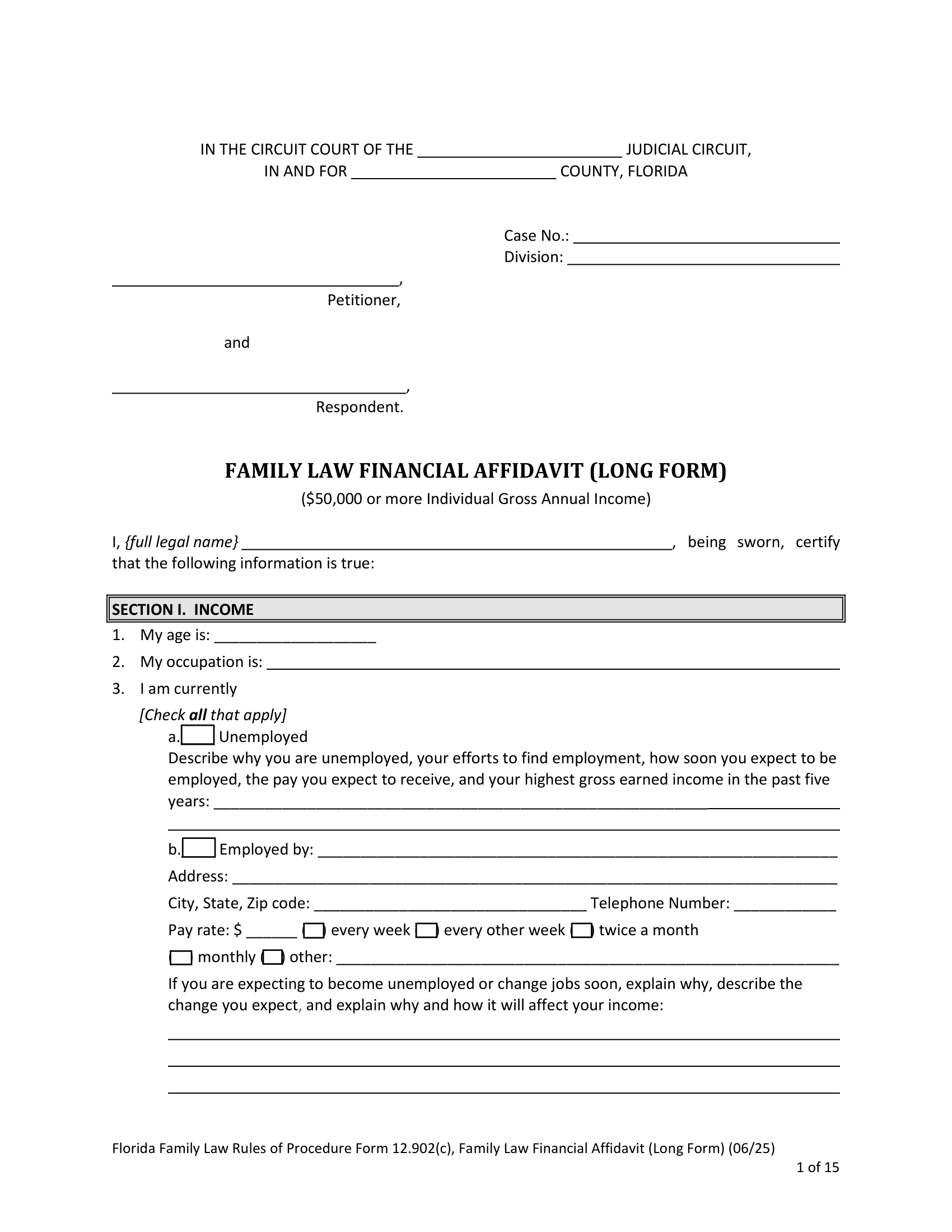
Form 12.902(c), page 1, caption and opening — tap to open the full page
What it asks
IN THE CIRCUIT COURT OF THE ___ JUDICIAL CIRCUIT, IN AND FOR ___ COUNTY, FLORIDA, the case number, division, Petitioner and Respondent, then “I, {full legal name}, being sworn, certify that the following information is true.”
What to put
Copy the caption from the petition or supplemental petition in your case. For example, Petitioner Maria Lopez and Respondent Daniel Reyes. Then your full legal name.
Common mistake
Using the long form’s heading without checking the line. It reads “$50,000 or more Individual Gross Annual Income.”
Section I, items 1 and 2
Age and occupation
Form 12.902(c), page 1, Section I, items 1 and 2 — tap to open the full page
What it asks
Item 1, your age. Item 2, your occupation.
What to put
Your age today and your occupation.
Common mistake
Skipping these because the short form does not ask them.
Section I, item 3a
Unemployed
Form 12.902(c), page 1, Section I, item 3a — tap to open the full page
What it asks
A box for unemployed, and a description of why you are unemployed, your efforts to find employment, how soon you expect to be employed, the pay you expect to receive, and your highest gross earned income in the past five years.
What to put
Every part of the description the item asks for, including the highest gross earned income in the past five years.
Common mistake
Checking the box and leaving the description blank.
Section I, item 3b
Employed
Form 12.902(c), page 1, Section I, item 3b — tap to open the full page
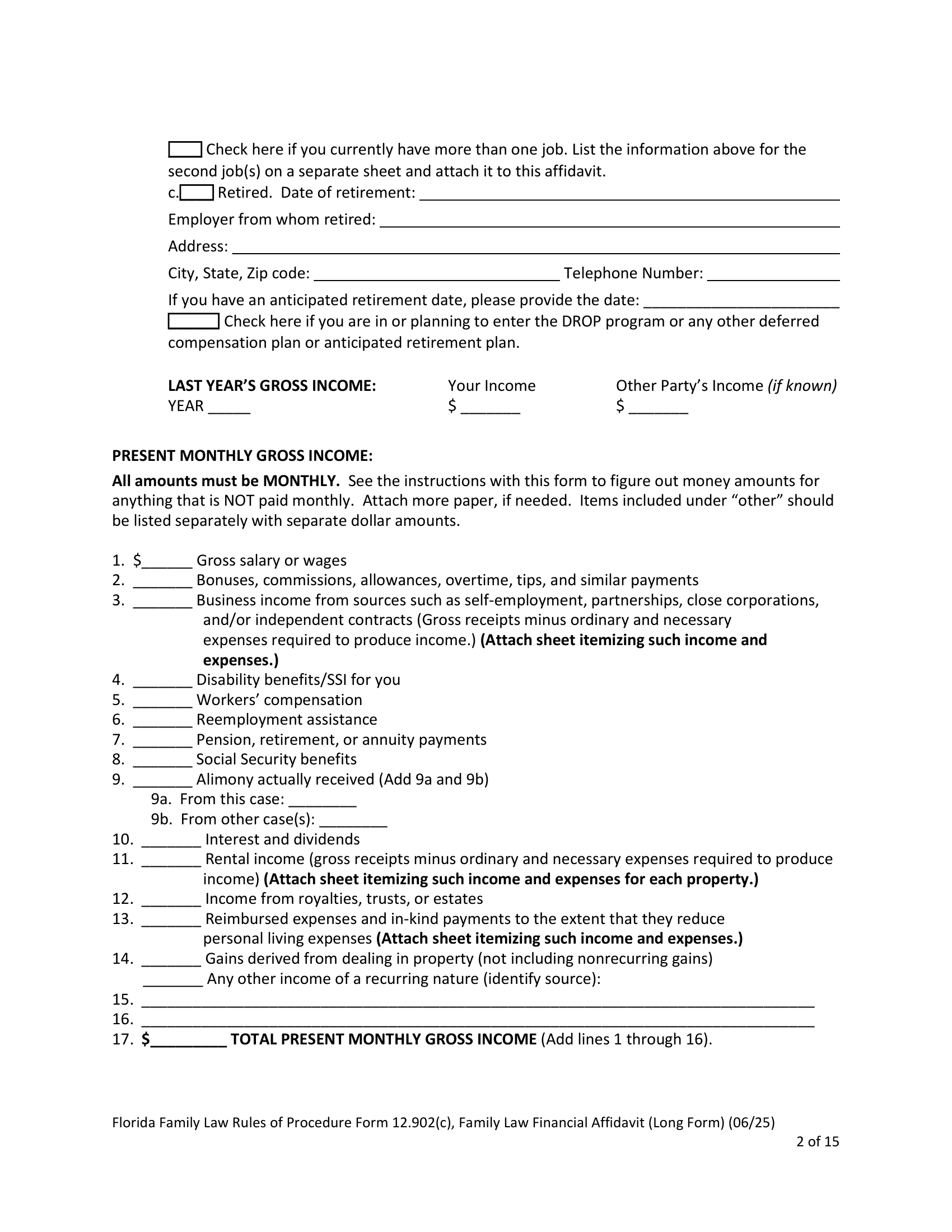
Form 12.902(c), page 2, Section I, item 3b (continued) — tap to open the full page
What it asks
Employer, address, city, state, ZIP, telephone number, pay rate with boxes for every week, every other week, twice a month, monthly or other; an explanation if you expect to become unemployed or change jobs soon; and a box to check if you have more than one job.
What to put
Your current employer and pay rate as on your pay stub. If you have more than one job, check the box and attach a separate sheet with the same information for each other job, as the form asks.
Common mistake
Leaving out an expected job change. The item asks you to explain it and how it will affect your income.
Section I, item 3c
Retired
Form 12.902(c), page 2, Section I, item 3c — tap to open the full page
What it asks
Date of retirement, the employer you retired from and its address and telephone, any anticipated retirement date, and a box for being in or planning to enter the DROP program or any other deferred compensation plan or anticipated retirement plan.
What to put
Fill in whichever parts apply. Item 3 says to check all that apply.
Common mistake
Leaving the DROP box unchecked when you are in or planning to enter a deferred compensation or retirement plan the box describes.
Last year’s gross income
Your income and the other party’s income (if known)
Form 12.902(c), page 2, last year’s gross income — tap to open the full page
What it asks
The year, your gross income for that year, and the other party’s gross income for that year if known.
What to put
Your gross income from your most recent full year. Fill in the other party’s only if you know it.
Common mistake
Entering a monthly figure. This line is annual.
Section I, lines 1 through 3
Salary, bonuses, and business income
Form 12.902(c), page 2, Section I, lines 1 through 3 — tap to open the full page
What it asks
Line 1, gross salary or wages. Line 2, bonuses, commissions, allowances, overtime, tips, and similar payments. Line 3, business income from self-employment, partnerships, close corporations, and/or independent contracts, as gross receipts minus ordinary and necessary expenses, with an itemizing sheet attached.
What to put
Monthly gross amounts, and the itemized sheet for line 3.
Common mistake
Multiplying weekly pay by 4. The instructions use 52 weeks divided by 12 months.
Section I, lines 4 through 8
Disability, workers’ compensation, reemployment assistance, pension, Social Security
Form 12.902(c), page 2, Section I, lines 4 through 8 — tap to open the full page
What it asks
Line 4, disability benefits/SSI for you; line 5, workers’ compensation; line 6, reemployment assistance; line 7, pension, retirement, or annuity payments; line 8, Social Security benefits.
What to put
The monthly amount of each benefit you receive. Line 6 is labeled “Reemployment assistance,” where the short form says Unemployment Compensation.
Common mistake
Leaving benefit income off because it is not a paycheck.
Section I, line 9
Alimony actually received
Form 12.902(c), page 2, Section I, line 9 — tap to open the full page
What it asks
The total of 9a (from this case) and 9b (from other case(s)).
What to put
What you actually receive, split by case.
Common mistake
Entering the ordered amount when the payments are not being made.
Form 12.902(c), page 2, Section I, lines 10 through 14 — tap to open the full page
What it asks
Line 10, interest and dividends; line 11, rental income (gross receipts minus ordinary and necessary expenses, with a sheet itemizing income and expenses for each property); line 12, royalties, trusts, or estates; line 13, reimbursed expenses and in-kind payments to the extent they reduce personal living expenses, with an itemizing sheet; line 14, gains from dealing in property, not including nonrecurring gains.
What to put
Monthly figures, and the sheets lines 11 and 13 call for.
Common mistake
One combined rental sheet for several properties. Line 11 asks for each property.
Section I, lines 15 through 17
Other recurring income, and total present monthly gross income
Form 12.902(c), page 2, Section I, lines 15 through 17 — tap to open the full page
What it asks
Lines 15 and 16, any other income of a recurring nature, with its source; line 17, TOTAL PRESENT MONTHLY GROSS INCOME, adding lines 1 through 16.
What to put
Each other source on its own line, then the total.
Common mistake
Lumping several sources into one amount.
Section I, lines 18 through 22
Income tax, FICA, Medicare, union dues, mandatory retirement
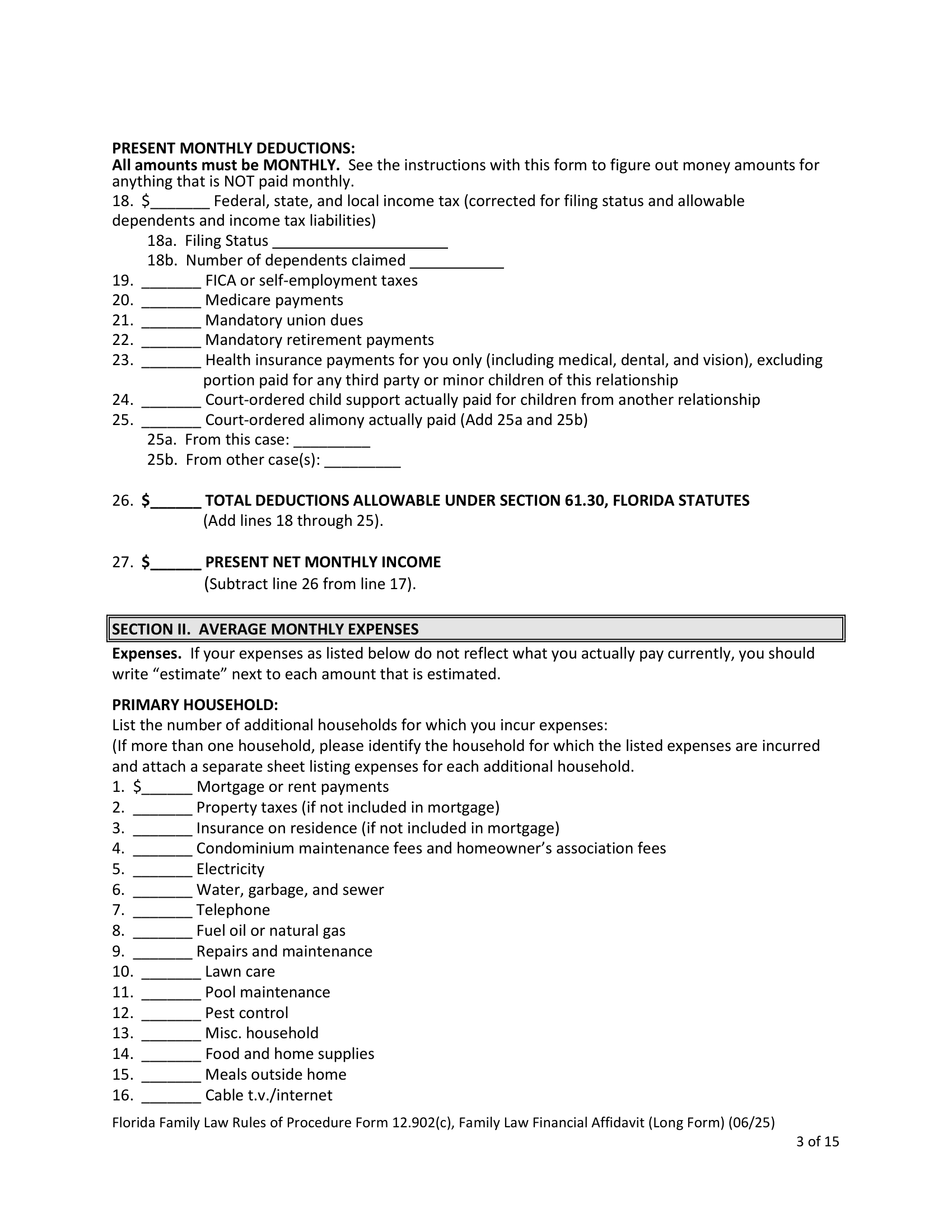
Form 12.902(c), page 3, Section I, lines 18 through 22 — tap to open the full page
What it asks
Line 18, federal, state, and local income tax corrected for filing status and allowable dependents and income tax liabilities, with 18a filing status and 18b number of dependents claimed; line 19, FICA or self-employment taxes; line 20, Medicare payments; line 21, mandatory union dues; line 22, mandatory retirement payments.
What to put
Monthly amounts, with 18a and 18b filled in.
Common mistake
Listing voluntary retirement contributions on line 22. The line says mandatory.
Section I, line 23
Health insurance payments for you only
Form 12.902(c), page 3, Section I, line 23 — tap to open the full page
What it asks
Health insurance for you only, including medical, dental, and vision, excluding the portion paid for any third party or minor children of this relationship.
What to put
Your own share of the premium. Section II has line 50 for the children’s health insurance and lines 71, 73 and 74 for other coverage not listed on line 23 or 50.
Common mistake
Including a spouse’s or the children’s portion here.
Section I, lines 24 through 27
Support paid, total deductions, net income
Form 12.902(c), page 3, Section I, lines 24 through 27 — tap to open the full page
What it asks
Line 24, court-ordered child support actually paid for children from another relationship; line 25, court-ordered alimony actually paid (25a this case, 25b other cases); line 26, TOTAL DEDUCTIONS ALLOWABLE UNDER SECTION 61.30, FLORIDA STATUTES, adding lines 18 through 25; line 27, PRESENT NET MONTHLY INCOME, line 17 minus line 26.
What to put
Amounts actually paid under court orders, then the two totals.
Common mistake
Listing support for the children in this case on line 24. The line is for children from another relationship.
Section II, lines 1 through 27
Primary household
Form 12.902(c), page 3, Section II, lines 1 through 27 — tap to open the full page
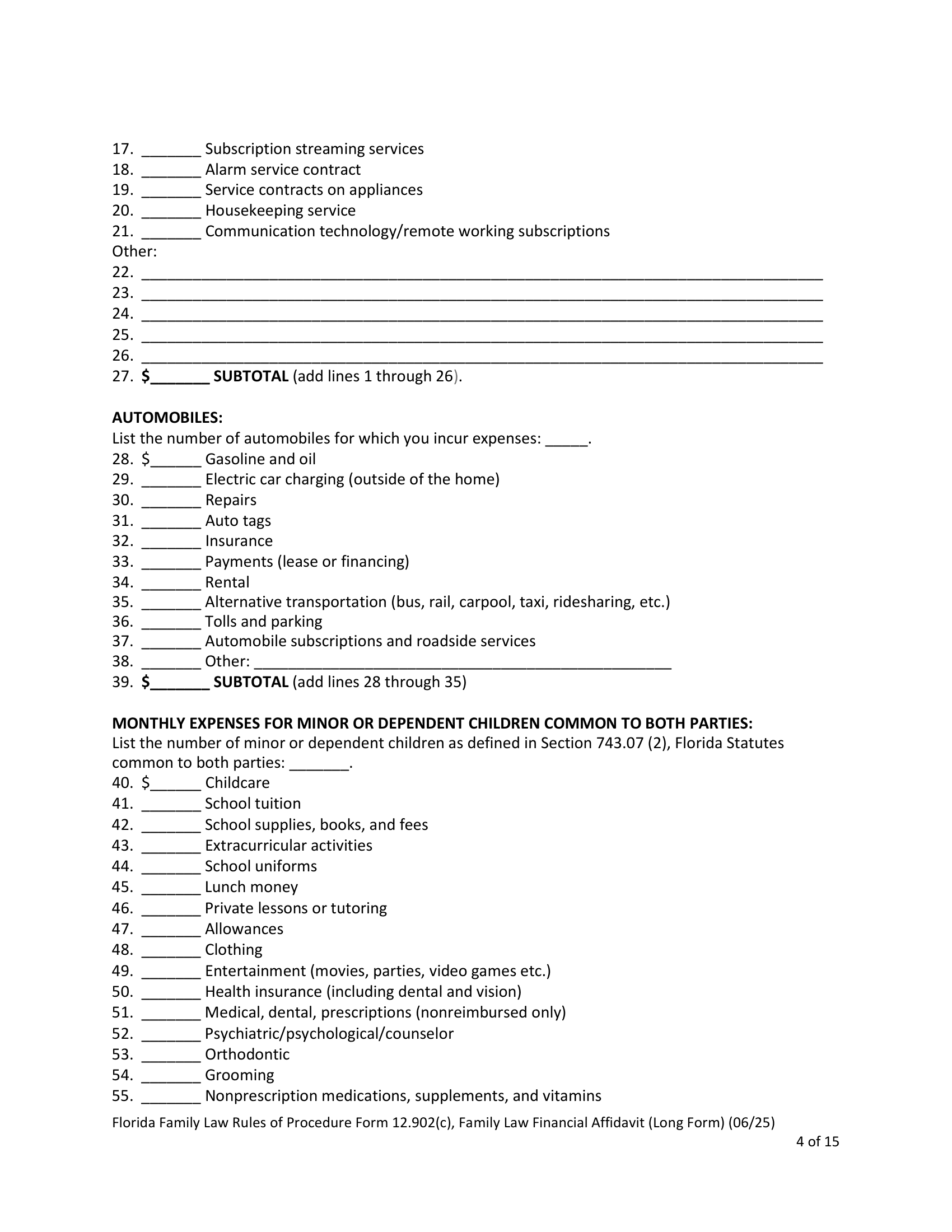
Form 12.902(c), page 4, Section II, lines 1 through 27 (continued) — tap to open the full page
What it asks
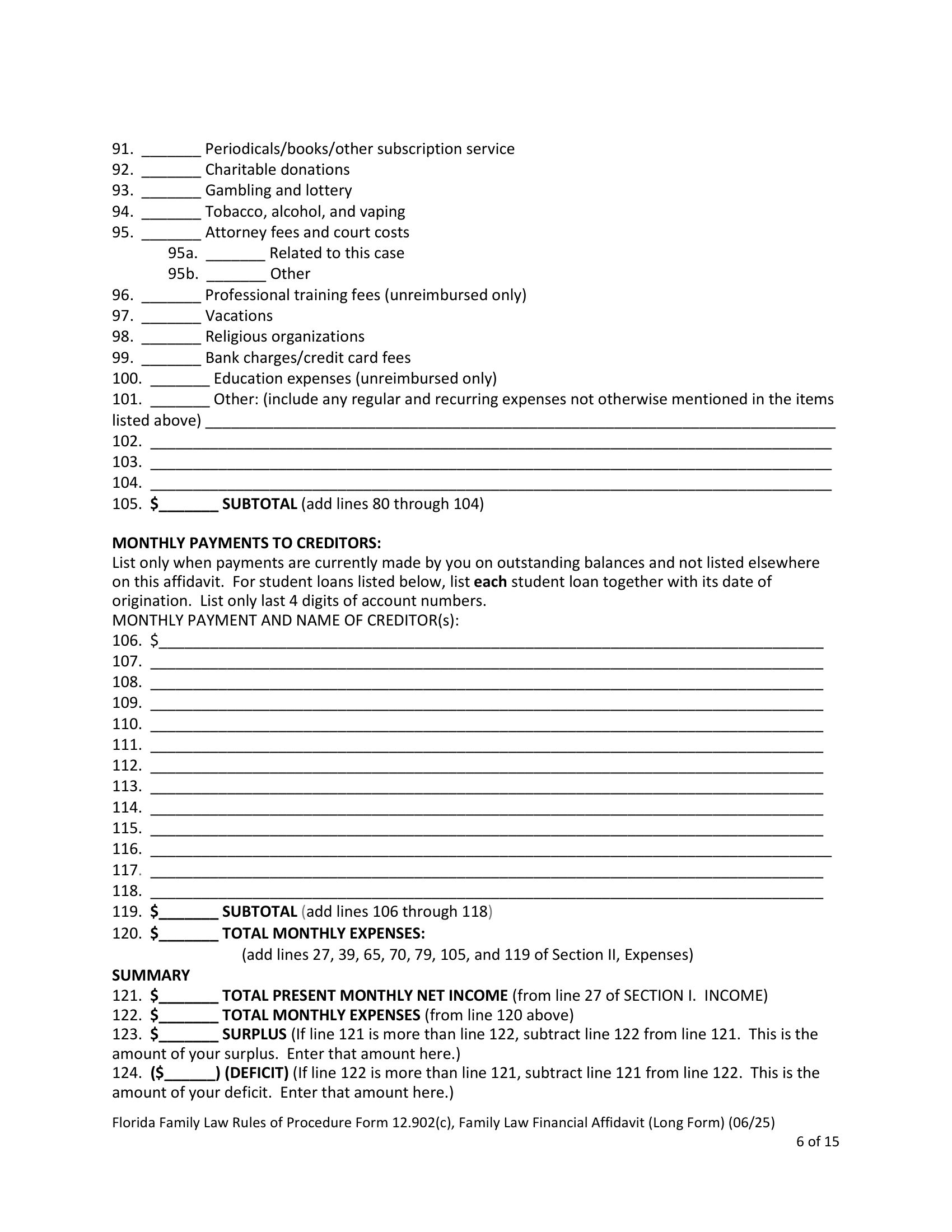
The number of additional households you pay expenses for, then mortgage or rent, property taxes and insurance (if not in the mortgage), condominium and homeowner’s association fees, utilities, telephone, repairs, lawn, pool, pest control, food, meals outside the home, cable and internet, streaming, alarm, appliance service contracts, housekeeping, remote working subscriptions, other lines, and a SUBTOTAL at line 27.
What to put
Average monthly amounts. If you pay for more than one household, the section asks you to identify which household these figures are for and attach a separate sheet for each additional household. Write “estimate” next to any amount that does not reflect what you actually pay now.
Common mistake
Putting an annual tax or insurance bill in as a monthly figure. Divide it by 12.
Section II, lines 28 through 39
Automobiles
Form 12.902(c), page 4, Section II, lines 28 through 39 — tap to open the full page
What it asks
The number of automobiles you pay expenses for, then gasoline and oil, electric car charging outside the home, repairs, tags, insurance, lease or financing payments, rental, alternative transportation, tolls and parking, subscriptions and roadside services, other, and a SUBTOTAL at line 39.
What to put
Monthly amounts. The printed instruction at line 39 reads “add lines 28 through 35,” although lines 36, 37 and 38 are also automobile expenses; check how you totaled it against the lines you used.
Common mistake
Listing the car payment here and again under creditors.
Section II, lines 40 through 65
Expenses for minor or dependent children common to both parties
Form 12.902(c), page 4, Section II, lines 40 through 65 — tap to open the full page
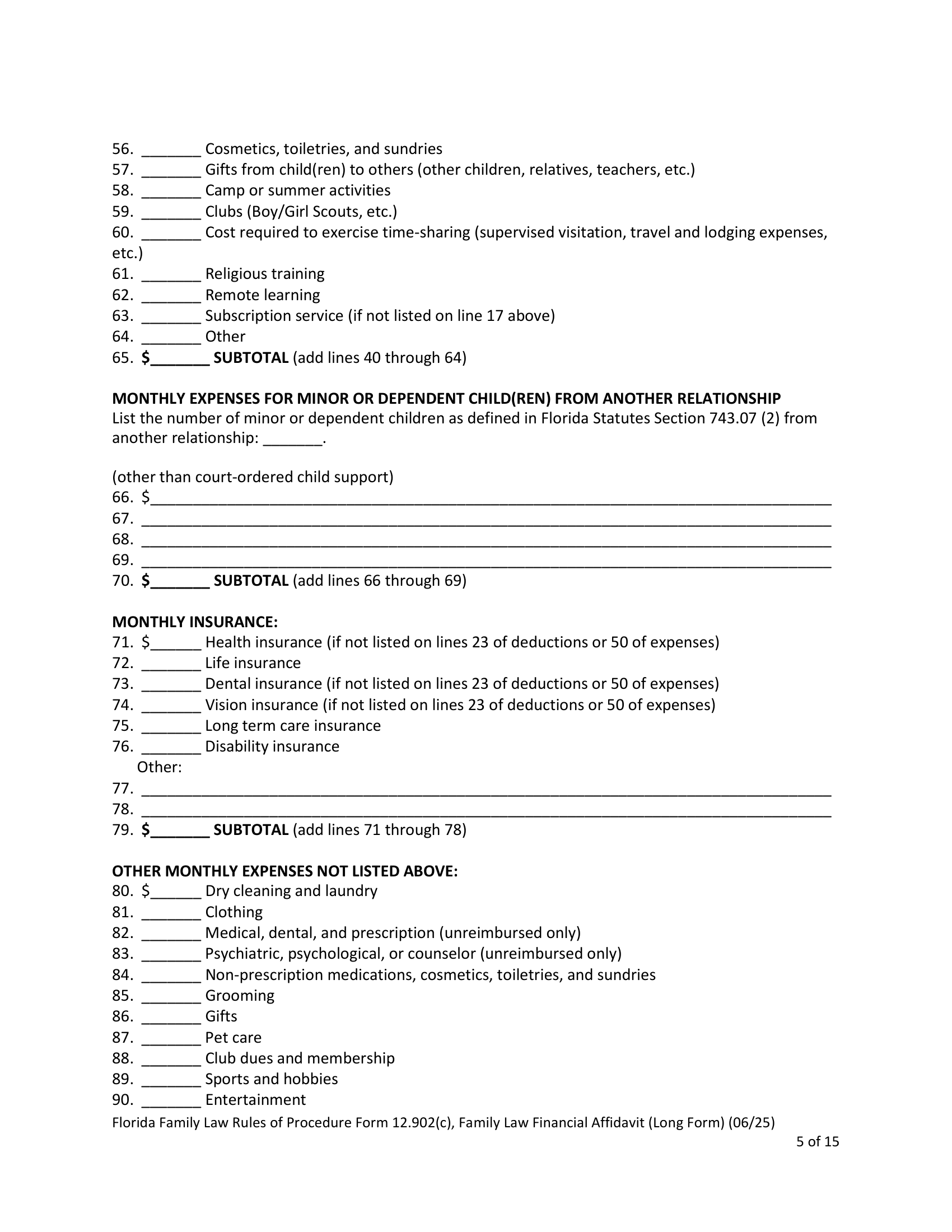
Form 12.902(c), page 5, Section II, lines 40 through 65 (continued) — tap to open the full page
What it asks
The number of minor or dependent children common to both parties, as defined in section 743.07(2), Florida Statutes, then childcare, tuition, school supplies, activities, uniforms, lunch money, lessons, allowances, clothing, entertainment, health insurance, unreimbursed medical, counseling, orthodontic, grooming, nonprescription items, toiletries, gifts, camp, clubs, the cost required to exercise time-sharing, religious training, remote learning, subscriptions, other, and a SUBTOTAL at line 65.
What to put
What you actually spend per month for the children you share with the other party. Line 60 is where the cost of exercising time-sharing goes, such as supervised visitation, travel and lodging.
Common mistake
Counting the children’s health insurance on line 50 and again on line 71. Lines 71, 73 and 74 say “if not listed on lines 23 of deductions or 50 of expenses.”
Section II, lines 66 through 70
Expenses for children from another relationship
Form 12.902(c), page 5, Section II, lines 66 through 70 — tap to open the full page
What it asks
The number of minor or dependent children from another relationship, then their expenses other than court-ordered child support, and a SUBTOTAL at line 70.
What to put
Expenses you pay for those children beyond court-ordered support, which is already on line 24.
Common mistake
Repeating court-ordered support here. The section excludes it.
Section II, lines 71 through 79
Monthly insurance
Form 12.902(c), page 5, Section II, lines 71 through 79 — tap to open the full page
What it asks
Health, dental and vision insurance not already on line 23 or 50, life, long term care, disability, other lines, and a SUBTOTAL at line 79.
What to put
Premiums not counted elsewhere, monthly.
Common mistake
Repeating your own health premium from line 23.
Section II, lines 80 through 105
Other monthly expenses not listed above
Form 12.902(c), page 5, Section II, lines 80 through 105 — tap to open the full page
Form 12.902(c), page 6, Section II, lines 80 through 105 (continued) — tap to open the full page
What it asks
Dry cleaning, clothing, unreimbursed medical and counseling, toiletries, grooming, gifts, pet care, clubs, hobbies, entertainment, subscriptions, charitable donations, gambling and lottery, tobacco, alcohol and vaping, attorney fees and court costs (95a related to this case, 95b other), unreimbursed professional training, vacations, religious organizations, bank and card fees, unreimbursed education, other regular and recurring expenses, and a SUBTOTAL at line 105.
What to put
Your own recurring expenses, averaged monthly.
Common mistake
Folding this case’s attorney fees into line 95b. Line 95a is for fees related to this case.
Section II, lines 106 through 119
Monthly payments to creditors
Form 12.902(c), page 6, Section II, lines 106 through 119 — tap to open the full page
What it asks
The monthly payment and name of each creditor, and a SUBTOTAL at line 119.
What to put
Only payments you are currently making on outstanding balances that are not listed elsewhere on the affidavit, as the section says. List each student loan with its date of origination, and only the last 4 digits of account numbers.
Common mistake
Listing a mortgage or car payment already entered in the household or automobile sections.
Section II, line 120 and Summary (lines 121 through 124)
Total monthly expenses, surplus or deficit
Form 12.902(c), page 6, Section II, line 120 and summary — tap to open the full page
What it asks
Line 120, TOTAL MONTHLY EXPENSES, adding the subtotals at lines 27, 39, 65, 70, 79, 105 and 119. Line 121, net income from line 27 of Section I; line 122, expenses from line 120; line 123, the surplus if line 121 is more; line 124, the deficit if line 122 is more.
What to put
The totals, and either line 123 or line 124, not both.
Common mistake
Carrying line 27 of Section II (the household subtotal) into line 121. Line 121 takes line 27 of Section I, present net monthly income.
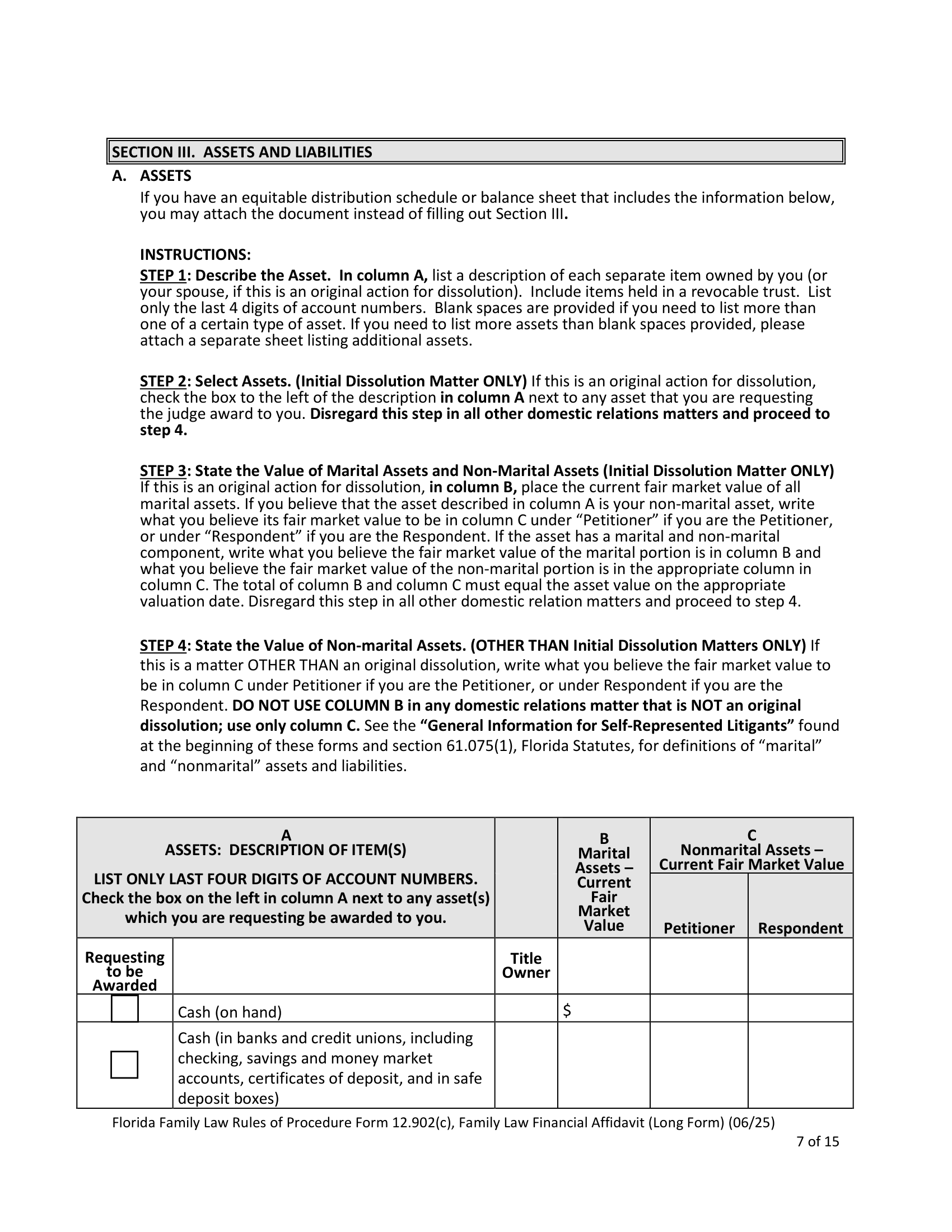
Section III A, instructions and columns
Assets: how to use columns A, B and C
Form 12.902(c), page 7, Section III A, instructions and columns — tap to open the full page
What it asks
Step 1, describe each asset in column A, including items held in a revocable trust. Steps 2 and 3, for an original dissolution only, check the box next to assets you ask to be awarded and enter marital value in column B and nonmarital value in column C. Step 4, for any matter other than an original dissolution, enter the value in column C under Petitioner or Respondent and do not use column B.
What to put
In a modification or any other matter that is not an original dissolution, use column A and column C only. In an original dissolution, the step 3 instruction says the total of columns B and C must equal the asset’s value on the appropriate valuation date.
Common mistake
Filling in column B in a modification. Step 4 says DO NOT USE COLUMN B in any domestic relations matter that is not an original dissolution.
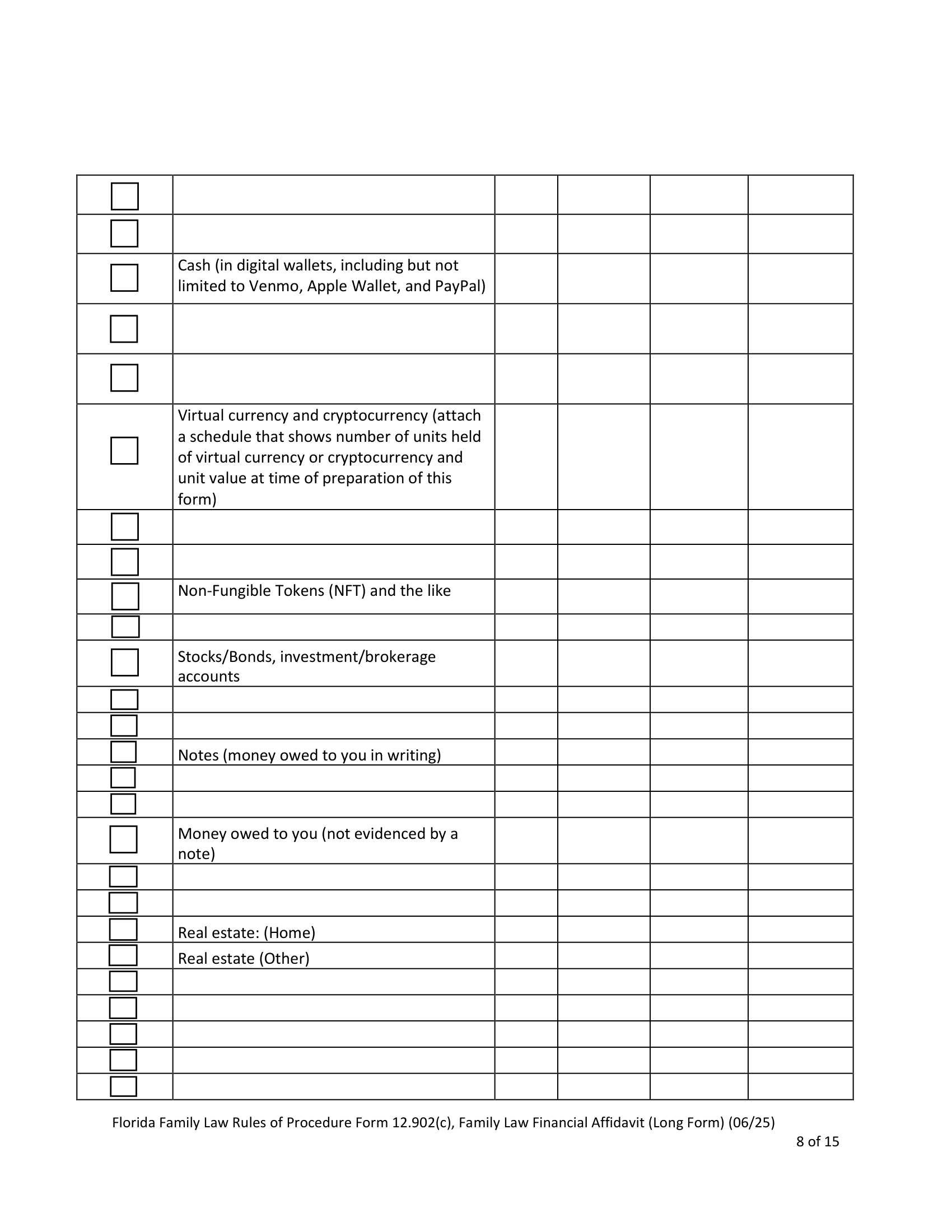
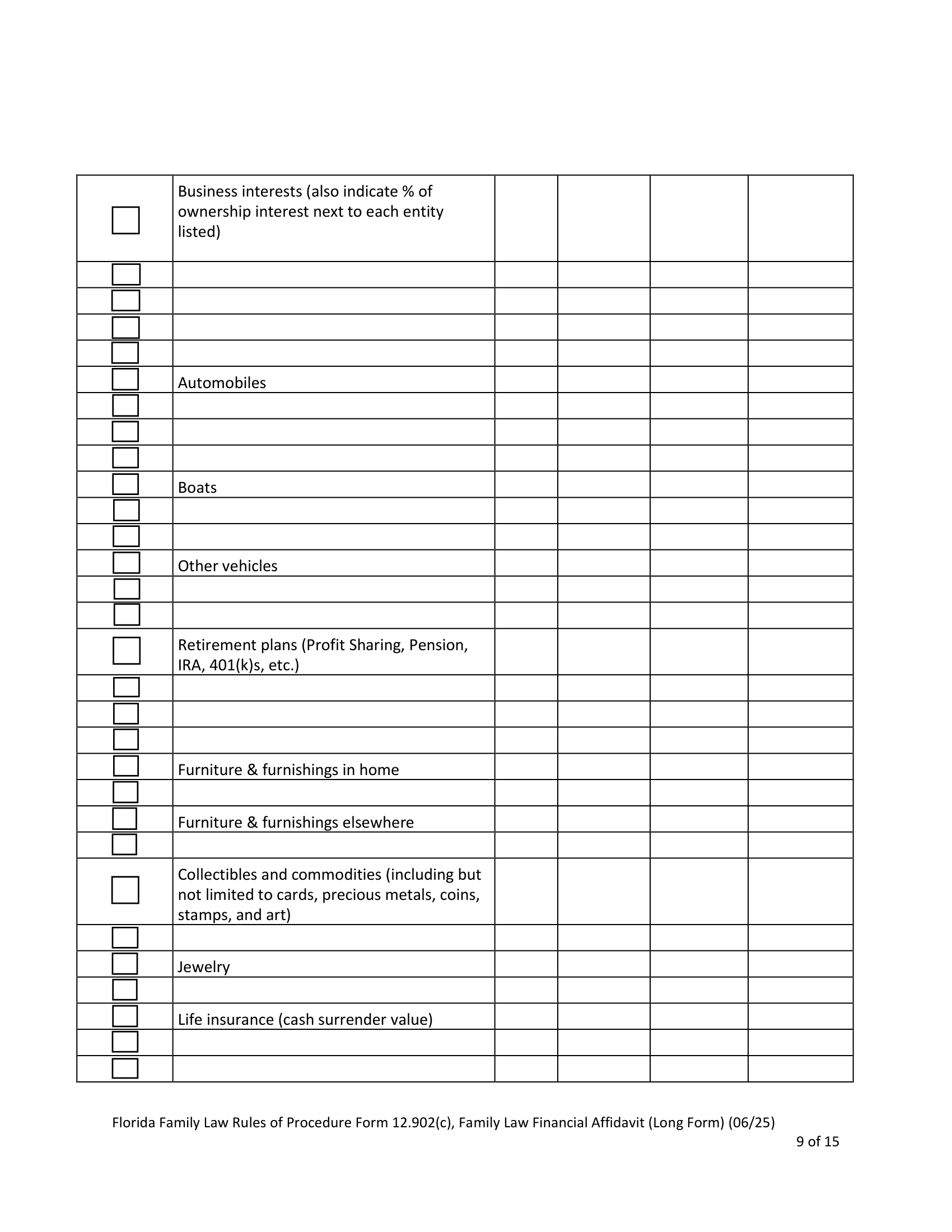
Section III A, asset rows
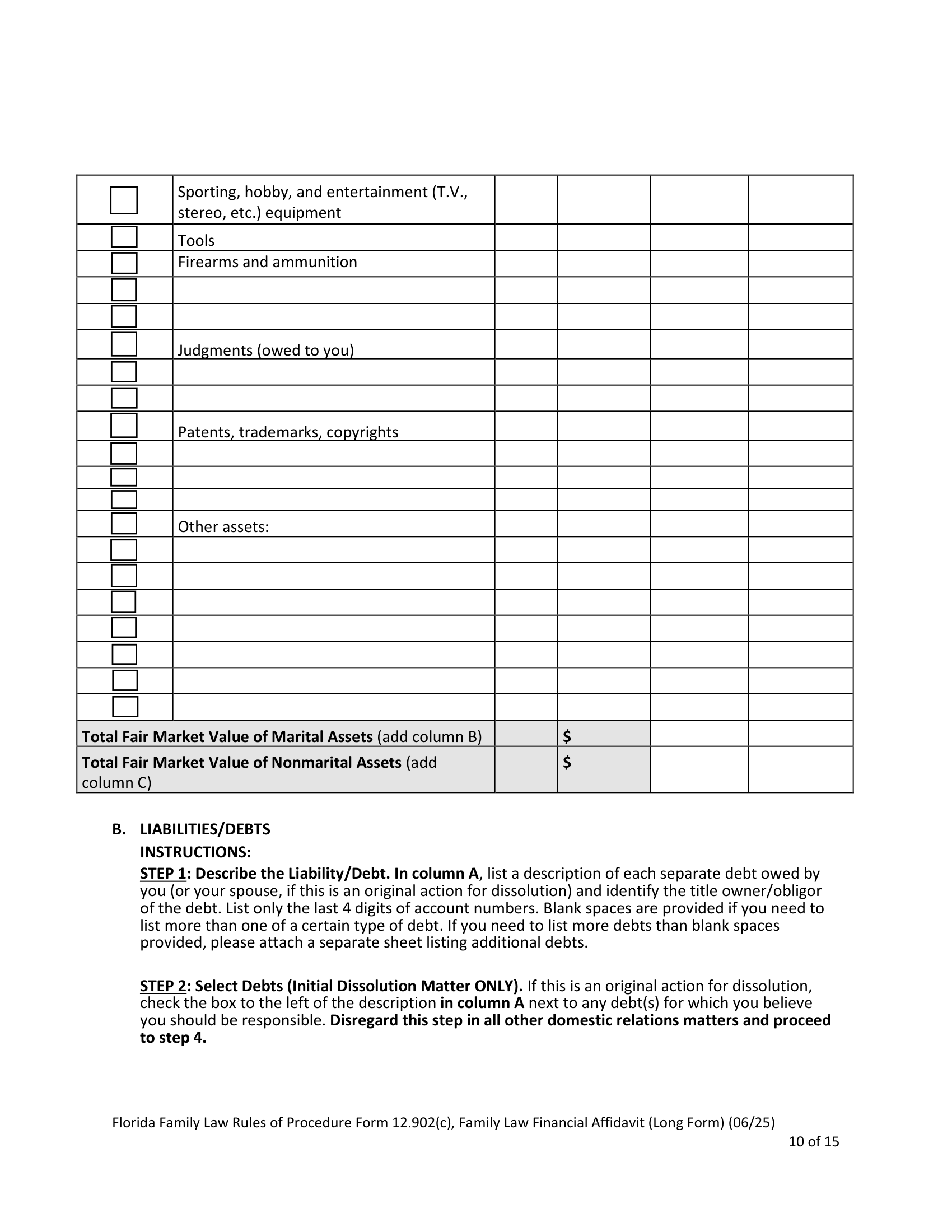
Cash through patents, trademarks, copyrights
Form 12.902(c), page 7, Section III A, asset rows — tap to open the full page
Form 12.902(c), page 8, Section III A, asset rows (continued) — tap to open the full page
Form 12.902(c), page 9, Section III A, asset rows (continued) — tap to open the full page
Form 12.902(c), page 10, Section III A, asset rows (continued) — tap to open the full page
What it asks
Rows for cash on hand; cash in banks and credit unions; cash in digital wallets such as Venmo, Apple Wallet and PayPal; virtual currency and cryptocurrency; non-fungible tokens; stocks, bonds and brokerage accounts; notes and money owed to you; real estate (home and other); business interests with percentage owned; automobiles, boats and other vehicles; retirement plans; furniture; collectibles; jewelry; life insurance cash surrender value; sporting and hobby equipment; tools; firearms and ammunition; judgments owed to you; patents, trademarks and copyrights; other assets; and totals for columns B and C.
What to put
One asset per row, last four digits only for accounts, the title owner, and its current fair market value. For virtual currency, attach the schedule the row asks for, showing the number of units held and the unit value at the time you prepare the form.
Common mistake
Leaving off digital wallet balances or crypto holdings. Each has its own row.
Section III B
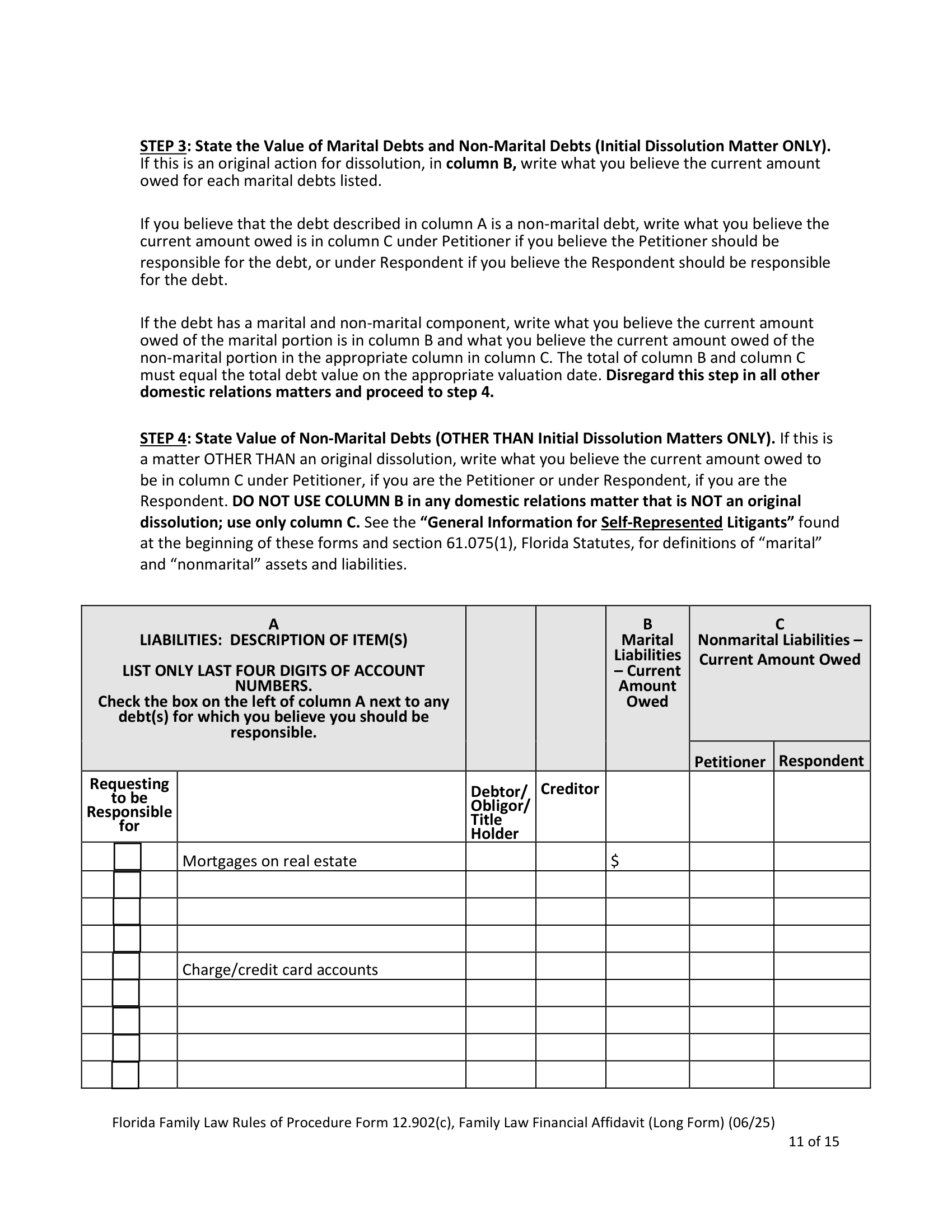
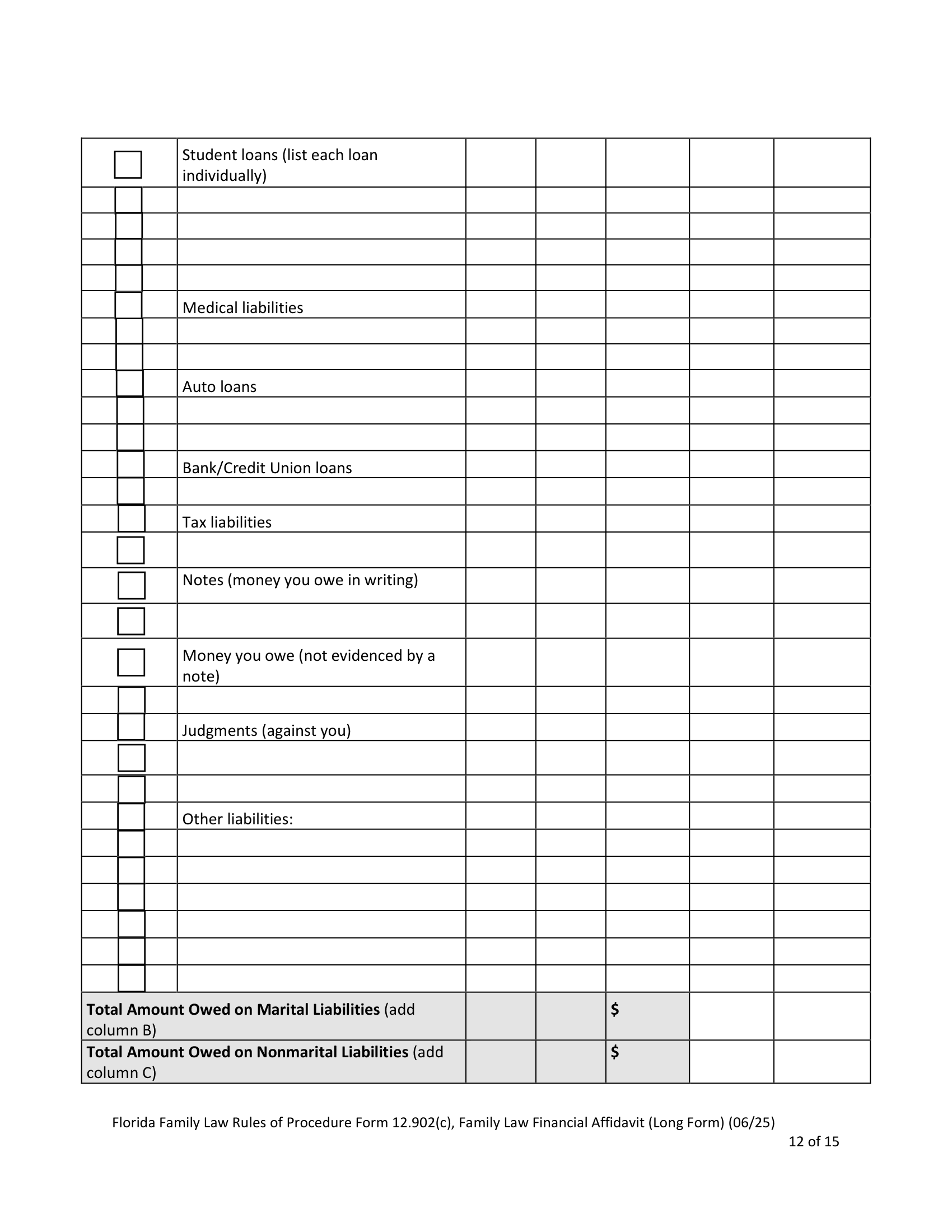
Liabilities and debts
Form 12.902(c), page 10, Section III B — tap to open the full page
Form 12.902(c), page 11, Section III B (continued) — tap to open the full page
Form 12.902(c), page 12, Section III B (continued) — tap to open the full page
What it asks
The same four steps for debts, with columns for the debtor, obligor or title holder and the creditor. Rows cover mortgages, charge and credit card accounts, student loans (each loan listed individually), medical liabilities, auto loans, bank and credit union loans, tax liabilities, notes and money you owe, judgments against you, other liabilities, and totals for columns B and C.
What to put
Each debt with the current amount owed. Outside an original dissolution, step 4 says to use column C only. In an original dissolution, check the box next to any debt you believe you should be responsible for.
Common mistake
Listing the monthly payment instead of the balance owed. Payments are in Section II.
Section III C
Net worth
Form 12.902(c), page 13, Section III C — tap to open the full page
What it asks
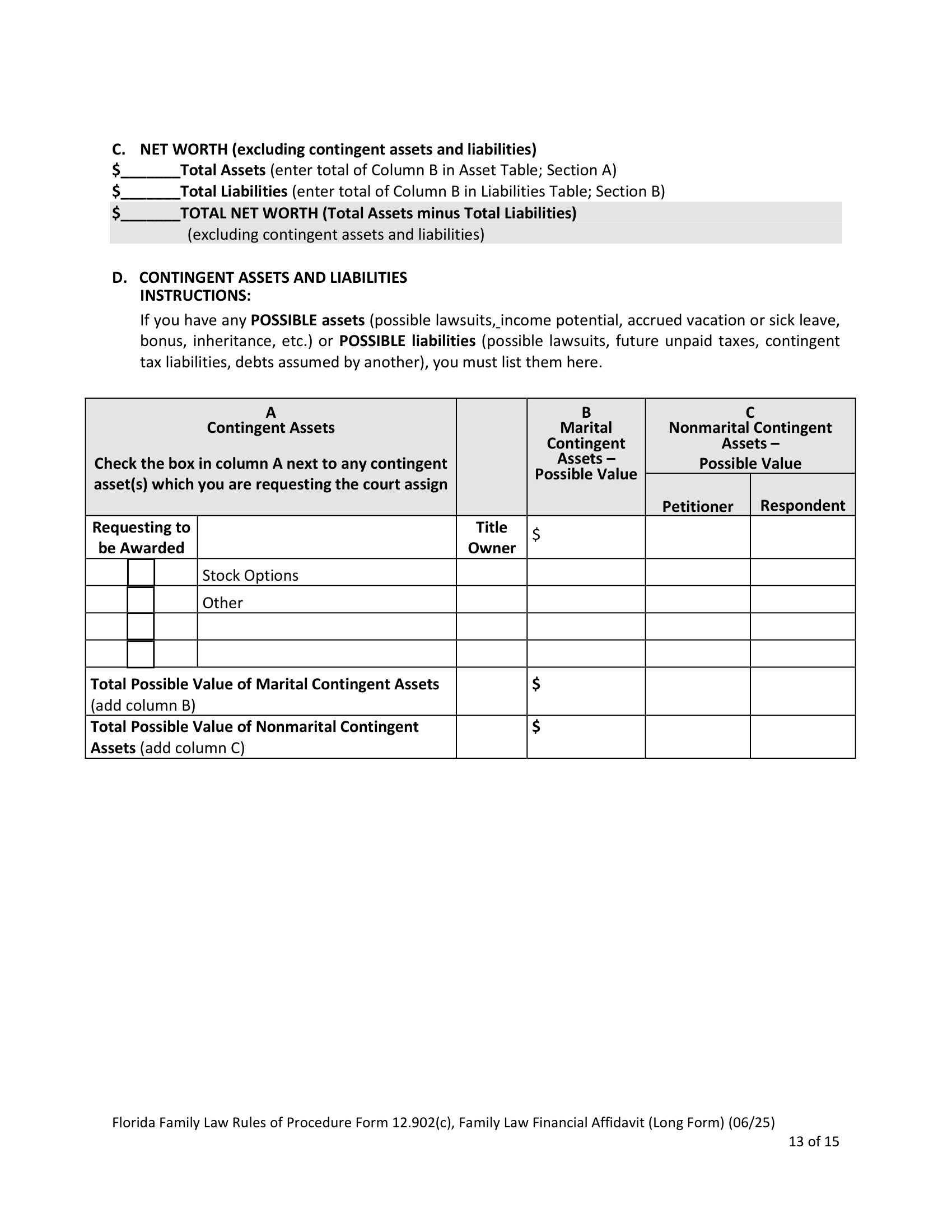
Total assets from column B of the asset table, total liabilities from column B of the liabilities table, and TOTAL NET WORTH, total assets minus total liabilities, excluding contingent assets and liabilities.
What to put
The three figures, taken from the column B totals as the form prints it.
Common mistake
Including contingent items. The heading excludes them.
Section III D
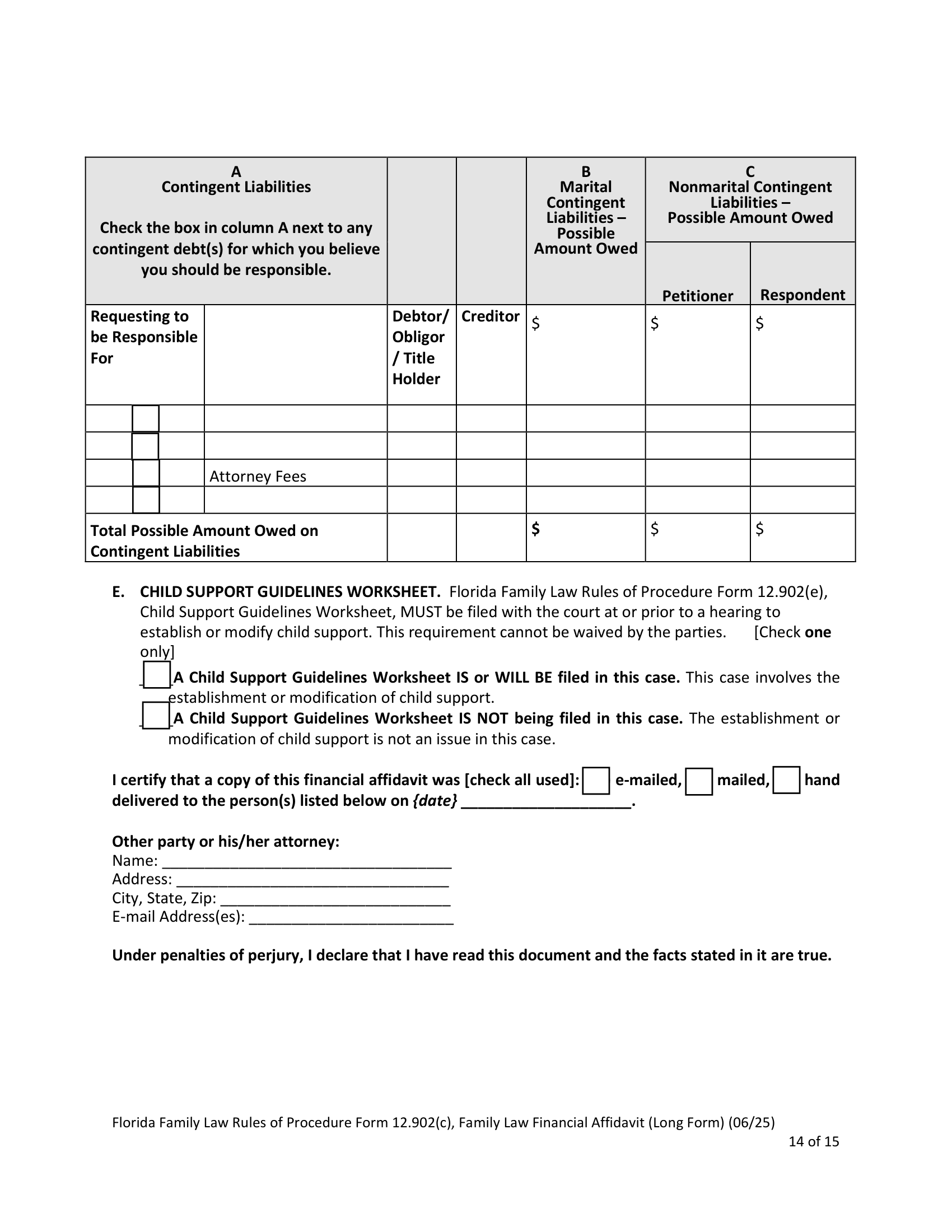
Contingent assets and liabilities
Form 12.902(c), page 13, Section III D — tap to open the full page
Form 12.902(c), page 14, Section III D (continued) — tap to open the full page
What it asks
Possible assets (possible lawsuits, income potential, accrued vacation or sick leave, bonus, inheritance) and possible liabilities (possible lawsuits, future unpaid taxes, contingent tax liabilities, debts assumed by another), in the same column layout, with rows for stock options and attorney fees.
What to put
Anything that may become an asset or a debt. The instructions in this section say you must list them.
Common mistake
Leaving out unvested stock options or an expected bonus because they are not certain.
Section III E
Child Support Guidelines Worksheet
Form 12.902(c), page 14, Section III E — tap to open the full page
What it asks
One of two statements: a Child Support Guidelines Worksheet IS or WILL BE filed because the case involves establishing or modifying child support, or one IS NOT being filed because child support is not an issue.
What to put
Check exactly one. The section states that Form 12.902(e) must be filed at or prior to a hearing to establish or modify child support and that this cannot be waived by the parties, which rule 12.285(k) also provides.
Common mistake
Checking “IS NOT” in a case where child support is being set or changed.
Certificate of service
I certify that a copy of this financial affidavit was
Form 12.902(c), page 14, certificate of service — tap to open the full page
What it asks
How it was sent, e-mailed, mailed, or hand delivered, the date, and the other party’s or their attorney’s name, address, city, state, ZIP and e-mail.
What to put
The method and date you actually used. The instructions say the copy must be mailed, e-mailed, or hand delivered on the same day shown in the certificate, and if mailed, postmarked that day.
Common mistake
Dating the certificate for a day other than the day the copy went out.
Signature
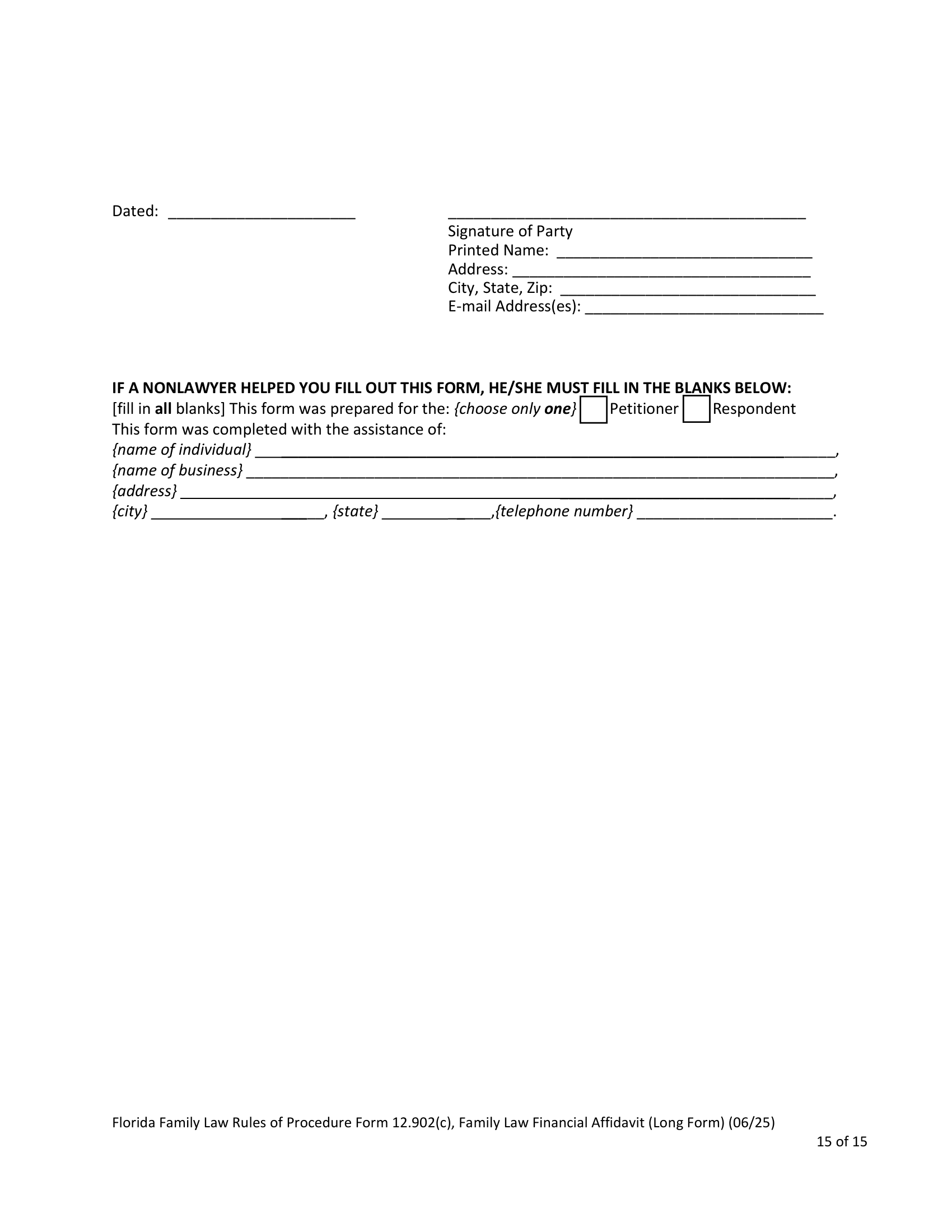
Under penalties of perjury
Form 12.902(c), page 14, signature — tap to open the full page
Form 12.902(c), page 15, signature (continued) — tap to open the full page
What it asks
The declaration that you have read the document and the facts stated in it are true, the date, your signature, and your printed name, address, city, state, ZIP and e-mail.
What to put
Your signature and contact details. There is no notary block. If you have a confidential-address finding, the instructions say to leave the address and telephone blank and file Form 12.980(h).
Common mistake
Signing before every section is complete.
Nonlawyer block
If a nonlawyer helped you fill out this form
Form 12.902(c), page 15, nonlawyer block — tap to open the full page
What it asks
Whether the form was prepared for the Petitioner or the Respondent, and the name, business, address, city, state and telephone number of any nonlawyer who helped.
What to put
Left blank if no one helped you. If a nonlawyer did, the instructions say that person must give you a Disclosure from Nonlawyer, Form 12.900(a), before helping.
Common mistake
Leaving it blank when someone did help you complete the form.
Common pitfalls
Using column B in a modification
Section III’s step 4 says that in any matter other than an original dissolution you enter values in column C under Petitioner or Respondent and DO NOT USE COLUMN B. Columns B and C are split between marital and nonmarital value only in an original dissolution.
Totaling Section II from the wrong lines
Section II restarts its numbering at 1, so it has its own line 27 (the household subtotal). Line 121 takes line 27 of Section I, present net monthly income. The automobile subtotal at line 39 is printed as “add lines 28 through 35” although the automobile lines run to 38.
Counting insurance twice
Line 23 is health insurance for you only. Line 50 is the children’s health insurance. Lines 71, 73 and 74 are only for coverage not already listed on line 23 or line 50.
Leaving out newer kinds of assets
The asset table has its own rows for digital wallets, virtual currency and cryptocurrency (with an attached schedule of units and unit values), and non-fungible tokens. Rule 12.285(e)(11) separately requires statements for the past 12 months for virtual currency transactions and a listing of current holdings.
Not updating it
Rule 12.285(f)(1) gives parties a continuing duty to supplement their disclosure, including financial affidavits, whenever a material change in their financial status occurs.
Filing the supporting documents
Rule 12.285(a)(3)(A) says that, other than the financial affidavit and the child support guidelines worksheet, documents produced under the mandatory disclosure rule are not filed in the court file without a court order. They are served on the other party.
What to file with 12.902(c)
12.902(e): Child Support Guidelines Worksheet. When child support is being established or modified, filed at or before the hearing under rule 12.285(k). Section III E states whether it is or will be filed.
12.932: Certificate of Compliance with Mandatory Disclosure. Rule 12.285(j) requires parties subject to mandatory disclosure to file it, identifying the documents delivered and certifying the date the financial affidavit and documents were served.
12.902(b): Family Law Financial Affidavit (Short Form). Instead of this form if your gross annual income is under $50,000, unless the other party requests the long form through the Standard Family Law Interrogatories or the court orders it. Read the 12.902(b) walkthrough.
12.980(h): Request for Confidential Filing of Address. Instead of entering your address, if a judge has found you to be the victim of one of the crimes the instructions list.
12.915: Designation of Current Mailing and E-mail Address. If you choose to serve and receive documents by e-mail. The instructions say to designate your address on this form and give it on every form you sign.
The instructions say to file the affidavit with the clerk of the circuit court in the county where the petition was filed, and that if you file electronically you must follow the procedures of the judicial circuit where you file.
When do I use the long form financial affidavit in Florida?
When your gross annual income is $50,000 or more. Rule 12.285(e)(1) of the Florida Family Law Rules of Procedure calls for Form 12.902(c) at that level, and also lets the other party, through the Standard Family Law Interrogatories, or the court on its own motion, require a party under $50,000 to complete it.
Which columns do I use in Section III in a modification case?
Column A to describe each item and column C for its value, under Petitioner or Respondent. Step 4 of the Section III instructions says that in any matter other than an original dissolution you do not use column B.
Does the long form have to be notarized?
The form has no notary block. It ends with a declaration under penalties of perjury that you have read the document and the facts stated in it are true, followed by your signature.
When is it due?
The instructions say a copy must be served on the other party within 45 days of being served with the petition, if it is not served with your initial papers, and filed with the court. Rule 12.285(b)(2) sets 45 days from service of the initial pleading for initial and supplemental proceedings, and (b)(1) sets earlier deadlines before a temporary financial hearing.
Can I attach a balance sheet instead of filling out Section III?
Section III A says that if you have an equitable distribution schedule or balance sheet that includes the information the section asks for, you may attach that document instead of filling out Section III.
Ready to prepare your Financial Affidavit?
Our guided tool helps you prepare an affidavit in your own words and fills out your court paperwork.